

Berkshire Hathaway announces $9.8bn write-down

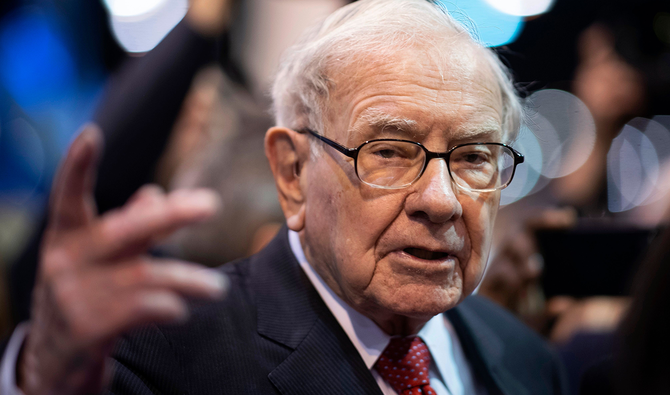
Warren Buffett, CEO of Berkshire Hathaway. (AFP/File)
Short Url
Updated 10 August 2020
Follow

Berkshire Hathaway announces $9.8bn write-down

  • Despite the write-down, Berkshire said second quarter net income surged 87 percent because of gains in stock investments such as Apple Inc. as markets rebounded

LONDON: Berkshire Hathaway Inc. on Saturday announced a $9.8 billion write-down and 10,000 job losses at its Precision Castparts aircraft parts unit, as the coronavirus pandemic caused widespread pain at Warren Buffett’s conglomerate.

Despite the write-down, Berkshire said second quarter net income surged 87 percent because of gains in stock investments such as Apple Inc. as markets rebounded.

Operating profit fell 10 percent, cushioned by a temporary bump at the Geico auto insurer, as the pandemic caused “relatively minor to severe” damage to most of Berkshire’s more than 90 operating businesses.

“The write-down was prudent,” said Cathy Seifert, an equity analyst at CFRA Research. “It’s a recognition of what the market has long believed, that the purchase price was rich, and the integration not as smooth as many would have hoped.”

Berkshire, which paid $32.1 billion for Precision in 2016 in its largest acquisition, and which Buffett at the time called a steep price, said COVID-19 caused airlines to slash plane orders, significantly curbing demand for Precision’s products.

Buffett himself soured on airlines during the quarter, selling $6 billion of their stock and telling shareholders on May 2 the industry’s future had become “much less clear to me.”

Berkshire said Precision, which also makes industrial parts, saw revenue fall by one-third and plans an “aggressive restructuring” to shrink operations. Precision ended 2019 with 33,417 employees, and has shed 30 percent of its workforce.

During the quarter, Buffett, who turns 90 on Aug. 30, also took advantage of Berkshire’s underperforming shares by repurchasing $5.1 billion of stock, even as the pandemic reduced other companies’ ability to buy back their own shares.

Berkshire’s stock has significantly underperformed broader markets since the end of 2018, and Seifert said investors should welcome the buybacks.

“Berkshire tends to go against the grain, and when so many companies suspended buybacks, Berkshire did the opposite,” she said. “The market should react positively, because it shows Berkshire is confident in its prospects.”

Those repurchases confirmed Berkshire’s hint in a July 8 regulatory filing it had become more aggressive with buybacks after loosening its buyback policy in 2018.


European gas prices soar almost 50% as Iran conflict halts Qatar LNG output

Updated 02 March 2026
Follow

European gas prices soar almost 50% as Iran conflict halts Qatar LNG output

  • Analysts warn prolonged disruption could push prices higher
  • Some shipments of oil, LNG through Strait of Hormuz suspended
  • Benchmark Asian LNG price up almost 39 percent

LONDON: ​Benchmark Dutch and British wholesale gas prices soared by almost 50 percent on Monday, after major liquefied natural gas exporter Qatar Energy said it had halted production due to attacks in the Middle East.

Qatar, soon to cement its role as the world’s second largest LNG exporter after the US, plays a major role in balancing both Asian and European markets’ demand of LNG.

Most tanker owners, oil majors and ‌trading houses ‌have suspended crude oil, fuel and liquefied natural ​gas shipments ‌via ⁠the ​Strait of ⁠Hormuz, trade sources said, after Tehran warned ships against moving through the waterway.

Europe has increased imports of LNG over the past few years as it seeks to phase out Russian gas following Russia’s invasion of Ukraine.

Around 20 percent of the world’s LNG transits through the Strait of Hormuz and a prolonged suspension or full closure would increase global competition for other ⁠sources of the gas, driving up prices internationally.

“Disruptions to ‌LNG flows would reignite competition between ‌Asia and Europe for available cargoes,” said ​Massimo Di Odoardo, vice president, gas ‌and LNG research at Wood Mackenzie.

The Dutch front-month contract at the ‌TTF hub, seen as a benchmark price for Europe, was up €14.56 at €46.52 per megawatt hour, or around $15.92/mmBtu, by 12:55 p.m. GMT, ICE data showed.

Prices were already some 25 percent higher earlier in the day but extended gains ‌after QatarEnergy’s production halt.

Benchmark Asian LNG prices jumped almost 39 percent on Monday morning with the S&P Global ⁠Energy Japan-Korea-Marker, widely used ⁠as an Asian LNG benchmark, at $15.068 per million British thermal units, Platts data showed.

“If LNG/gas markets start to price in an extended period of losses to Qatari LNG supply, TTF could potentially spike to 80-100 euros/MWh ($28-35/mmBtu),” Warren Patterson, head of commodities strategy at ING, said. The British April contract was up 40.83 pence at 119.40 pence per therm, ICE data showed.

Europe is also relying on LNG imports to help fill its gas storage sites which have been depleted over the winter and are currently around 30 percent full, the latest data from Gas Infrastructure ​Europe showed. In the European carbon ​market, the benchmark contract was down €1.10 at €69.17 a tonne