

3 days of heavy monsoon rains kill 58 people across Pakistan

A woman carries sack of wheat and household goods while she wades through a flooded area of Dadu, a district in the Pakistan's southern Sindh province, Sunday, Aug. 9, 2020. (AP)
Short Url
Updated 10 August 2020
Follow

3 days of heavy monsoon rains kill 58 people across Pakistan

  • Rains also partially damaged about 100 homes and caused a breach in a main flooded canal
  • In some parts rescuers with the army’s help are still trying to evacuate people from flood-hit villages

KARACHI: Three days of heavy monsoon rains triggering flash floods killed at least 58 people in various parts of Pakistan, as troops with boats rushed Sunday to evacuate people from flood-affected districts in the country’s southern Sindh and southwestern Baluchistan provinces.
Every year, many cities in Pakistan struggle to cope with the annual monsoon deluge, drawing criticism about poor planning. The monsoon season runs from July through September, during which swelling rivers cause damage to crops and infrastructure.
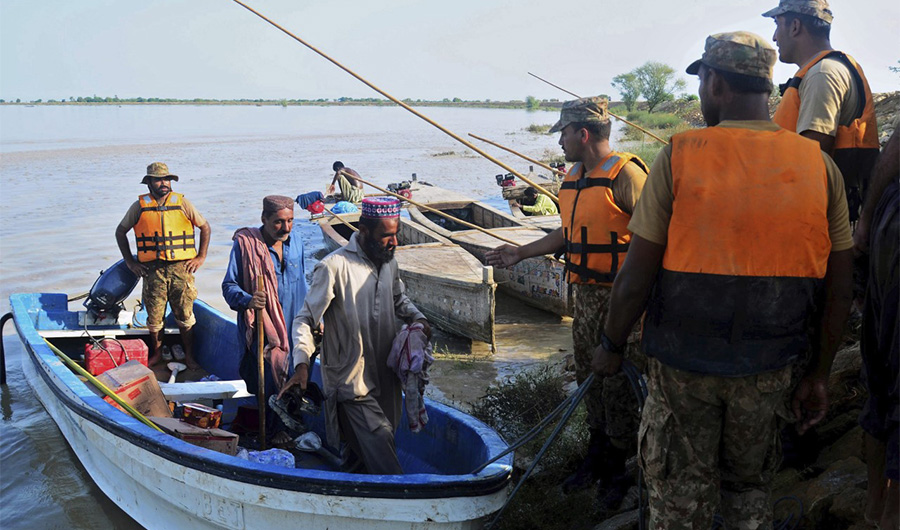


Pakistani army soldiers evacuate villagers from a flooded areas of Dadu, a district in Pakistan's southern Sindh province, Sunday, Aug. 9, 2020. (AP) 

According to Pakistan’s National Disaster Management Authority, 19 people were killed in rain-related incidents in the northwestern Khyber Pakhtunkhwa province, 12 in southern Sindh province, eight in Punjab province and 10 in the country’s scenic northern Gligit Baltistan region in the past three days.
Rains also partially damaged about 100 homes and caused a breach in a flooded main canal, inundating villages in Sindh province. In a statement, the military said troops used boats to rescue stranded people and move them to safety. It said a medical camp was also established and food was being provided to the rescued people.
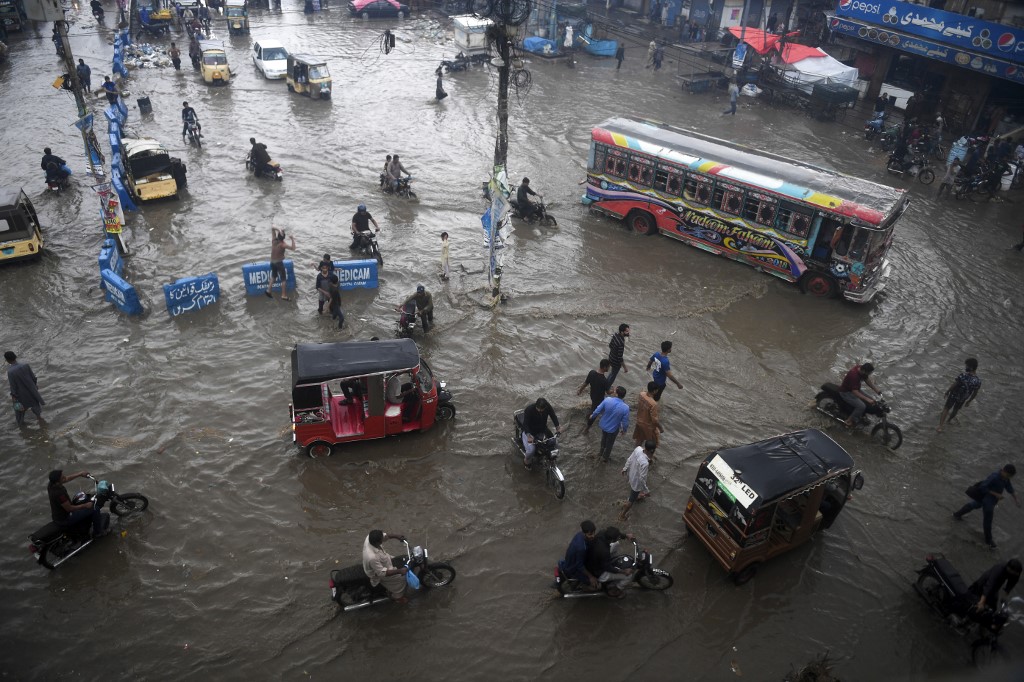


Commuters make their way along a flooded street after heavy monsoon rains in Pakistan's port city of Karachi on August 7, 2020. (AFP)

Heavy rains also lashed many districts in the southwestern Baluchistan province, killing eight people, damaging homes and inundating many villages in the district of Jhal Magsi, according to Saleem Zakir, spokesman for provincial disaster management authority. He said rescuers with the army’s help were still trying to evacuate people from the district’s flood-hit villages.
He said floods damaged a bridge and a gas pipeline and destroyed coastal roads on the Arabian Sea, severing links to the port of Gwadar, part of China’s multi-billion dollar one-road project linking south and Central Asia to China.
According to local media reports, hundreds of people moved to nearby hills when the floodwaters entered their villages in remote areas of Baluchistan, and the military used helicopters and boats to move them to safer places. Authorities were dispatching tents and food for the flood-affected people.
Heavy rainfall began last week and continued Sunday, flooding streets even in the eastern city of Lahore. It especially disrupted normal life last week in Karachi, the provincial capital of Sindh province and Pakistan’s commercial hub, where sewage flooded most of the streets, prompting Prime Minister Imran Khan to order the army to assist authorities in handling the situation.
According to the Meteorological Department, heavy rains are expected to continue next week.
In Pakistan and neighboring India, deadly floods occur regularly during the monsoon season. 


Islamabad dismisses claims about paying up to 8 percent interest on foreign loans as ‘misleading’

Updated 22 February 2026
Follow

Islamabad dismisses claims about paying up to 8 percent interest on foreign loans as ‘misleading’

  • Pakistan has long relied on external loans to help bridge persistent gaps in public finances and foreign exchange reserves
  • Pakistan’s total external debt, liabilities stand at $138 billion at an overall average cost of around 4 percent, ministry says

KARACHI: Pakistan’s finance ministry on Sunday dismissed as “misleading” claims that the country is paying up to 8 percent interest on external loans, saying the overall average cost of external public debt is approximately 4 percent.

Pakistan has long relied on external loans to help bridge persistent gaps in public finances and foreign exchange reserves, driven largely by a narrow tax base, chronic trade deficits, rising debt-servicing costs and repeated balance-of-payments pressures.

Over the decades, successive governments have turned to multilateral and bilateral lenders, including the International Monetary Fund, the World Bank and the Asian Development Bank, to support budgetary needs and shore up foreign exchange reserves.

The finance ministry on Sunday issued a clarification in response to a “recent press commentary” regarding the country’s external debt position and associated interest payments, and said the figures required contextual explanation to ensure accurate understanding of Pakistan’s external debt profile.

“Pakistan’s total external debt and liabilities currently stand at $138 billion. This figure, however, encompasses a broad range of obligations, including public and publicly guaranteed debt, debt of Public Sector Enterprises (both guaranteed and non-guaranteed), bank borrowings, private-sector external debt, and intercompany liabilities to direct investors. It is therefore important to distinguish this aggregate figure from External Public (Government) Debt, which amounts to approximately $92 billion,” it said.

“Of the total External Public Debt, nearly 75 percent comprises concessional and long-term financing obtained from multilateral institutions (excluding the IMF) and bilateral development partners. Only about 7 percent of this debt consists of commercial loans, while another 7 percent relates to long-term Eurobonds. In light of this composition, the claim that Pakistan is paying interest on external loans ‘up to 8 percent’ is misleading.

The overall average cost of External Public Debt is approximately 4 percent, reflecting the predominantly concessional nature of the borrowing portfolio.”

With respect to interest payments, public external debt interest outflows increased from $1.99 billion in Fiscal Year (FY) 2022 to $3.59 billion in FY2025, representing an increase of 80.4 percent, not 84 percent as reported. In absolute terms, interest payments rose by $1.60 billion over this period, not $1.67 billion, it said.

According to the State Bank of Pakistan’s records, Pakistan’s total debt servicing payments to specific creditors during the period under reference were as follows: the IMF received $1.50 billion, of which $580 million constituted interest; Naya Pakistan Certificates payments totaled $1.56 billion, including $94 million in interest; the Asian Development Bank received $1.54 billion, including $615 million in interest; the World Bank received $1.25 billion, including $419 million in interest; and external commercial loans amounted to nearly $3 billion, of which $327 million represented interest payments.

“While interest payments have increased in absolute terms, this rise cannot be attributed solely to an expansion in the debt stock,” the ministry said. “Although the overall debt stock has increased slightly since FY2022, the additional inflows have primarily originated from concessional multilateral sources and the IMF’s Extended Fund Facility (EFF) under the ongoing IMF-supported program.”

Pakistan secured a $7 billion IMF bailout in Sept. 2024 as part of Prime Minister Shehbaz Sharif’s efforts to stabilize the South Asian economy that narrowly averted a default in 2023. The government has since been making efforts to boost trade and bring in foreign investment to consolidate recovery.

“It is also important to note that the increase in interest payments reflects prevailing global interest rate dynamics. In response to the inflation surge of 2021–22, the US Federal Reserve raised the federal funds rate from 0.75-1.00 percent in May 2022 to 5.25–5.50 percent by July 2023. Although rates have since moderated to around 3.75 percent, they remain significantly higher than 2022 levels,” the finance ministry said.

“The government remains committed to prudent debt management, transparency, and the continued strengthening of Pakistan’s macroeconomic stability,” it added.