Virus school closure turns aspiring financier into Islamabad’s favorite pet portraitist

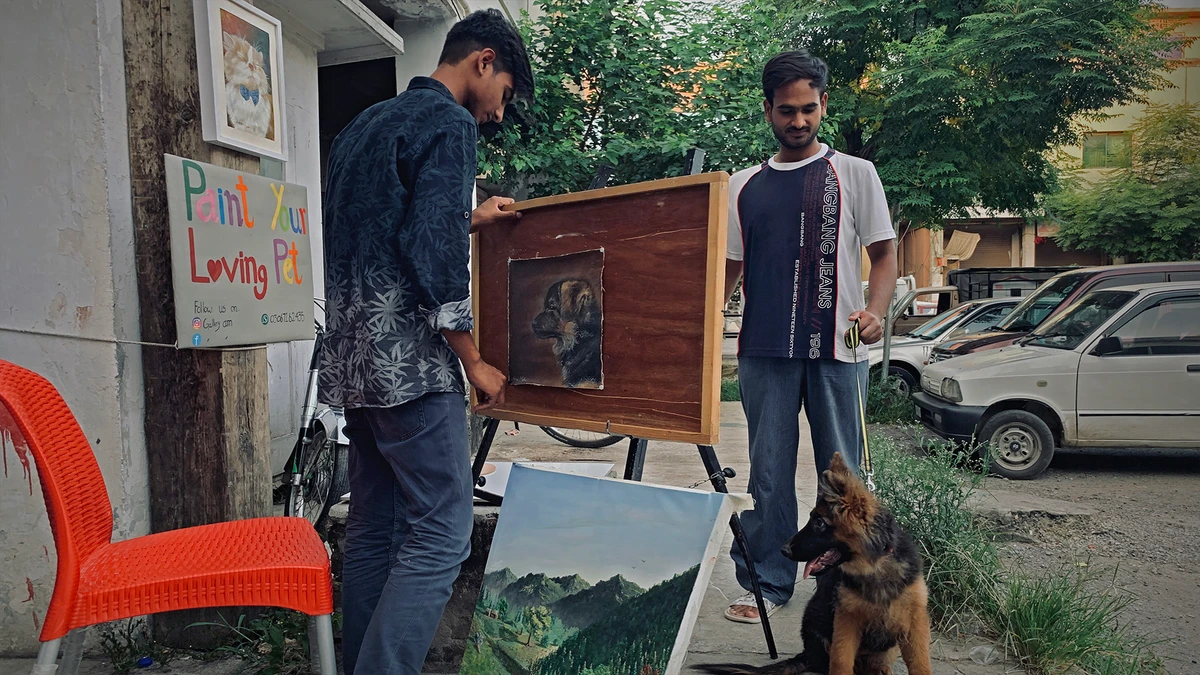
A German Shepherd puppy is sitting still while Arbaz Malik is completing its portrait in Maqbool Market in F7 Islamabad on Aug. 5, 2020. (AN photo by Sib Kaifee)
Short Url
Updated 08 August 2020
Follow

Virus school closure turns aspiring financier into Islamabad’s favorite pet portraitist

  • In front of a veterinary clinic in Islamabad’s F7 sector, a 19-year-old artist set up a pet portrait studio
  • Malik began painting at a young age, but animals entered his canvas only last year, when his beloved cat went missing

ISLAMABAD: With a science certificate in his pocket, Arbaz Malik was ready for college when the coronavirus struck and shut the door of his dream school. Putting the 19-year-old’s education on hold, the pandemic has, however, opened to him a strikingly different career path: pet portraiture.

In front of a veterinary clinic at a small market in Islamabad’s F7 sector, Malik set up a tiny pop-up studio which draws attention with a rainbow sign “Paint Your Loving Pet” and furry customers waiting for their turn to be captured in paint.
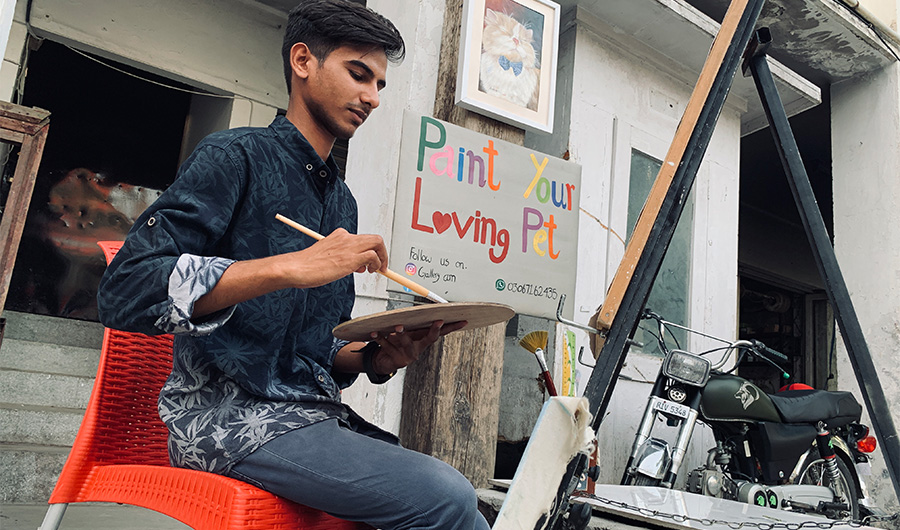


Arbaz Malik, 19, setting up his pop-up studio in Maqbool Market in F7 Islamabad on Aug. 5, 2020. (AN/Sib Kaifee)

“I was very excited for school to begin, I am aiming to get a Bachelor of Business Management (BBM) degree,” he said. But as the pandemic made everything become uncertain, the current job as a pet portraitist gives him “a positive thing to look forward to every day.”

Malik’s engagement in the arts began at a young age, but until recently he was trying to master landscape and cityscape painting. Animals entered his canvas only last year, when his beloved cat Shpanty went missing.

Heartbroken, unable to find Shpanty, Malik eventually painted her portrait from a photograph. Seeing the result, his brother, Arsalan, advised him to think about turning talent into a career.
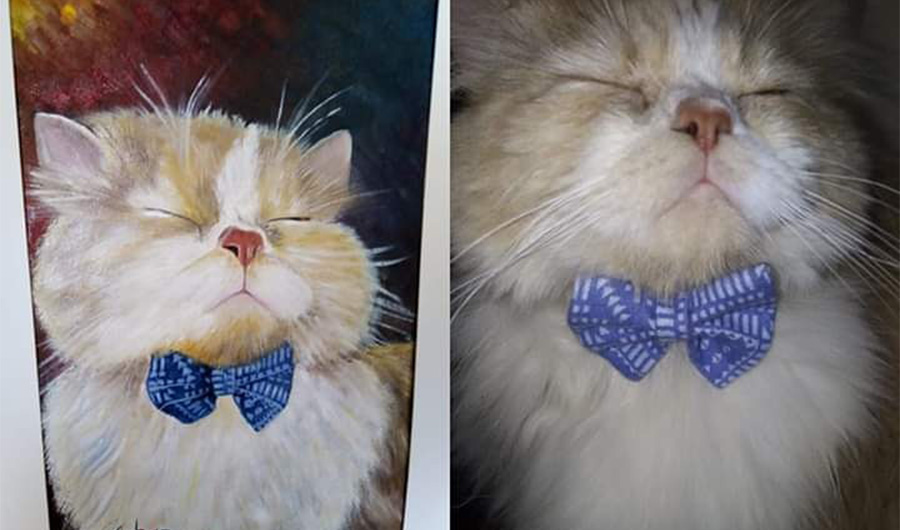


Arbaz Malik's cat Shpanty went missing in 2019. Her portrait, left, was Malik's first step into the pet portraiture business. (Photo courtesy: Arbaz Malik)

“My brother suggested that I come here to the same place we would bring our cat, and see if pet parents going in and out of the clinic might be interested in getting their pets painted,” Malik told Arab News while painting a German Shephard pup patiently sitting next to his easel.

“Three months ago, with the support of the clinic, I began my business.”

Dog, cat, bird, and even horse owners have since become Malik’s faithful and broad customer base. His paintings have already traveled across the world into homes in Canada and France with repeat customers commissioning him to paint pet portraits which they carry abroad as gifts for relatives and friends.

When his college reopens, Malik wants to attend classes full time, but says he will not give up art.

“I will always do both, even after my studies are complete,” he said, “I love painting too much.”

He also loves animals, which is what he and his customers have in common.

“Pets are so important, you love them, they are beautiful and innocent, and they really are your best friend,” Malik said, “They even help you fight off depression, because their support and love are unconditional.”
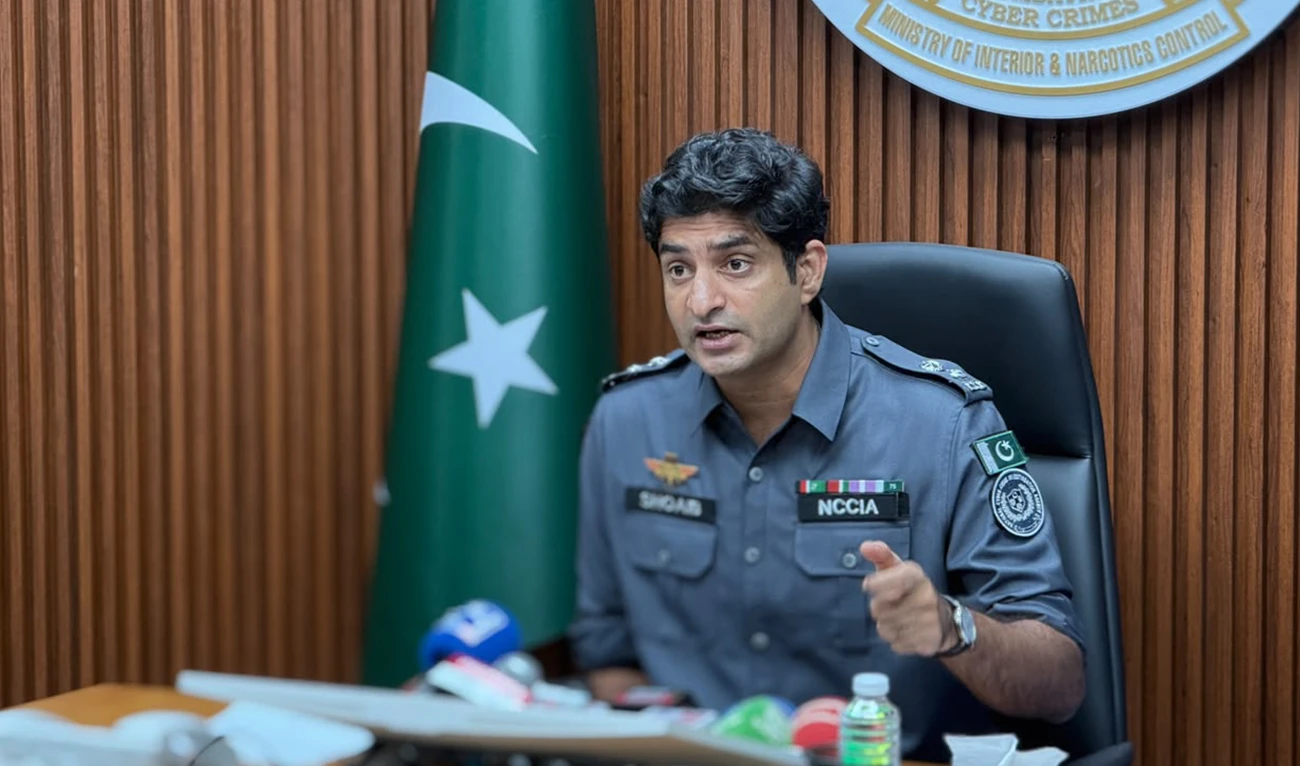
Pakistan’s president defends ongoing strikes in Afghanistan, urges Kabul to dismantle militants

Updated 02 March 2026
Follow

Pakistan’s president defends ongoing strikes in Afghanistan, urges Kabul to dismantle militants

  • Afghanistan on Thursday launched attacks in retaliation for Pakistani airstrikes the previous Sunday
  • Pakistan’s military says it is only targeting Afghan military installations to avoid civilian casualties

ISLAMABAD: Pakistan’s president on Monday defended his country’s ongoing military strikes in neighboring Afghanistan, saying Islamabad tried all forms of diplomacy before targeting militants operating from Afghan territory, and called on the Taliban government in Kabul to disarm groups responsible for attacks in Pakistan.

Pakistan earlier said it is in “open war” with Afghanistan, alarming the international community. The border area remains a stronghold for militant organizations including Al-Qaeda and the Daesh (Islamic State) group.

“(The Afghan Taliban) must choose to dismantle the terror groups that survive on conflict and its war economy,” Asif Ali Zardari said during a speech to lawmakers, adding that “no state accepts serial attacks on its soil.”

Afghanistan on Thursday launched attacks in retaliation for Pakistani airstrikes the previous Sunday. Since then, Pakistan has carried out operations along the border, with Information Minister Attaullah Tarar claiming the killing of 435 Afghan forces and the capture of 31 Afghan positions.

Kabul has denied such claims.

In Afghanistan, the deputy government spokesman Hamdullah Fitrat said Pakistan’s military fired mortar shells at a refugee camp in eastern Kunar province, killing three children and injuring three others.

Afghanistan’s defense ministry said Afghan forces carried out strikes targeting a Pakistani military facility near Paktia province, causing “substantial losses and heavy casualties.”

Pakistan’s military did not respond to questions. It has said Pakistan is only targeting Afghan military installations to avoid civilian casualties.

Pakistan has witnessed a surge of violence in recent months and blames it on the outlawed Pakistani Taliban, known as Tehreek-e-Taliban Pakistan or TTP. It operates both inside Pakistan and from Afghan territory.
Islamabad accuses Afghanistan’s Taliban government of providing safe havens for the TTP, which Kabul denies.

The latest cross-border fighting ended a ceasefire brokered by Qatar and Turkiye in October. The two sides failed to reach a permanent agreement during talks in Istanbul.

Zardari reiterated Pakistan’s call for talks, saying, “We have never walked away from dialogue.”

The Pakistani leader again accused Afghanistan of acting as a proxy for India by sheltering militant groups.

“Stop being used by another country as a battlefield for their ambitions,” he said.

Zardari cited a recent report from the United Nations Security Council’s monitoring team that described the presence of militant groups in Afghanistan as an extra-regional threat.