Young Saudi woman takes pioneering role in male-dominated engineering industry

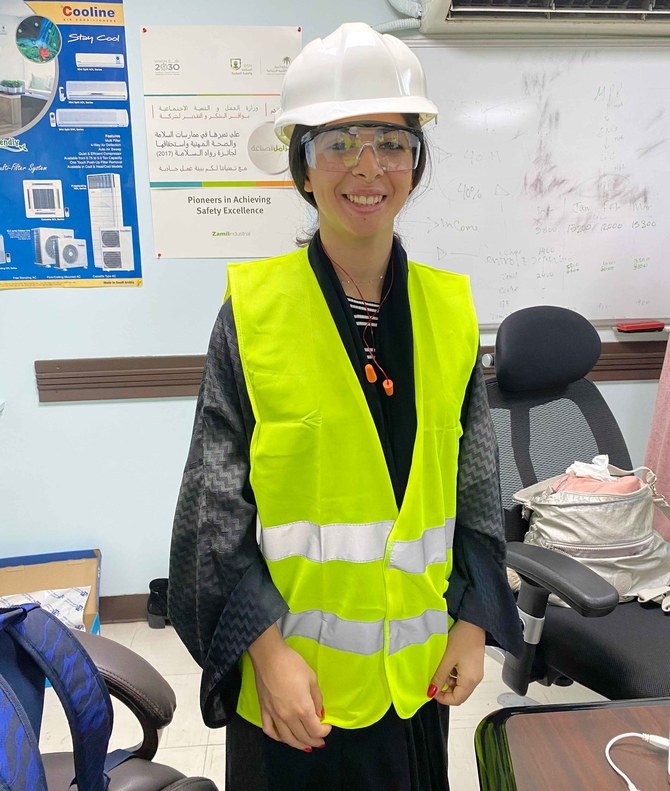
Rawan Abukhaled. (Supplied)
Short Url
Updated 08 August 2020
Follow

Young Saudi woman takes pioneering role in male-dominated engineering industry

  • Rawan Abukhaled, 23, keen to provide digital solutions that help cut costs

JEDDAH: A young Saudi is setting the pace by becoming the only woman working at a manufacturing plant as a digital transformation consultant for GE Digital in the Kingdom.

Rawan Abukhaled, 23, has paved the way for hopeful young Saudi engineers to not be afraid of being the only woman in the room.

“I’m probably one of the first women to join the industry in the Kingdom,” she said. “I want to be the best representation of a female Saudi engineer in this field, so everyone around me thinks, ‘Hey, we need to hire more women.’ I’m constantly trying to get that idea through,” she added.

She is aware of how male-dominated the industry is, not just in Saudi Arabia but around the world. “When I got my first job in the US as a software developer, I was one of the very few females in the room as a software developer and now there are sometimes no other women in the room.”

Abukhaled is passionate about making change, and her job depends on it. She is keen on providing companies with digital solutions that help them to cut costs and raise productivity.

“Today, I’m learning in the field hands-on, rather than in an office. And for soft skills, this is a client-facing job. So, I am in situations that challenge me to grow, especially in my interactions with customers. I’m the only local or regional person on the ground, so the (GE Digital) team in the US relies on me to go to customer sites, and that helps me grow both my technical and soft skills.”

HIGHLIGHT

She is aware of how male-dominated the industry is, not just in Saudi Arabia but around the world. She has paved the way for hopeful young Saudi engineers to not be afraid of being the only woman in the room.

The industrial and systems engineering graduate gained a sense of how much she could do for women when she studied at Virginia Tech, US. She took part in a campaign to become the vice president of the Saudi Student Club and succeeded in becoming the first woman to be elected to the role in 80 years.

Abukhaled said that she was flabbergasted at the number of women approaching her to ask what it was like and the impact it left on female students around her. “I was the vice president of a student club. Even something that small inspired women.”

When she was growing up, Abukhaled wanted to get into medicine. “As I got older, I realized I wasn’t that great in biology and I was more interested in physics and math, so I knew engineering was a better fit for me.”

Her current job with GE Digital allows her to work in the two areas she feels strongly about: Technology and people. “There’s a geek side to me that likes the math and problem-solving, and the other side of me that loves the social network and interacting with people.”

Her father has supported her throughout. He was an industrial engineer, which ended up being a great asset as the two of them shared common interests. “We are a lot alike. He became an influential leader in a multinational organization, and I want to follow in his footsteps. He’s supported me every step of the way, ever since I was a little girl.”


Experimental farm in Al-Lith looks into future of Saudi Arabian agriculture

Updated 02 February 2026
Follow

Experimental farm in Al-Lith looks into future of Saudi Arabian agriculture

  • Research initiative reflects strategic transformation

JEDDAH: An experimental farm in Saudi Arabia’s Al-Lith Governorate is one of the research initiatives reflecting the strategic transformation taking place in the Kingdom’s agricultural sector.

The farm uses highly efficient, sustainable production models that combine scientific research with commercial application, contributing to strengthening the country’s food security system and the sustainability of water resources.

Located in the Ghumaiqa Center on an area of about 10 hectares, the cutting-edge farm is a testing platform for modern agricultural technologies that tackle the challenge of water scarcity.

The farm includes developed open fields and modern greenhouses, supported by smart irrigation encompassing drip and sprinkler irrigation alongside surface and subsurface technologies.

All the systems operate via smart controls that enable the monitoring of water consumption and ensure improved efficiency, thereby achieving a balance between agricultural production and water conservation.

The farm also uses treated and diluted low-salinity seawater.

It aims to diversify agricultural water sources, reduce reliance on freshwater, and open new horizons for agriculture in coastal and semi-arid environments.

A view of the experimental farm in Al-Lith. (SPA)

The project represents a promising investment opportunity in the field of smart agriculture, enabling the development of commercially scalable production models, particularly for high-value vegetables and fruits, while reducing operational costs associated with water and energy, enhancing the economic feasibility of future agricultural projects.

In addition, the project contributes to transferring and localizing agricultural expertise, supporting local food supply chains, and creating an attractive environment for agricultural investment.

This aligns with Sustainable Development Goals and enhances the efficiency of the private sector in adopting innovative agricultural solutions.

Yahya bin Abdulrahman Al-Mahabi, the director of the Ministry of Environment, Water and Agriculture office in Al-Lith Governorate, told the Saudi Press Agency that the project represented the future of agriculture in the Kingdom.

He explained that the vision was based on investing in technology, enhancing the return on water per unit, and integrating scientific research with investment opportunities.

Al-Mahabi spoke of the experimental farm as a modern, scalable and replicable model applicable in several regions of the Kingdom, particularly in coastal environments.

Al-Mahabi highlighted the Ministry of Environment, Water and Agriculture’s commitment to supporting distinctive projects that contributed to achieving food security while developing rural areas and enhancing agricultural production efficiency, in line with the objectives of the Kingdom’s Vision 2030.