

Pakistan jails five men for killing endangered snow leopard

This undated picture released Nov. 26, 2006 by the Pakistan’s Press Information Department (PID) shows an adult female snow leopard lying on the ground in Chitral, in northern Khyber Pakhtunkhwa, Pakistan. (AFP/File)
Short Url
Updated 06 August 2020
Follow

Pakistan jails five men for killing endangered snow leopard

  • Only 300 snow leopards are believed to be left in the wild in Pakistan in the areas of Himalayas, Hindukush and Karakoram mountains
  • The poachers were sentenced to two years in jail, after authorities caught them following a social media post

PESHAWAR: Five men were sentenced to prison in an expedited trial on Wednesday for killing a snow leopard in northern Pakistan, wildlife officials confirmed.

Four poachers and their facilitator were arrested by the Gilgit-Baltistan Wildlife Department on charges of killing a female leopard near the Hoper glacier in the region’s Nagar district in late July. The hunters uploaded their photos with the body of the endangered cat to social media, after which they were traced by the authorities.

“Informers told us that in the Hopar Nagar area someone shot the precious snow leopard. The concerned wildlife officials alerted local police and we arrested the illegal hunters and seized the leopard’s dead body,” Gilgit-Baltistan Wildlife Department spokesman Tariq Husain told Arab News on Thursday.

Divisional Forest Officer Jibran Haider, who has magistrate powers, convicted the accused in an expedited trial. Two were sentenced to two years in jail, two to one year’s imprisonment and their facilitator to one month behind bars, he said.

Only 300 snow leopards are believed to be left in the wild in Pakistan.
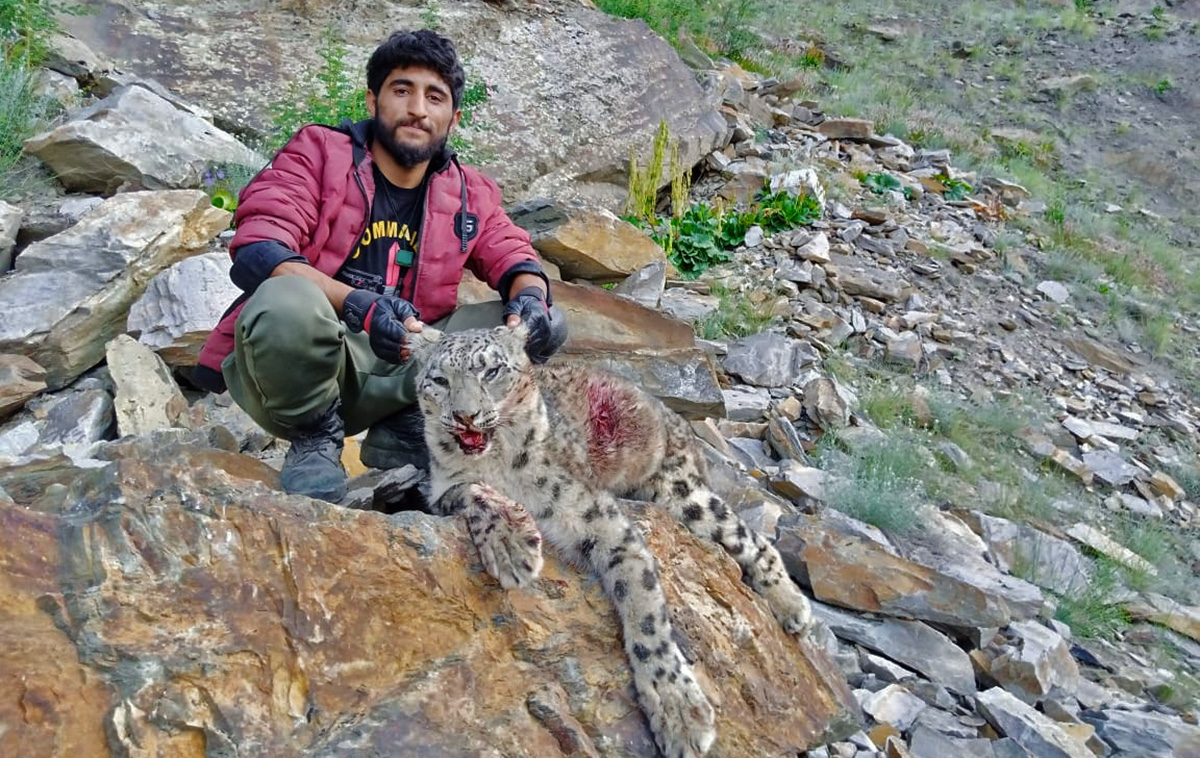


The photograph posted on social media, in which a poacher poses with a dead snow leopard, helped Gilgit-Baltistan authorities identify the men who killed the endangered cat in Nagar district last month. (Social media)

“There are about 300 snow leopards in Pakistan’s Himalayan, Hindukush and Karakoram regions,” Snow Leopard Foundation deputy director Jaffarudin said. 

However, not only poachers pose a danger to the wild feline.

The foundation has been working on improving the socio-economic conditions of mountain communities in Gilgit Baltistan, Khyber Pakhtunkhwa, and Azad Jammu and Kashmir which share the ecosystem with the endangered species.

Snow leopards often attack livestock and local residents sometimes kill them in defense.

“Leopards attack our kids and women too, they say, and that’s why they kill this precious animal,” Husain of the wildlife department said, adding that when it comes to actual poachers the department is on alert and several arrests have taken place in the recent past.

Activists lauded the recent arrest but say that law enforcement is still insufficient as local authorities do not have proper surveillance tools. 

“No doubt the wildlife department is facing problems as they can’t cover the whole area,” wildlife activist Mumtaz Gohar said, “If the hunter had not posted the photos on social media, the incident would definitely have gone unreported like many others.”


Pakistan top military commander urges ‘multi-domain preparedness’ amid evolving security threats

Updated 9 sec ago
Follow

Pakistan top military commander urges ‘multi-domain preparedness’ amid evolving security threats

  • Asim Munir says Pakistan faces layered challenges spanning conventional, cyber, economic and information domains
  • His comments come against the backdrop of tensions with India, ongoing militant violence in western border regions

ISLAMABAD: Pakistan’s top military commander Field Marshal Asim Munir on Tuesday stressed the need for “multi-domain preparedness” to counter a broad spectrum of security challenges facing the country, saying they ranged from conventional military threats to cyber, economic and information warfare.

Pakistan’s security environment has remained volatile following a brief but intense conflict with India earlier this year, when the two nuclear-armed neighbors exchanged missile and artillery fire while deploying drones and fighter jets over four days before a ceasefire was brokered by the United States.

Pakistan has also been battling militant violence in its western provinces of Khyber Pakhtunkhwa and Balochistan, where authorities say armed groups operate from across the border in Afghanistan and receive backing from India. Both Kabul and New Delhi have rejected claims.

The military has also warned that disinformation constitutes a new form of security threat, prompting tighter regulations that critics say risk suppressing dissent. Munir also pointed to a “complex and evolving” global, regional and internal security landscape while addressing participants in the National Security and War Course at the National Defense University (NDU).

“These challenges span conventional, sub-conventional, intelligence, cyber, information, military, economic and other domains, requiring comprehensive multi-domain preparedness, continuous adaptation and synergy among all elements of national power,” he said, according to a military statement.

“Hostile elements increasingly employ indirect and ambiguous approaches, including the use of proxies to exploit internal fault lines, rather than overt confrontation,” he continued, adding that future leaders must be trained and remain alert to recognize, anticipate and counter these multi-layered challenges.

Munir also lauded the NDU for producing strategic thinkers who he said were capable of translating rigorous training and academic insight into effective policy formulation and operational outcomes.