

From Monday, Pakistan will be open for business as coronavirus lockdowns lifted

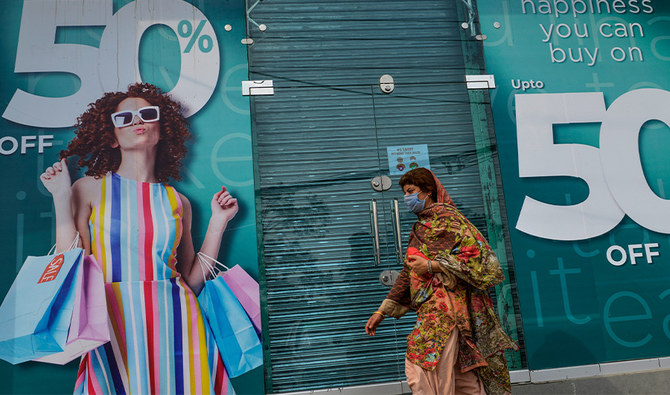
A woman walks past a shuttered market in Rawalpindi on July 29, 2020. (AFP)
Updated 07 August 2020
Follow

From Monday, Pakistan will be open for business as coronavirus lockdowns lifted

  • Tourist destinations to open from Aug 8, restaurants, theatres and beauty salons from Aug 10 and schools and marriage halls from Sept 15
  • Planning minister Asad Umar warns that lockdowns could return if people changed their attitudes or became careless with social distancing and masks

ISLAMABAD: Planning Minister Asad Umar announced on Thursday that virtually all sectors in Pakistan shut down to prevent the spread of the novel coronavirus would be reopened next week, other than schools and marriage halls which would open in September.

In March, Pakistan shut all its schools and land borders and decided to limit international flights and discourage large gatherings to try to halt the spread of the coronavirus.

But with infections and deaths down nearly 80 percent since their peak as per government records, the National Coordination Committee (NCC), the apex body set up to oversee coronavirus mitigation efforts, met on Thursday to decide on measures to help the country return to normalcy. 


The meeting was chaired by Prime Minister Imran Khan and attended by representatives from all provinces.

"Restaurants and cafes, outdoor and indoor, will be allowed to open from Monday [August 10], and standard operating procedures will be finalised in the next two to three days," Umar told media after the meeting. "When it comes to the recreational sector, which includes public parks, theatres, cinemas, amusement parks and arcades ... these will also be allowed to open from Monday."

He said educational institutions would resume from September 15, pending a final review on September 7.

"Marriage halls can be opened from September 15, and hotels can hold wedding functions," the planning minister said, adding that business centres, expo halls, and beauty salons and spas could open from August 10, when all shops and markets would also revert to their pre-lockdown timings.

“Whatever their [shops] normal operations were … they can go back to the old system,” Umar said. 

Tourist destinations will open from August 8 and a ban on riding pillion on motorbikes would be lifted, he said.

However, Umar warned that “the threat is not over.”

“Improvement has happened because we made a clear strategy, which our administrative machinery in the provinces implemented on the ground,” he said, calling the decline in coronavirus cases and the lifting of lockdowns “the success of the Pakistani nation.”

But “if carelessness begins… if we see a change in the attitude of the public … then once again that process of lockdowns” could resume, the minister warned. 

International media reported this month a “sharp decline” in coronavirus cases in Pakistan, saying major hospitals had reported beds were freeing up in previously overflowing coronavirus wards, and the tally of patients on ventilators had halved over July. 

The success comes even as PM Khan resisted the World Health Organization's advice, declaring in May that lockdowns were too costly for the poor and reopening the economy, opting for “smart lockdowns” only in coronavirus hotspots. 

"I appeal to the people," the planning minister said as he announced lifting lockdown restrictions: "that you have to take more precautionary measures than before. We have the experience and we have learned from them."


Pakistan’s deputy PM says country seeks to convert $1 billion UAE deposit into investment

Updated 28 December 2025
Follow

Pakistan’s deputy PM says country seeks to convert $1 billion UAE deposit into investment

  • Ishaq Dar says the UAE will acquire shares in Pakistani companies using the amount, with transaction to be completed by March 31
  • The UAE’s remaining $2 billion in deposits, part of funds used to shore up Pakistan’s foreign reserves, are due for rollover in January

ISLAMABAD: Pakistan is seeking to convert part of its financial support from the United Arab Emirates into long-term investment to reduce external debt, Deputy Prime Minister Ishaq Dar said on Saturday, following talks with UAE President Sheikh Mohamed bin Zayed Al Nahyan during his visit to Islamabad.

Dar said Pakistan was engaged with the UAE on converting $1 billion in deposits into equity investment, potentially involving stakes in companies linked to the Fauji Fertilizer Group, a move that would end Pakistan’s repayment obligation on that portion of the funds.

The UAE has been one of Pakistan’s key financial backers in recent years, providing $3 billion in deposits to the central bank as part of a broader effort to stabilize the country’s external finances and unlock support from the International Monetary Fund.

Speaking at a year-end briefing, Dar said Pakistan had already begun discussions with the UAE on rolling over the first $1 billion tranche, but Islamabad now wanted to replace short-term borrowing with investment.

“They will be acquiring some shares, and this liability will end,” Dar said, adding that discussions were under way for the transaction to be completed by March 31.

Dar said the Fauji Foundation Group was taking the lead in the process, with plans for partial disinvestment by Fauji-linked and other companies to facilitate the deal.

He added that Pakistan also raised the issue of a separate $2 billion rollover due in January during talks with the UAE leadership, saying Islamabad had conveyed that converting debt into investment would be preferable to repeated rollovers.

The issue was discussed during Al Nahyan’s visit, which Dar described as cordial, adding that the UAE had expressed willingness to expand its investment footprint in Pakistan.

Pakistan has relied on repeated rollovers of deposits from friendly countries to manage its balance-of-payments pressures, a practice economists say provides short-term relief but adds to debt vulnerabilities unless replaced with foreign direct investment.

The country acquired $5 billion from Saudi Arabia and $4 billion from China, which, along with the UAE, helped shore up its foreign reserves and meet IMF conditions at a time when its external account was under severe pressure.

Dar said Pakistan was now focused on shifting from temporary financing toward longer-term capital inflows to stabilize its economy and reduce reliance on external borrowing.