

Lebanese open their doors to those left homeless by deadly blast

1 / 3
A Lebanese couple inspect the damage to their house in an area overlooking the destroyed Beirut port on August 5, 2020 in the aftermath of a massive explosion in the Lebanese capital. (AFP)
2 / 3
The home of one of the people staying at the Azad residence - a family in Beirut who took in some of those who lost their homes because of the blast. (Supplied: Cyrus Azad).
3 / 3
Azad shows their living room turned into a sleeping area in Beirut's Aicha Bakkar district. (Supplied: Cyrus Azad)
Short Url
Updated 06 August 2020
Follow

Lebanese open their doors to those left homeless by deadly blast

  • Baytna Baytak, a housing scheme helping medical workers on the front line of the coronavirus battle, has stepped in to offer aid in the wake of the Beirut explosion
  • The massive explosion that rocked the capital has killed at least 135 people, wounded over 4,000, and has left more than 300,000 people homeless due to severe damage

LONDON: Lebanese across the country have opened their houses to people left homeless by Tuesday’s explosion at Beirut port.

“I see this as a chance to help everyone who’s really going through the worst. I don’t wish a crisis like this on anybody, and I hope that everybody can come together and offer whatever they can to help,” Cyrus Azad, an American University of Beirut student, whose family sheltered those affected, told Arab News.

The massive explosion that rocked the capital has killed at least 135 people, wounded over 4,000, and has left more than 300,000 people homeless due to severe damage.

Many in the country have offered temporary shelter for those affected by the blast.

Opinion

This section contains relevant reference points, placed in (Opinion field)

Baytna Baytak, which translates to “My house is yours,” is among groups connecting the homeless with temporary places to stay.

The initiative was initially created to house Lebanese nurses and doctors who were at the forefront of the country’s battle with the coronavirus and could not return home in fear of infecting their families.

“Baytna Baytak’s mission is to secure a location in which medical and Red Cross teams can sleep so they can focus on their daily duties without having to worry about transportation (some of them live far from their place of work) or about commuting and exposing their families to the virus (some of them live with elderly people),” Jawad Abboud, a Baytna Baytak member, told Arab News.

“Today and after the apocalyptic Beirut blast, we have decided to expand our mission to find shelters to as many individuals as possible who have lost their homes and have nowhere to sleep,” he added.

Following the explosion’s disastrous impact on the capital’s infrastructure, Baytna Baytak expanded its services and network “to provide faster and more effective housing solutions for families who lost their homes,” an Instagram post said.


CALL FOR ACTION To Donate visit our website www.baytnabaytak.com

A post shared by بيتنا بيتك (@baytna_baytak) on

The post included numbers for call centers that are taking donations, volunteers and those in need, as well as hotlines for mental health and lifeline, food and clothing donations.

“A lot of my friends and their friends who lived in the Mar Mikhael area lost their homes to the damage, so naturally my family and I opened the doors to our home to them and told them they can stay as long as they need to get on their feet and figure things out,” Azad said.

“I would never want to be in such a position and I’m very grateful that my home and family weren’t as affected as they were,” he added.
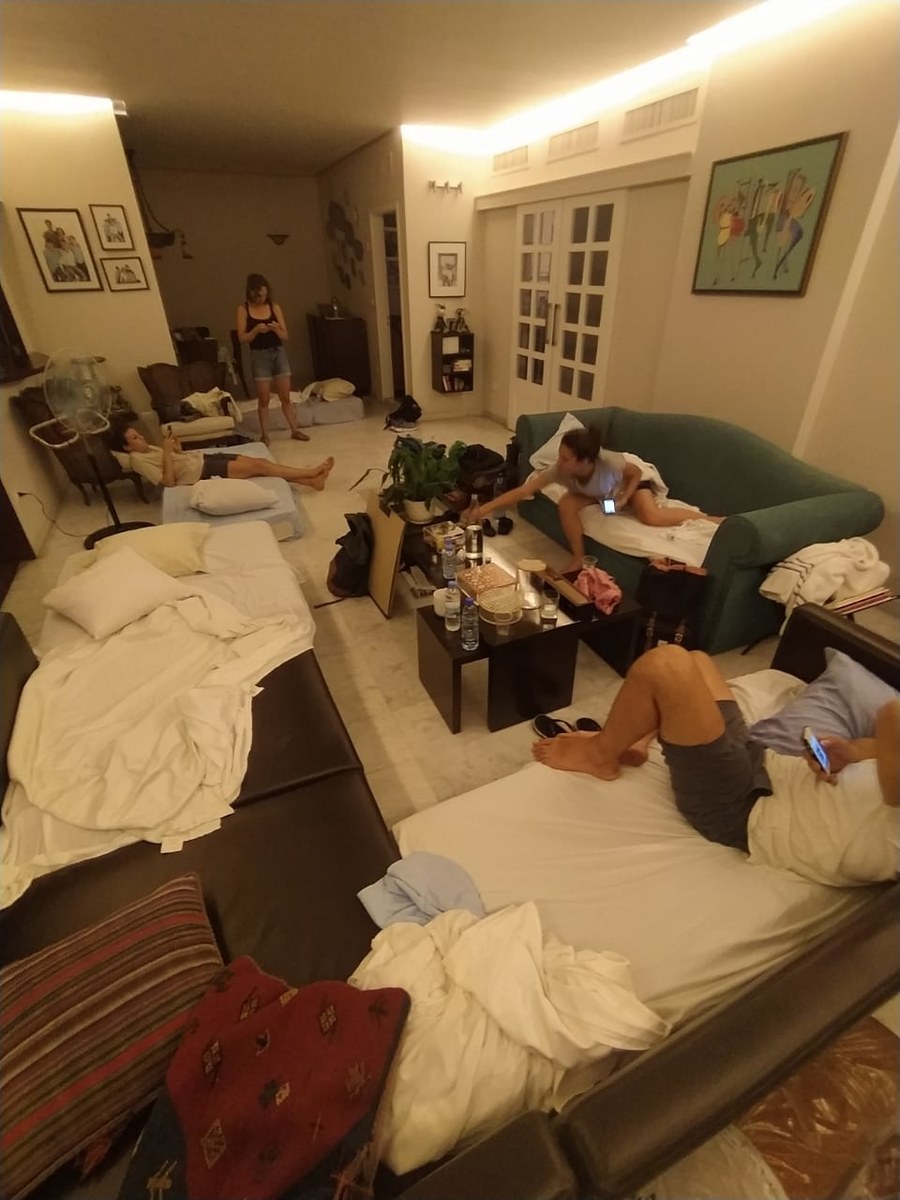


Azad shows their living room turned into a sleeping area in Beirut's Aicha Bakkar district. (Supplied: Cyrus Azad)

Lebanese officials have opened investigations into the cause of the explosion, which is said to be caused by 2,700 tons of neglected ammonium nitrate confiscated from a Russian-leased cargo ship in 2014. While some government officials claim they have repeatedly requested the removal of these chemicals from the port, rampant corruption and negligence left them – like countless other requests – unanswered.

Citizens and residents of the country say they know that the government will not do much to help, with promised financial aid to the poorest families hit hardest by the coronavirus pandemic failing to arrive. As a result, the Lebanese have relied on each other for support and aid during difficult times, such as the Beirut blast.

“It showed how the humanity of random people could help society and how much the Lebanese were thankful for the actions of the front-line heroes, and were happy to show their support throughout the whole pandemic,” Abboud said.

For those who want to donate and help:

People who have houses/studios/hotel rooms to offer or would like to contribute can visit baytnabaytak.com

For cash donations: +96181233092

For accommodation needs: +96179139537

For donations towards accommodations of those in need: +96179139586


Iraqi lawmakers to elect president Tuesday, PM appointment next

Updated 25 January 2026
Follow

Iraqi lawmakers to elect president Tuesday, PM appointment next

  • Parliamentary speaker Haibat Al-Halbussi announced on Sunday that the new parliament will convene on Tuesday to elect a president

BAGHDAD: Iraq’s parliament will meet on Tuesday to elect the country’s new president, who will then appoint a prime minister expected to be Nouri Al-Maliki after he was endorsed by the largest Shiite bloc.
By convention, a Shiite Muslim holds the post of prime minister, the parliament speaker is Sunni and the largely ceremonial presidency goes to a Kurd.
Parliamentary speaker Haibat Al-Halbussi announced on Sunday that the new parliament will convene on Tuesday to elect a president, according to the official INA press agency.
The president will then have 15 days to appoint a prime minister, who is usually nominated by the largest Shiite bloc formed through post-election alliances.
On Saturday, the Coordination Framework alliance — whose Shiiite factions have varying links to Iran — endorsed former prime minister and powerbroker Al-Maliki as the country’s next premier.
The alliance, to which Al-Maliki belongs, spoke of his “political and administrative experience and his record in running the state.”
Kurdish parties have yet to agree on a presidential candidate, who must be endorsed by other blocs and win a two-thirds majority in parliament.
The presidency is usually held by the Patriotic Union of Kurdistan (PUK). This year, the rival Kurdistan Democratic Party (KDP) named its own candidate: Foreign Minister Fuad Hussein.
Although Maliki’s endorsement effectively guarantees him the post, forming a new government remains a daunting challenge that could drag on for months and still fail.
The designated premier has one month to form a government and present it to parliament for a vote of confidence.
The 75-year-old Maliki, a shrewd politician, is set to return to power at a time of seismic changes in the Middle East, as Tehran’s regional influence wanes and tensions with Washington rise.
Government formation in Iraq must balance internal political dynamics and power-sharing among major parties, all under the continued influence of Iraq’s two main allies: Iran and the United States.
A close Iran ally, Al-Maliki will be expected to address Washington’s longstanding demand that Baghdad dismantle Tehran-backed factions, many of which are designated terrorist groups by the US.
Last month, Iraqi officials and diplomats told AFP that Washington demanded the eventual government exclude Iran-backed armed groups, even though most of them hold seats in parliament, and have seen their political and financial clout increase.
But Iraq is struggling with weak economic growth and cannot risk punitive measures by the US, which has already sanctioned several Iraqi entities, accusing them of helping Tehran evade sanctions.