
Book Talk: Pakistani self-help author says it’s time to focus on mental health in Pakistan

Shahzad Malik poses with his book Dare to Be You, Pakistan's first English language self-help book, at his home in Lahore, Pakistan, on July 30, 2020. (Photo courtesy: Shahzad Malik)
Short Url
Updated 03 August 2020
Follow

Book Talk: Pakistani self-help author says it’s time to focus on mental health in Pakistan

  • Shahzad Malik is the author of Pakistan’s first self-help book in English called Dare To Be You
  • Talking about mental health important in the context of coronavirus and heightened post-lockdown anxiety, Malik says

RAWALPINDI: Shahzad Malik, the author of Pakistan’s first self-help book in English, has said he was inspired to write his book, Dare To Be You, to bring focus to mental health in Pakistan and help create a climate where more people were comfortable talking about and tackling mental health concerns in their lives.
Malik’s book, his first, is for everyone, he says, but particularly for young people like university students and professionals who find themselves racked with doubt over how to actualize their dreams while also achieving happiness.
According to the International Journal of Emergency Mental Health and Human Resilience, up to 16 percent of Pakistan’s 220 million population suffers from mild to moderate psychiatric illness. The country has one psychiatrist for every 10,000 people and only five dedicated psychiatric hospitals nationwide.
“Pakistan has a lot of stigma around getting help [for mental health concerns] or trying to improve yourself, but that culture is changing,” Malik told Arab News in an interview. “Self-development is now picking up and people are starting to embrace therapy and focus on mental wellness overall.”
Nuclear-armed Pakistan is plagued by insurgencies, deadly criminal gangs, extrajudicial executions and sectarian killings, as well as unemployment and poverty, giving rise to mental health disorders.
Given its myriad problems, talking about mental health is important for a country like Pakistan, Malik said, and particularly now in the context of the coronavirus and the heightened post-lockdown anxiety which have become a matter of government concern around the world. The author said he hoped his book would ignite more conversations around mental health in Pakistan also, a topic that like suicide has often been taboo in Pakistani society.
“With everything that’s happened with the pandemic, things are finally getting turned inwards and people are reflecting,” Malik said.
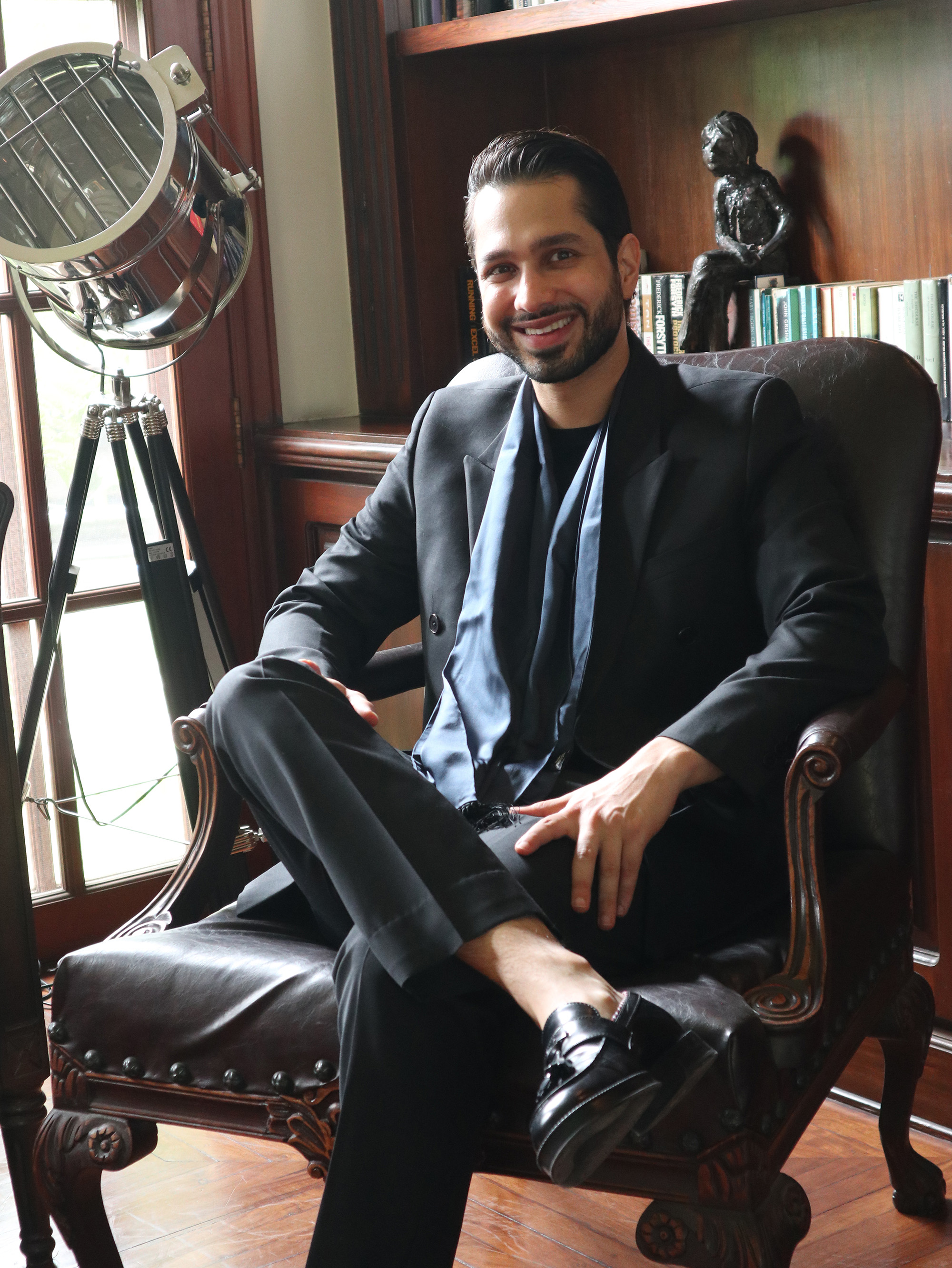


Shahzad Malik, the author of Dare to Be You, Pakistan's first English language self-help book, poses at his home in Lahore, Pakistan, on July 30, 2020. (Photo courtesy: Shahzad Malik)

Malik, 33, was born and raised in Lahore and was always expected, he said, to join the family business, which includes Master MoltyFoam, one of Pakistan’s most trusted names in the bedding, furniture and health care industry.
“I never got a choice growing up about what I wanted to do or where I wanted to be; it was always like, when you grow up you’re going to work with the family,” said Malik, who has a master’s degree in business administration from Bentley University in the United States. “That always got me a little bit lost in life.”
Malik currently serves as a director for his family’s group of industries, and is managing director of an energy company in its portfolio.
“I had a lot of questions like ‘if I wasn’t doing this, what would I be doing?’” he said.
At 13, Malik found himself pouring over biographies of influential figures like Warren Buffet and Steve Jobs and moved on to reading self-development and self-help books.
“I was a lost teenager,” Malik said, laughing, “and all that reading sparked the interest in me and that’s where it all began really.”
After joining the family business since finishing his MBA, Malik says he started to think even more about finding self-fulfilment as a young leader. But there wasn’t a single book or platform he could recommend to his team to help them achieve their goals better and attain happiness.
“There wasn’t one book that touched on all the different ingredients that I believe are a starter kit for self-help,” Malik said. “That’s when I set out to do it myself and I have been working on it for the last five years and have put it together now.”
The book, Malik said, is a starting point for “everyone and anyone who wants to improve themselves.”
“Dare To Be You touches upon everything from fear, gratitude, passion, happiness, self-forgiveness,” he added, “but its overall essence is how you can be the best version of yourself and where you can begin your self-development process.”
“I wish I had had that when I was growing up,” the author said. “It would have made it a lot easier for me to guide and direct myself.”

Top Pakistani clerics warn government against sending troops to Gaza to disarm Hamas

Updated 23 December 2025
Follow

Top Pakistani clerics warn government against sending troops to Gaza to disarm Hamas

  • Pakistani clerics raise alarm over reports of pressure on Muslim nations to provide troops for Gaza stabilization force under Trump peace plan
  • Islamabad has previously said that it is willing to join the international stabilization force but ‘not ready’ to play any role in disarming Hamas

ISLAMABAD: A group of Pakistan’s top religious and political leaders on Monday warned the government against sending Pakistani troops to Gaza to disarm Palestinian group Hamas, amid discussions over a proposed International Stabilization Force (ISF) for the Palestinian territory.

The representative gathering, chaired by prominent scholar Mufti Taqi Usmani, brought together leaders from Deobandi, Barelvi, Ahl-e-Hadees and Shia schools of thought, alongside leaders of the country’s main religio-political parties, Jamiat Ulema-e-Islam-Fazl (JUI-F) and Jamaat-e-Islami (JI).

The international stabilization force, which is to be composed of troops from Muslim countries, is the cornerstone of President Donald Trump’s peace plan for Gaza announced in Sept. Islamabad has previously said it is willing to join the ISF but “not ready” to play any role in disarming Hamas. Hamas’s Gaza chief Khalil Al-Hayya said this month the group had a “legitimate right” to hold weapons, while Israel has repeatedly insisted that Hamas be disarmed.

In a joint statement issued after the meeting in the port city of Karachi on Monday, Pakistani clerics raised alarm over reports that international pressure is mounting on Muslim-majority nations to provide troops for the transitional security force in Gaza, following Israel-Hamas ceasefire.

“In such circumstances, demands are being made to Muslim countries that they send their forces there to disarm Hamas,” the statement said. “Several Muslim governments have already refused this, and pressure is being increased on Pakistan.”

Last month, the United Nations Security Council approved Washington’s plan, which called for a yet-to-be-established Board of Peace as a transitional authority that Trump would head, and the stabilization force, which would be empowered to oversee borders, provide security and demilitarize the territory.

The gathering of Pakistani clerics urged Islamabad to resist any diplomatic overtures from Washington regarding troop deployment.

“This gathering, with full emphasis, demands the Government of Pakistan refrain from sending its forces to disarm Hamas and that it should not yield to any pressure in this regard,” the statement said.

The assembly expressed complete support for the liberation of Palestine and described the effort as a “duty of every Muslim.”

It said that Pakistan’s armed forces are “imbued with the spirit of jihad” and that the “notion of placing them against any sacred struggle for the liberation of Baitul Muqaddas or Palestine is impossible for the nation to accept.”

The religious leaders characterized the proposal as a “conspiracy” from which the government must “protect the country.”

Pakistani foreign office spokesperson Tahir Andrabi and the prime minister’s spokesperson for foreign media, Mosharraf Zaidi, did not respond to Arab News requests for comment on the statement.

Washington reportedly views Pakistan as a prime candidate for the ISF, given its experience in high-intensity border conflicts and internal counter-insurgency operations.

Last week, Pakistan’s foreign office said that Islamabad had not taken any decision on joining the proposed stabilization force for Gaza and had received no formal request from the US or any other country in this regard.

“I am not aware of any specific request made to Pakistan. We will inform you about any development if it takes place,” Andrabi told reporters.

He also sought to distance the government from rumors of a pending visit by Pakistan’s defense forces chief, Field Marshal Asim Munir, to the US to meet President Trump.