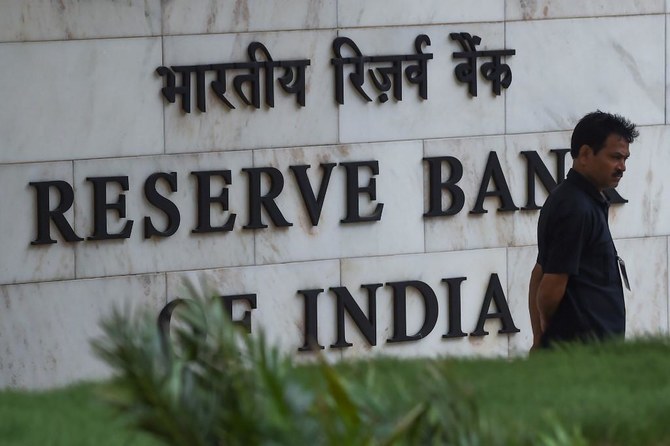
MUMBAI: India’s worsening economic outlook as coronavirus cases soar has raised the chance the central bank will cut interest rates at its policy review on Thursday, in spite of inflationary pressures.
Around two-thirds of economists in a Reuters poll expect the Reserve Bank of India (RBI) to cut the repo rate by another 25 basis points (bps) on Aug. 6 to a record low of 3.50 percent, and once more next quarter.
“High inflation has added confusion to the Reserve Bank’s policy outlook, but given the state of aggregate demand, we forecast the RBI will continue easing,” said Rahul Bajoria, economist at Barclays who expects a 25-bp cut.
Annual retail inflation rose in June to 6.09 percent from 5.84 percent in March, remaining above the RBI’s medium-term target range of 2 percent-6 percent.
The RBI’s recent policies have focused on financial stability and the need to support growth despite the price target.
The country was placed under one of the strictest lockdowns in the world in late March for over two months to halt the spread of the coronavirus. The government gradually eased restrictions in June although infections continue to rise.
The poll showed most analysts expect the economy to contract 20 percent in the June quarter versus the April forecast of a 5.2 percent fall and remain in negative terrain until the December quarter.
For the full year 2020/21, the economy is likely to shrink 5.1 percent, which would be its weakest performance since 1979, a sharp contrast to the 1.5 percent expansion forecast in April.
Apart from rate cuts, Upasna Bharadwaj, economist at Kotak Mahindra Bank, expects liquidity and regulatory measures from the RBI to address demand shocks and financial market dislocations.
“RBI may look to widen the policy corridor to 75 bps by easing reverse repo by a higher quantum,” she said, adding that though they expect a 25-bp rate cut, it may not be effective in the current environment.
The RBI has already reduced the repo rate by a total of 115 basis points since February, on top of the 135 basis points in an easing cycle last year, from 6.50 percent, responding to slowing growth.
Some economists, however, feel it may be prudent for the RBI to pause in August before resuming its rate-cutting cycle once inflation has stabilized.
Weakness in growth versus above-target inflation, improving indicators and concerns over inflation expectations will put the RBI in a tough spot, said DBS economist Radhika Rao.
“It will be a close call, but we see slightly higher odds for a pause.”


India’s central bank likely to cut rates despite inflation risk
https://arab.news/83nkg
India’s central bank likely to cut rates despite inflation risk

- Annual retail inflation rose in June to 6.09 percent from 5.84 percent in March
- Country was placed under one of the strictest lockdowns in the world in late March


Real Estate Registry signs 10 agreements at forum in Riyadh
RIYADH: The Real Estate Registry concluded its participation in the Real Estate Future 2026, as a partner of the forum, with a distinguished presence that included the launch of its business portal, the signing of 10 agreements and memoranda of understanding with entities from the public and private sectors, the organization of specialized workshops, and the awarding of the Gold Award at the Real Estate Excellence Awards.
During his participation in the forum, the CEO of the firm, Mohammed Al-Sulaiman, reviewed the latest developments in real estate registration in the Kingdom in a keynote speech, highlighting the pivotal role of the Real Estate Registry in building a unified and reliable system for data. He also announced the launch of the national blockchain infrastructure, which aims to enable the microcoding of real estate assets, enhance transparency, expand investment opportunities, and support innovative ownership models within a reliable regulatory framework.
On the sidelines of the forum, Al-Sulaiman met with Nigeria’s Minister of Housing and Urban Development, Ahmed Dangiwa. During the meeting, they discussed areas of joint cooperation, exchanged experiences and advice on shaping the future of the real estate sector, and reviewed best practices in implementing real estate registration systems that enhance reliability and improve the efficiency of property registration.
efficiency of property registration systems.
The Real Estate Registry’s participation included organizing three specialized workshops that focused on the role of geospatial technologies in identifying ownership, enhancing transparency, and improving the quality of real estate data.
The workshop “Empowering the Real Estate Registry for the Business Sector” reviewed digital solutions that enable the business sector to manage its real estate assets more efficiently and enhance governance and technical integration. The workshop “From Off-Plan Sales to Title Deed” focused on the journey of documenting real estate ownership and the role of the registry in linking the stages of development and documentation within an integrated digital system.
On the sidelines of the forum, the Real Estate Registry signed 10 agreements and memorandums of understanding, including a deal with Yasmina Information Technology Co. to utilize real estate data in developing smarter insurance solutions that support the real estate sector and enhance service reliability.
Partnerships were also signed with Haseel, NewTech, and Sahl, as well as HissaTech and Droub, to develop innovative digital solutions in property ownership, fractional ownership, and asset tokenization, as well as real estate finance and investment within a trusted regulatory framework.
Further collaborations included an MoU with ROSHN Group, an agreement with the Saudi Water Authority to enable data integration and quality enhancement, an agreement with the Saudi National Bank, and a partnership with Saudi Post to link the national address with the property registry as a unified geospatial identifier supporting data accuracy and integration.
The registry’s participation was crowned with the Golden Award at the Real Estate Excellence Awards in the category of Excellence in Property Documentation, in recognition of its role in building a model based on transparency, accuracy, and speed, as well as advanced digital technologies and specialized legal expertise, contributing to rights protection and increasing the sector’s attractiveness.
The Real Estate Registry emphasized that its participation reflects its continued role as a key enabler of the real estate sector, a trusted data source, and an active partner in driving digital transformation, enhancing market efficiency, and building investor and financier confidence, in line with Saudi Arabia’s Vision 2030 objectives for a fully integrated and sustainable digital real estate ecosystem.


