

Duterte puts Metro Manila back under strict lockdown

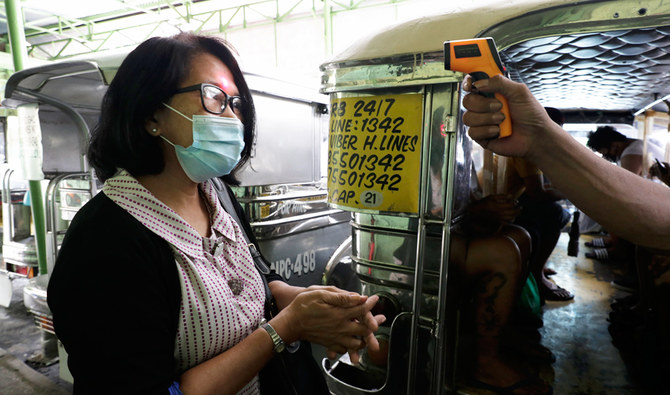
Temperature is taken before riding a passenger jeepney to help curb the spread of COVID-19 as drivers at Quezon city terminal were allowed back on the road. (AP)
Short Url
Updated 03 August 2020
Follow

Duterte puts Metro Manila back under strict lockdown

  • Follows Philippines exceeding 100,000 coronavirus infections

MANILA: President Rodrigo Duterte has ordered a reimposition of a strict quarantine status in the country’s National Capital Region (NCR) and surrounding provinces.

This follows an urgent appeal made by the country’s health professionals to put Metro Manila back under enhanced community quarantine (ECQ) for the next two weeks, which will be used as a “timeout” to refine the government’s pandemic control strategies, warning that the country’s health care system was on the brink of a collapse.
Instead of an ECQ, however, Malacanang spokesperson Harry Roque said the President has “reverted the NCR, and the provinces of Laguna, Cavite, Rizal and Bulacan to modified enhanced community quarantine (MECQ) effective midnight Aug.  4 as recommended by members of his Cabinet.” This will run through Aug.  18.
Duterte earlier in the day met with key members of his Cabinet to discuss an urgent appeal by medical groups to put Metro Manila back on strict lockdown, warning that the country’s health care system was on the brink of a collapse.
On Saturday, medical associations sent a “distress signal to the nation,” saying: “Our health care system is overwhelmed.”
“Our health care workers are sounding a distress call. We need a short breather; we are already exhausted,” Jose Santiago, Philippine Medical Association president, said as he read out a joint letter on behalf of the medical groups during a virtual press conference.
“We have witnessed a consistent rise in the number of infections and these among other scenarios prompts us to act now and act fast,” it added.
“We are in a losing battle against COVID-19, and we need to come up with a consolidated plan. Hence, we, as frontliners dedicated to win the battle against COVID-19, call on our government to put Mega Manila back to Enhanced Community Quarantine (ECQ) for a period of two weeks, from Aug. 1 to 15,” the letter said.
Santiago said that “health workers are burnt-out with the seemingly endless number of patients” at hospitals.
A return to ECQ, he added, would also give an opportunity for the government to discuss strategies with the medical community.
In response, Roque announced on Saturday that the president had “heard the concerns of the medical community and the chief executive has directed the Inter-Agency Task Force for Emerging Infectious Diseases (IATF-EID) to act on these concerns immediately.”
“The Palace considers our skilled, tireless and dedicated health care workers as important frontliners in the battle against COVID-19. We are grateful for their immense contributions to heal our people and our nation during these difficult times. Your voices have been heard. We cannot afford to let down our modern heroes. This is our commitment,” he said.
Heeding Duterte’s directive, Executive Secretary Salvador Medialdea convened a meeting on Saturday night and were to submit their recommendations to the president on Sunday.
Aside from reverting to MECQ, Roque said the president also agreed to the distribution of 20 million facemasks to the poor, and the hiring of additional health care workers to augment the current workforce, including the hiring of 10,000 medical professionals and the calling to active duty and enlistment to the Armed Forces of the Philippines .
Health care workers would also be provided additional benefits, such as risk allowance for private sector health care workers treating COVID-19 patients, life insurance, free accommodation, free transportation, and free and frequent testing.
Also approved was the Cabinet’s recommendation to issue work and quarantine passes to minimize movement, while local government units are directed to intensify the localized lockdown strategy.
The guidelines for minimum health standards will also be strictly enforced and intensified, while use of RT-PCT testing as gold standard has likewise been approved.

he total number of COVID-19 cases in the Philippines crossed the 100,000 mark on Sunday, according to the latest data released by the Department of Health (DOH) which showed a record high of 5,032 new infections, taking the nationwide total to 103,185, six months after the first coronavirus case was reported in the country.

According to the health department, Metro Manila or the National Capital Region (NCR) accounted for the highest number of new COVID-19 cases, with 2,737 infections reported.
Meanwhile, the total recoveries also increased to 65,557 with 301 reported during the day. The death toll, on the other hand, increased 2,059 as 20 more people died from the disease.


Ukraine drops NATO goal as Trump envoy sees progress in peace talks

Updated 57 min 18 sec ago
Follow

Ukraine drops NATO goal as Trump envoy sees progress in peace talks

  • The move marks a major shift for Ukraine, which has fought to join NATO as a safeguard against Russian attacks and has such an aspiration included in its constitution

BERLIN/KYIV: President Volodymyr Zelensky offered to drop Ukraine’s aspirations to join the NATO military alliance as he held five hours of talks with US envoys in Berlin on Sunday to end the war with Russia, with negotiations set to continue on Monday.
Trump’s envoy Steve Witkoff said “a lot of progress was made” as he and Trump’s son-in-law Jared Kushner met Zelensky in the latest push to end Europe’s bloodiest conflict since World War Two, though full details were not divulged.
Zelensky’s adviser Dmytro Lytvyn said the president would comment on the talks on Monday once they were completed. Officials, Lytvyn said, were considering the draft documents.
“They went on for more than five hours and ended for today with an agreement to resume tomorrow morning,” Lytvyn told reporters in a WhatsApp chat.
Ahead of the talks, Zelensky offered to drop Ukraine’s goal to join NATO in exchange for Western security guarantees.
The move marks a major shift for Ukraine, which has fought to join NATO as a safeguard against Russian attacks and has such an aspiration included in its constitution. It also meets one of Russia’s war aims, although Kyiv has so far held firm against ceding territory to Moscow.
“Representatives held in-depth discussions regarding the 20-point plan for peace, economic agendas, and more. A lot of progress was made, and they will meet again tomorrow morning,” Witkoff said in a post on X.
The talks were hosted by German Chancellor Friedrich Merz, who a source said had made brief remarks before leaving the two sides to negotiate. Other European leaders are also due in Germany for talks on Monday.
“From the very beginning, Ukraine’s desire was to join NATO, these are real security guarantees. Some partners from the US and Europe did not support this direction,” Zelensky said in answer to questions from reporters in a WhatsApp chat.
“Thus, today, bilateral security guarantees between Ukraine and the US, Article 5-like guarantees for us from the US, and security guarantees from European colleagues, as well as other countries — Canada, Japan — are an opportunity to prevent another Russian invasion,” Zelensky said.
“And it is already a compromise on our part,” he said, adding the security guarantees should be legally binding.
Russian President Vladimir Putin has repeatedly demanded Ukraine officially renounce its NATO ambitions and withdraw troops from the about 10 percent of Donbas which Kyiv still controls. Moscow has also said Ukraine must be a neutral country and no NATO troops can be stationed in Ukraine.
Russian sources said earlier this year that Putin wants a “written” pledge by major Western powers not to enlarge the US-led NATO alliance eastwards — shorthand for formally ruling out membership to Ukraine, Georgia, Moldova and other former Soviet republics.
Sending Witkoff, who has led negotiations with Ukraine and Russia on a US peace proposal, appeared to be a signal that Washington saw a chance of progress nearly four years after Russia’s 2022 invasion.
Under pressure from Trump to sign a peace deal that initially backed Moscow’s demands, Zelensky accused Russia of dragging out the war through deadly bombings of cities and Ukraine’s power and water supplies.
A ceasefire along the current front lines would be a fair option, he added.

‘CRITICAL MOMENT’
Germany’s Defense Minister Boris Pistorius said it was a “good sign” Trump had sent his envoys while fielding questions in an interview with the ZDF broadcaster on the suitability of Witkoff and Kushner, two businessmen, as negotiators.
“It’s certainly anything but an ideal setup for such negotiations. That much is clear. But as they say, you can only dance with the people on the dance floor,” Pistorius said.
On the issue of Ukraine’s offer to give up its NATO aspirations in exchange for security guarantees, Pistorius said Ukraine had bitter prior experience of relying on security assurances. Kyiv had in 1994 agreed to give up its Soviet-era nuclear arsenal in exchange for territorial guarantees from the US, Russia and Britain.
“Therefore, it remains to be seen to what extent this statement Zelensky has now made will actually hold true, and what preconditions must be met,” Pistorius said.
“This concerns territorial issues, commitments from Russia and others,” he said, adding mere security guarantees, especially without significant US involvement, “wouldn’t be worth much.”
Britain, France and Germany have been working to refine the US proposals, which in a draft disclosed last month called for Kyiv to cede more territory, abandon its NATO ambitions and accept limits on its armed forces.
European allies have described this as a “critical moment” that could shape Ukraine’s future, and sought to shore up Kyiv’s finances by leveraging frozen Russian central bank assets to fund Kyiv’s military and civilian budget.