Philippines to update COVID-19 strategy as health care workers seek ‘timeout’

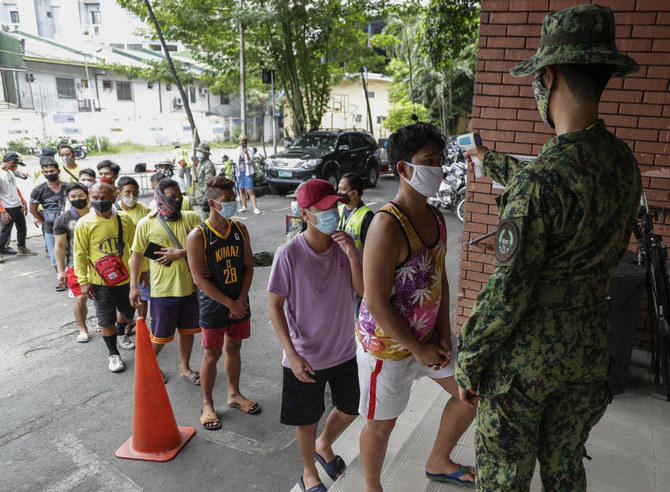
The government appears reluctant to revive strict curbs on movement in the capital, saying there are other ways to control the spread of the disease. (File/AFP)
Short Url
Updated 02 August 2020
Follow

Philippines to update COVID-19 strategy as health care workers seek ‘timeout’

  • The Southeast Asian country on Saturday reported 4,963 additional coronavirus infections

MANILA: The Philippines’ health department vowed on Sunday to update its game plan against COVID-19 within a week and sought to beef up the health care workforce in the capital Manila, where medical frontliners are calling for reviving strict lockdowns.
The Southeast Asian country on Saturday reported 4,963 additional coronavirus infections, the largest single-day jump on record, bringing its total confirmed cases to 98,232, while its death toll had climbed to 2,039.
It has the second-highest number of coronavirus infections and COVID-19 deaths in the region, behind Indonesia.
In the largest call yet from medical experts to contain the virus, 80 groups representing 80,000 doctors and a million nurses, on Saturday said the Philippines was losing the fight against the disease and warned of a collapse of the health care system from soaring infections without tighter controls.
In a statement issued following an unscheduled meeting late on Saturday of the government’s coronavirus task force to address the concerns of doctors and nurses, the Department of Health said it would come up with an updated COVID-19 strategy within seven days.
It appealed to health care workers in the provinces and those returning from abroad to help beef up the frontline workforce in the capital, and sought help from universities and medical groups in hiring more doctors, nurses and other medical staff.
The government appears reluctant to revive strict curbs on movement in the capital, saying there are other ways to control the spread of the disease.
Still, the health department said it supports the health care workers’ call for a “timeout” and would “proactively lead the implementation of effective localized lockdowns.”
“The battle is not over, and it will not be for a long time yet,” the department said in a statement. But “we will marshal all our efforts to turn the tide.”


Cuba says attacking speedboat had nearly 13,000 rounds of ammunition

Updated 9 sec ago
Follow

Cuba says attacking speedboat had nearly 13,000 rounds of ammunition

  • Firefight took place at a range of 20 meters, Cuba says
  • Incoming crew originally ‌set out on two vessels but ditched one
HAVANA: A commando of Cuban exiles who intended to infiltrate Cuba on a speedboat was armed with nearly 13,000 rounds of ammunition, 13 rifles and 11 pistols, Cuban officials said on Friday, providing new details about Wednesday’s deadly exchange of gunfire at sea. The government in Havana has said 10 Cuban nationals coming from the United States entered Cuban waters and opened fire on a border guard vessel, leading Cuban forces to return fire killing four and wounding six others, who were taken into custody.
In an attempt to dispel doubts about its account to date, senior Cuban Interior Ministry officers displayed the captured armaments from the studio on a special television program, including bins full of at least some of the 12,846 recovered rounds. They also showed pictures of the vessels, each peppered with bullet holes from ‌the firefight they ‌said took place at a range of 20 meters (66 feet).
The confrontation took place ‌at ⁠a fraught moment ⁠in US-Cuban relations, with US President Donald Trump pressuring the island by imposing a virtual oil blockade after capturing and ousting Venezuelan President Nicolas Maduro, a crucial Cuban ally, on January 3.
Cuba has identified the assailants as Cuban exiles, some of whom had been previously placed on a list of accused terrorists, who came from the United States with the intent to sow chaos and attack military units on the Communist-ruled island.
“The intent of this group is to infiltrate, to promote public disorder. To incite the people to unite. To carry out something violent. Attack military units ⁠in order to incite social unrest and to unite the people in order to ‌steal the revolution. That has been duly proven,” said Col. Victor Alvarez ‌of the Interior Ministry.
Cuba says response ‘proportional’
US politicians have expressed skepticism over Cuba’s version of events. Secretary of State Marco ‌Rubio on Wednesday said his government would independently investigate, adding that it was not a US operation and ‌that no US government personnel were involved.
Cuban officers said the infiltrators set out from Marathon in the Florida Keys on two vessels but ditched one at some point due to technical difficulties. They united on one speedboat, which a US official said was reported stolen in Florida. Cuba said it recovered a drone, radios, knives, a portable power plant, bolt cutters and ‌other materiel. They also found emblems of the November 30th Movement and People’s Self-Defense, anti-communist groups that oppose the Cuban government.
Cuba says a patrol of five ⁠border guard members on ⁠a 9-meter boat spotted the incoming vessel shortly after 7 a.m., with some members of the incoming crew in the water, about one nautical mile off a cay on the Caribbean island’s northern coast, about 100 miles (160 km) from Marathon.
The infiltrators opened fire at a distance of 185 meters, striking the captain of the Cuban vessel in the abdomen, Cuba said. Bleeding heavily, the wounded captain remained at the helm and steered toward the enemy vessel, leading to a firefight at a distance of about 20 meters, the officers said.
Cuba called its response “proportional.”
“It is a defensive model that practically never uses firearms, and the use of firearms is proportional to the type of action being carried out against our force,” said Interior Ministry Col. Ybey Carballo.
The captured Cuban nationals were receiving medical care and face charges including armed aggression, illegal entry into national territory, crimes associated with terrorist acts, and arms trafficking, prosecutor Edward Robert Campbell told the program. He said they face prison terms of up to 10 to 15 years for the lesser offenses and 20 to 30 years — or even the death penalty — for the more serious charges.