

UAE official tells Turkey to stop meddling in Arab affairs over Libya

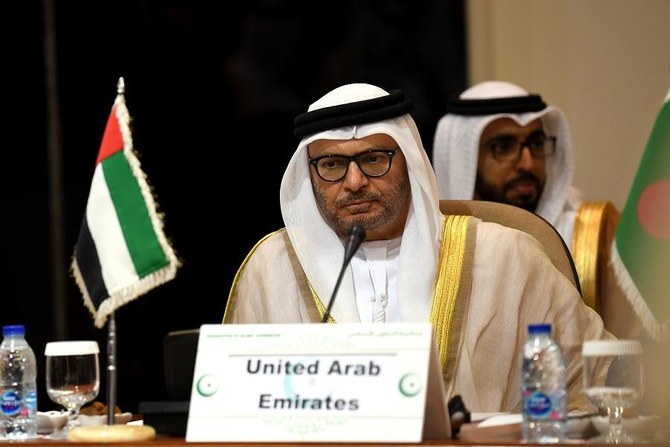
UAE's Minister of State for Foreign Affairs Anwar Gargash attends an extraordinary meeting for the Organization of Islamic Cooperation (OIC) on Foreign Ministers level in Jeddah on July 17, 2019. (File/AFP)
Short Url
Updated 02 August 2020
Follow

UAE official tells Turkey to stop meddling in Arab affairs over Libya

  • Turkish media had reported the Turkish minister making remarks critical of the UAE’s actions over Libya

ABU DHABI: A UAE official on Saturday urged Turkey to stop interfering in Arab affairs, mockingly referring to the Ottoman empire which collapsed a century ago.
The backlash came after Turkey condemned what it termed “malicious” actions by the UAE in Libya, where the two countries support opposing sides in its grinding conflict. Anwar Gargash, minister of state for foreign affairs, called on Turkey “to stop intervening in Arab affairs.”
Turkey can no longer behave like “the Sublime Porte and use the language of colonialism,” he said, referring to the government of the Ottoman empire which ruled the Arab world for centuries.
“The Sublime Porte and colonialist illusions belong to the archives of history... and relations between states are not conducted with threats,” Gargash wrote.
Turkey backs the UN-recognized Government of National Accord (GNA) in western Libya, while the forces of eastern-based strongman Khalifa Haftar are supported by the UAE, Egypt and Russia.
“Abu Dhabi does what it does in Libya, does what it does in Syria. All of it is being recorded. At the right place and time, the accounts will be settled,” Turkey’s Defense Minister Hulusi Akar said in an interview.
“It is necessary to ask Abu Dhabi, where this hostility, where these intentions, where this jealousy comes from,” he said, quoted Friday on the Turkish Defense Ministry’s website.

BACKGROUND

Libya has been torn by violence since the 2011 ouster of long-time dictator Muammar Qaddafi in a NATO-backed uprising, and the conflict has since drawn in multiple foreign powers.

Tensions have been steadily rising in the Libyan conflict in recent weeks, with Egypt threatening it would launch a military intervention if GNA forces try to capture their next target — the coastal city of Sirte, currently held by Haftar’s troops.
Recently, the US military said that Russia appeared to be sending more military equipment to its mercenaries in Libya, including Sirte, in breach of an arms embargo.
Its Africa Command said there was mounting evidence from satellite pictures of Moscow’s military cargo planes, including IL-6s, bringing supplies to fighters from the Russian Wagner Group.
Both sides have been mobilizing forces around Sirte where any major new escalation could risk drawing major regional powers further into Libya’s messy conflict.
Libya has been torn by violence since the 2011 ouster of long-time dictator Muammar Qaddafi in a NATO-backed uprising, and the conflict has since drawn in multiple foreign powers.


UN humanitarian chief’s fresh funding call as Sudan crisis passes 1,000 days amid famine, mass displacement

Updated 04 February 2026
Follow

UN humanitarian chief’s fresh funding call as Sudan crisis passes 1,000 days amid famine, mass displacement

  • ‘Today we are signaling that the international community will work together to bring this suffering to an end,’ Tom Fletcher tells fundraising event in Washington
  • Sudan is a central pillar of the UN’s global humanitarian plan for 2026, which aims to save 87m lives worldwide, he adds

NEW YORK CITY: The UN on Tuesday launched a renewed appeal for funding and the political backing to address what it described as the catastrophic humanitarian crisis in Sudan, which has now been locked in civil war for more than 1,000 days.

Speaking at a fundraising event for Sudan in Washington, organized by the US Institute for Peace, the UN under-secretary-general for humanitarian affairs, Tom Fletcher, said the scale of the suffering in Sudan had reached intolerable levels marked by famine, mass displacement and widespread sexual violence against women and girls.

“The horrific humanitarian crisis in Sudan has endured more than 1,000 days — too long,” he said. “Too many days of famine, of brutal atrocities, of lives uprooted and destroyed.”

The global community was now united in its desire to halt the suffering and ensure life-saving aid reaches those most in need, Fletcher said.

“Today we are signaling that the international community will work together to bring this suffering to an end,” he added.

Sudan is a central pillar of the UN’s global humanitarian plan for 2026, which aims to save 87 million lives worldwide, Fletcher explained as he thanked donors, including the US, the EU and the UAE, for stepping forward.

“Sudan is the most important component of that plan,” he said, noting that humanitarian operations there have been chronically underfunded and plagued by danger. “We have lost hundreds of colleagues in Sudan, colleagues of incredible courage.”

The UN plans to provide food, medicine, water and sanitation services to more than 14 million people across Sudan this year, as well as protection for vulnerable groups, Fletcher said.

He stressed that funding alone would not be sufficient, however, and called for stronger measures to protect civilians and aid workers, secure humanitarian access and support a temporary truce between the warring factions.

“The money is not enough,” he said. “We need the air assets, the security, the medical support for our teams, and the mediation work that has to underpin the access.”

The UN will work, through the Sudan Humanitarian Initiative, with the so-called “Quad” group of international partners (the US, Egypt, Saudi Arabia and the UAE) and others to identify priority areas for urgent action and remove obstacles to the delivery of aid, Fletcher said.

He added that the UN seeks visible progress toward a humanitarian truce in Sudan within the next few weeks, and called for those guilty of any violations in the country to be held accountable.

“We have set a target date of the beginning of Ramadan to make visible progress on this work,” Fletcher said. Ramadan is expected to begin on or around Feb. 17 this year.

Quoting UN Secretary-General Antonio Guterres, he added that the urgency of ending the conflict was growing as the third anniversary of its outbreak on April 15, 2023, approaches.

“The guns must fall silent and a path to peace must be charted,” Fletcher said, adding that the UN fully supports efforts to secure a humanitarian truce and rapidly scale up aid across Sudan.

“Today, we’re saying, ‘Enough.’ Let today be the signal that the world is uniting in solidarity for practical impact.”