

In Makkah, a fortunate few pray at Hajj for a pandemic-free world

A handout picture provided by the Saudi Ministry of Media on July 30, 2020 shows Muslim pilgrims praying on Mount Arafat, also known as Jabal al-Rahma (Mount of Mercy), southeast of the holy city of Mecca, during the climax of the Hajj pilgrimage amid the COVID-19 pandemic. (AFP)
Short Url
Updated 31 July 2020
Follow

In Makkah, a fortunate few pray at Hajj for a pandemic-free world

  • Only a few thousand pilgrims, Saudis and foreign residents, are gathering this year for the annual pilgrimage
  • This year, Saudi Arabia has risen to the challenge of keeping the Hajj safe from COVID-19

RIYADH: In years before the coronavirus, some 3 million white-clad pilgrims from across the world flocked to Islam’s holiest sites to attend Hajj under Saudi Arabia’s blistering sun.

With the pandemic making large gatherings impossible, only a few thousand pilgrims — Saudis and foreign residents — are gathering this year on Mount Mercy on the plains of Arafat for the most important ritual. They share a common plea.
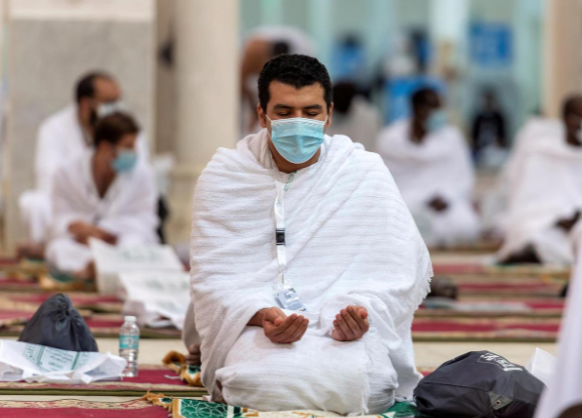


A Muslim pilgrum wearing a protective mask, prays inside Nimra Mosque in Arafat to mark Hajj's most important day, Day of Arafat, during his Hajj pilgrimage amid the coronavirus diease (COVID-19) pandemic, outside the holy city of Makkah, Saudi Arabia July 30, 2020. (SPA/ REUTERS)

“Everyone will be praying for this pandemic to end, and for all the people of the world to see better months to come after all the suffering caused by coronavirus,” said Ammar Khaled, a 29-year-old Indian pilgrim who is an IT professional in Jeddah.

Saudi Arabia stakes its reputation on its guardianship of Islam’s holiest sites in Makkah and Madina and its peaceful organization of Hajj.

Over the years, the kingdom has spent billions of dollars on making one of the world’s biggest religious gatherings more secure.

This year it faces the challenge of keeping Hajj, a once-in-a-lifetime duty for every able-bodied Muslim who can afford it and a major source of income for the government, safe from COVID-19.
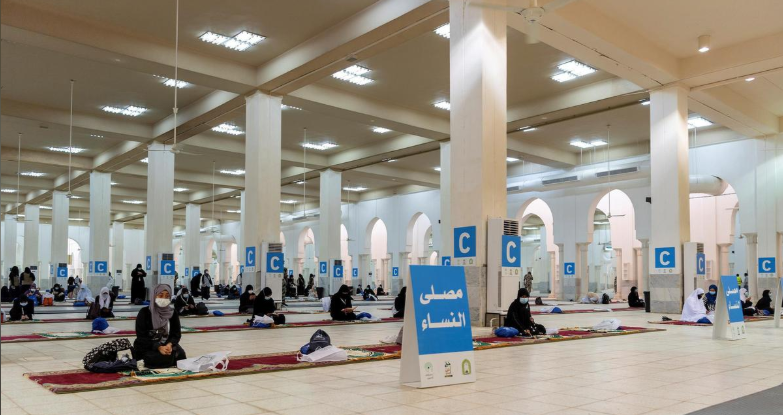


Muslim pilgrims maintain social distancing as they pray inside Nimra mosque in Arafat to mark Hajj's most important day, Day of Arafat, during their Hajj pilgrimage amid the coronavirus disease (COVID-19) pandemic, outside the holy city of Makkah, Saudi Arabia July 30, 2020. (SPA/ REUTERS)

For the first time in modern history it has dramatically reduced the number of pilgrims to ensure social distancing measures are adhered to.

The Hajj minister said in June the number of pilgrims would be limited to around 1,000, but no official number has been given for those performing the rituals this week. Some local media cited a figure of some 10,000.

Saudi health care and security professionals, on the frontlines of the battle against the disease, make up about 30% of the total, with the remainder coming from 160 nationalities residing in the Kingdom.

Mask-wearing pilgrims circled the Kaaba — a structure that is the most sacred in Islam and the direction which Muslims face to pray — in small groups of 50 people, each keeping a safe distance apart and accompanied by a health professional monitoring their movements.

Unlike past years when they lunged toward the Kaaba, pilgrims are not allowed to touch the plain stone cube building covered in black cloth and wrapped in Arabic writing in golden silk.
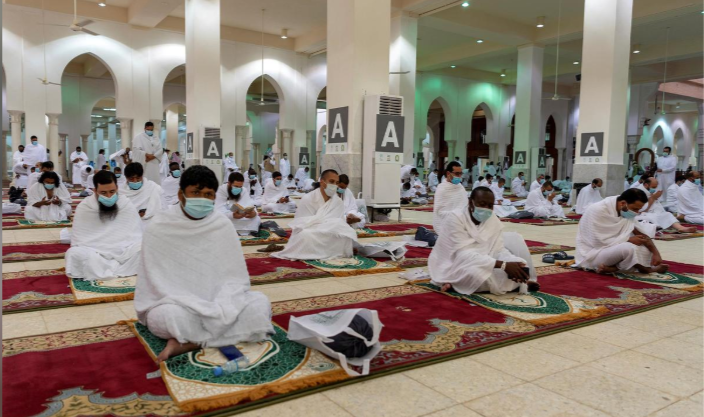


Muslim pilgrims maintain social distancing as they pray inside Nimra mosque in Arafat to mark Hajj's most important day, Day of Arafat, during their Hajj pilgrimage amid the coronavirus disease (COVID-19) pandemic, outside the holy city of Makkah, Saudi Arabia July 30, 2020. (SPA/ REUTERS)

Workers sanitised the structure, rubbing Oud perfume, the popular Arab sweet and woody scent, on its walls and carrying incense as they moved around the premises of the Grand Mosque.

Pilgrims took several medical tests and were asked to quarantine for a week before starting their journey, then isolate for another week in their hotel rooms.

They were given an electronic bracelet to monitor their movements and a suitcase containing all basic necessities.

On site, 3,500 workers spread across the Grand Mosque in Makkah to sanitise it using 54,000 liters (11,888 gallons) of disinfectant and 1,050 liters of air fresheners daily.

The floors of the mosque were scrubbed 10 times a day, up from three times in the past.

Six hospitals were dedicated to serving pilgrims and 51 clinics and 200 ambulances were spread across different sites, with the support of 62 field teams and 8,000 health care professionals.

“The kingdom is relying on years of experience in managing the pilgrimage and has worked hard in collaboration with the WHO to ensure that the pilgrimage goes very smooth,” said Hanan Balkhy, assistant director-general of antimicrobial resistance at the World Health Organization.

With joy and tears, pilgrims spent the day on Mount Arafat, where the Prophet Muhammad gave his last sermon, raising hands in prayer to atone for their sins, their lips moving behind face masks.

This year each pilgrim received sanitised pebbles in advance of the event on Friday, the first day of Eid Al-Adha or the feast of sacrifice.


Shaping future society: How intellectual forums contribute to cultural development

Updated 7 sec ago
Follow

Shaping future society: How intellectual forums contribute to cultural development

RIYADH: Modern nations do not transform on technological progress alone, but evolve through various factors such as values, religion, culture and assumptions that guide how societies interpret development.

Philosophy is one aspect of understanding civilization. Although it is often seen as abstract or far from reality, it plays an essential role in shaping a nation’s understanding of modernization.

It impacts how people see progress and discuss cultural identity, along with measuring the ethical implications of joining the global mindset.

Yet, by examining the philosophical thoughts that shape national narratives, people gain a deeper understanding of why societies adopt certain ideologies for development, resist others, and struggle to balance tradition with innovation.

Saudi Arabia, for example, defines its place on the global stage and navigates the complex tensions between heritage, aspiration and global responsibility through its own philosophy.

The Philosophy Forum, organized in Riyadh this week for the fifth year, witnessed the attendance of both local and international thinkers. During the conference, some Arab philosophers shared their beliefs in the idea that there is no absolute truth; while other philosophers differed, considering the Arab view on truth, culture and relativism.

“We must distinguish between the existence of relativity in science — the world is changing because it is relative — and our belief in absolute truths within our culture. For example, the only truly absolute thing in the world is death, which is mentioned in the Holy Qur’an,” Essam Gameil, professor of logic and critical thinking at Cairo University, told Arab News on the sidelines of the forum.

He added: “Our morals are unchanging; ethical principles are fixed. For example, respecting others is a fundamental principle; how can it be altered?

“Some concepts can be changed within the framework of science, but not in the humanities, not in religion, not in ethics. There are constants.

“It is the moral principles and rules that drive me forward,” Gameil said, adding that philosophy was created to solve issues that occurred in society during the time of Aristotle and Plato.

“It appeared to solve social problems … it was created to address lying, deception and more. Socrates was a moral philosopher and nothing else,” he said.

Gameil described Saudi Arabia as an example of “an extraordinary leap” in the Arab world in terms of development and philosophy.

He said that the Kingdom’s interest in philosophy and its organization of a major conference in the field stems from a crucial concept discovered by the Saudi leadership, which is that humanity has two aspects: A spiritual aspect and a material aspect, represented by the body.

“Studies typically focus on the body — artificial intelligence, engineering, and so on — but have often neglected the spiritual dimension. Philosophy is a human science; the more you emphasize it, the more certain concepts become firmly established and ingrained,” said Gameil.

Eman Al-Mulhem, a researcher in the philosophy of science at King Faisal University in Al-Ahsa, believes that the Kingdom’s situation presents three very promising paths: The philosophy and ethics of artificial intelligence, science and technology studies, and a re-reading of the Arab philosophical heritage using contemporary methodologies.

“This field is no longer a luxury, but a necessity. The question is no longer: What can a machine do? Rather, it has become: How do we preserve our humanity in a world where we share the power of decision-making with machines?” she said, highlighting the philosophy and ethics of AI.

She added: “We have a rich heritage, but we need modern tools to understand and reconstruct it, not just explain it. These fields are not only promising, but they are also capable of reshaping the role of philosophy in the Arab world.”

Al-Mulhem also works to connect Arab philosophical heritage to questions of contemporary science. She believes that philosophy is not detached from reality, but rather helps to reevaluate our relationship with science, humanity and the world.

On the question of whether Arab philosophical heritage is still suffering from global misconceptions, she said: “(It) still suffers some global misconceptions, such as being reduced to a mere extension of Greek philosophy or a stagnant tradition.”

However, the Riyadh International Philosophy Conference, which hosts philosophical minds from around the world, is helping to correct this image, she added.

“They present Arab heritage in a dynamic context, through the voices of its own scholars. At this conference, the world encounters Arab thoughts that engage in dialogue, produce ideas and critique — not as a static heritage, but as an integral part of contemporary global philosophy,” said Al-Mulhem.

“Philosophy is not far removed from humanity; it is closer than we imagine. Every question we ask, every attempt to understand the world, is a philosophical step,” she said.

“I believe that the Arab region today has a great opportunity to reclaim its role in producing knowledge, not just consuming it. And the Arab researcher is capable — given the right environment — of making a lasting impact that transcends geographical boundaries,” she added.