

In remote town, Eid celebrated two days before rest of Pakistan

Short Url
Updated 30 July 2020
Follow

In remote town, Eid celebrated two days before rest of Pakistan

  • Eid Al-Adha is celebrated at the end of the Hajj pilgrimage in Makkah
  • In a first, residents of small town in North Waziristan celebrate Eid before Saudi Arabia

PESHAWAR: Residents of a small town in North Waziristan celebrated Eid Al-Adha on Thursday, even when people were still performing Hajj pilgrimage in Makkah. 

Maulvi Rafiullah Dawar, a leading cleric of Haiderkhel village, told Arab News that religious leaders accepted the moonsighting testimony of five individuals after a careful evaluation. 

“We had five witnesses confirming that July 30 was the tenth day of Dhu al-Hijjah [the final month of the Muslim lunar calendar]. We evaluated and gauged their claims, found them valid under the Shariah law, and decided to observe Eid Al-Adha today,” he said. 

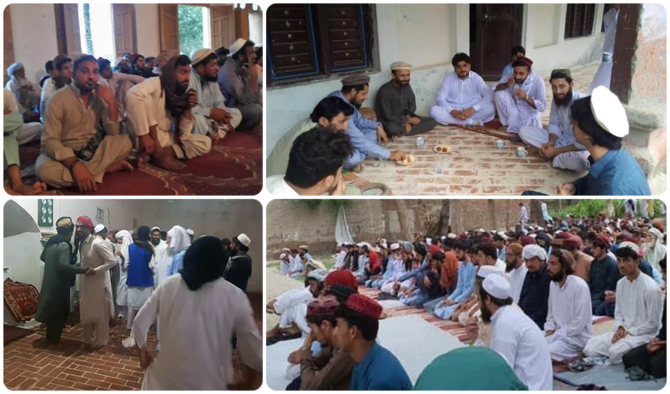
Malik Saleh Jan, a tribal elder from the town, said that Eid prayers were held in all three mosques including the central worship place in the dusty village.
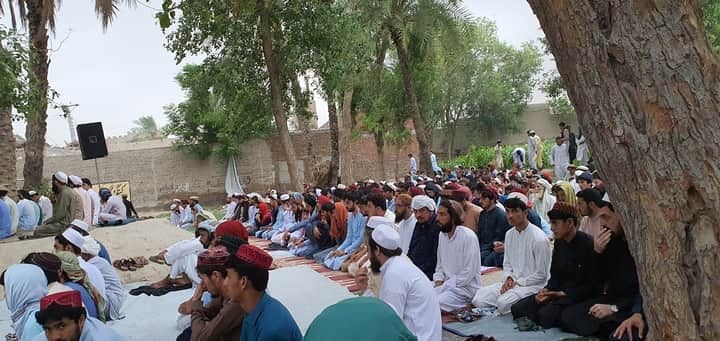


People listen to Eid al-Adha sermon at the central mosque in Haiderkhel, a town in North Waziristan tribal district, on July 30, 2020. (Photo courtesy Haiderkhel social activists)

“We slaughtered sacrificial animals today. Last night, fireworks by children lit up the sky after Eid was announced,” he told Arab News on phone.

Eid Al-Adha is celebrated after Muslims perform Hajj pilgrimage in Saudi Arabia.
According to Pakistan’s moonsighting committee led by Mufti Muneeb-ur-Rehman, the country would officially observe Eid Al-Adha on Saturday while the Kingdom would celebrate the festivity tomorrow. 

Jan said that people of Haiderkhel, which has a population of around 10,000, also observed Eid Al-Fitr one day before the rest of Pakistan. 

Ziaullah Bangash, adviser to the chief minister of Khyber Pakhtunkhwa province, told Arab News that the government should ensure that Eid was celebrated across the country on the same day. However, he lamented that this never happened since religious leaders had “a say in these matters.” 



Villagers of Haiderkhel, a town in North Waziristan tribal district, enjoy a light moment at a modest tea party as they celebrate Eid Al-Adha on July 30, 2020. (Photo courtesy Haiderkhel social activists)

While such Eid controversies are not new in Pakistan where people of the northwestern province frequently celebrate the two Muslim festivities before the rest of the country, the celebration of Eid Al-Adha in Haiderkhel has surprised many people since the event has not even been celebrated in Saudi Arabia. 

“The government needs to take a tough stance to resolve such issues with Eid celebrations once and for all,” Bangash said. 


Pakistan disburses record $9.2 billion agricultural loans in FY25, central bank says

Updated 57 min 40 sec ago
Follow

Pakistan disburses record $9.2 billion agricultural loans in FY25, central bank says

  • State Bank says farm lending rose 16 percent year-on-year to Rs2.58 trillion
  • Inflation eased to 5.8 percent in January as GDP growth hits 3.7 percent in Q1 FY26

KARACHI: Pakistan disbursed a record Rs2.58 trillion ($9.2 billion) in agricultural loans during fiscal year 2024–25, a 16 percent increase from the previous year, State Bank of Pakistan (SBP) Governor Jameel Ahmad said on Thursday while chairing a meeting of the Agricultural Credit Advisory Committee (ACAC).

Agricultural financing is considered critical to Pakistan’s rural economy, where farming contributes nearly one-fifth of GDP and employs a large share of the workforce. The government has repeatedly emphasized expanding credit access to small farmers as part of broader efforts to boost productivity, stabilize food supply and support economic recovery under an IMF-backed reform program.

According to official data shared at the meeting, agricultural credit disbursement reached Rs2.58 trillion in FY25, marking a record high. In the first half of FY26 alone, banks disbursed Rs1,412 billion in agricultural loans, while the number of borrowers increased to 2.97 million.

“During fiscal year 2025, record agricultural loans of Rs2.58 trillion were disbursed, reflecting an annual growth of 16 percent,” the State Bank governor said, according to a statement issued after the meeting.

He added that Pakistan had regained macroeconomic stability and that the economy was moving toward sustainable growth.

The governor said GDP growth in the first quarter of FY26 stood at 3.7 percent, while full-year growth was projected between 3.75 percent and 4.75 percent.

He also noted that headline inflation had declined to 5.8 percent in January 2026.

The committee reviewed measures to further expand credit access, including greater use of the central bank’s Zarkhez-e scheme to facilitate agricultural lending. Members also discussed promoting electronic warehouse receipt financing to enhance post-harvest liquidity and reduce distress sales of crops.

The statement said the purpose of electronic warehouse receipt financing was to “reduce forced sales of crops and strengthen linkages within the agricultural market.”

Agricultural lending has been a focus of Pakistan’s financial inclusion strategy, particularly as policymakers seek to improve rural incomes, stabilize food prices and strengthen export-oriented crop production amid broader economic reforms.
