

Proper disposal of animal remains during Eid vital for flight safety — Pakistani officials

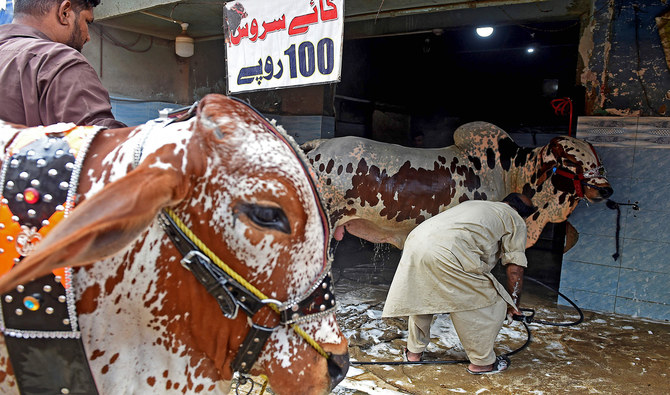
In this picture taken on July 27, 2020, Sheikh Sagheer, right, washes a cow for a customer at his car service station ahead of the Muslim festival Eid al-Adha or the 'Festival of Sacrifice', in the Pakistan's port city of Karachi. (AFP)
Short Url
Updated 30 July 2020
Follow

Proper disposal of animal remains during Eid vital for flight safety — Pakistani officials

  • Authorities say fear of bird strikes increases during Eid al-Adha since cities are usually not cleaned after the festivity
  • The Pakistan Air Force and Civil Aviation Authority have launched separate awareness campaigns to address the issue

LAHORE: The Pakistan Air Force on Thursday issued a public service message to emphasize the importance of safe disposal of animal offal and remains ahead of Eid al-Adha, saying the carcasses and remains of sacrificial animals could be hazardous for its aircrafts and aircrew since they attracted large number of birds. 

The issue was also raised by the country’s aviation industry officials who pointed out that most airports in Pakistan were surrounded by densely populated neighborhoods, adding that it posed a serious threat to flight operations during Eid al-Adha when people sacrificed animals and casually threw away their remains. 

“Lahore, Peshawar and Karachi airports are extremely vulnerable in this sense,” said Abdul Sattar Khokhar, senior joint-secretary at the Civil Aviation Division, on Thursday. “Eid al-Adha increases the danger further since many vicinities in our cities are not properly cleaned even after the festivity.” 

According to aviation experts, bird strikes are regular occurrences around the world, though the number of such incidents can be greater in countries like Pakistan. 

“Heavily populated areas around airports can be a big threat to airliners,” Abdullah Hafeez, a Pakistan International Airlines spokesperson, told Arab News. “According to the available data, 71 aircrafts were hit by birds last year. In the first seven months of 2020, there have been 22 such incidents. In fact, 10 bird strikes were recorded only in the month of July.” 

“Such incidents can cost us a lot,” he continued. “Even if a bird strikes does not cause damage, the aircraft still undergoes a complete examination that sometimes results in flight delays and mount operational expenses. It is the responsibility of the Civil Aviation Authority to take preventive measures to control such incidents.” 

According to ornithologists, pieces of flesh and fats attract big birds. 

“Vultures and crows like to eat flesh and fats. During the Eid, such stuff is usually available more than the routine days. Another reason why we see so many birds around airports is light since they also eat flying insects,” Anam Malik, a Zoology professor, told Arab News. 

Meanwhile, the Civil Aviation Authority maintained it was taking corrective measures to prevent bird-strike incidents. 

"The CAA has started a countrywide campaign to curb such occurrences. The purpose of the campaign is to educate people that they should not spread filth near airports since that can be extremely dangerous,” Khokhar told Arab News. 

He also added that the authorities had hired shooters near the airports in Lahore and Karachi to hunt these birds.

They also fire crackers while an aircraft takes off or lands to prevent an accident.


Pakistani stocks lose over 6,000 points due to heavy selling, regional tensions 

Updated 4 sec ago
Follow

Pakistani stocks lose over 6,000 points due to heavy selling, regional tensions 

  • KSE-100 index fell 6042.26 points or by 3.21 percent to close at 182,338.12 points, Pakistan Stock Exchange data states
  • Analysts say heavy selling triggered by Fauji Fertilizer Company’s earnings announcement, which fell short of expectations

KARACHI/ISLAMABAD: The Pakistan Stock Exchange (PSX) saw a massive drop of over 6,000 points on Thursday, which financial analysts attributed to heavy selling in the market and geopolitical tensions between Iran and the US. 

The KSE-100 index fell by 6042.26 points or 3.21 percent to close at 182,338.12 on Thursday evening, the PSX data showed, down from the previous close of 188,380.38 points.

The development took place as US President Donald Trump warned Iran this week that “time is running out” for the nation to negotiate a deal on its nuclear program, following the steady build-up of US military forces in the Gulf.

Meanwhile, Pakistani brokerage firm Topline Securities said equities witnessed a sharp sell-off in the stock market on Thursday, causing Pakistani stocks to plunge into a “severe downturn.”

“The steep decline was largely driven by Fauji Fertilizer Company’s (FFC) earnings announcement, which fell short of market expectations due to weaker-than-anticipated gross margins,” Topline Security’s Senior Equity Trader Naveed Nadeem said. 

Nadeem noted that the FFC, United Bank Limited (UBL), Engro Corporation (ENGROH), Oil & Gas Development Company (OGDC), and Hub Power Company (HUBC) collectively shaved 3,155 points off the benchmark index during the session.

Najeed Warsi, chief business officer at Al Habib Capital Markets, agreed. 

 “FFC’s [Fauji Fertilizer Company] below-expectation results didn’t help, triggering a sell-off,” he added. 

Ahsan Mehanti, CEO of Arif Habib Commodities, said geopolitical tensions between Washington and Tehran triggered the selling activity as well as the central bank’s recent decision to keep policy rate unchanged.

“Geopolitical uncertainty and SBP [State Bank of Pakistan] status quo in the policy rates projecting high inflation played a catalyst role in selling activity at PSX,” he said. 

Pakistan’s central bank held its key policy rate unchanged ​at 10.50 percent on Monday, defying market expectations for further easing.