12 killed in Philippine army clash with Daesh-linked group

1 / 2
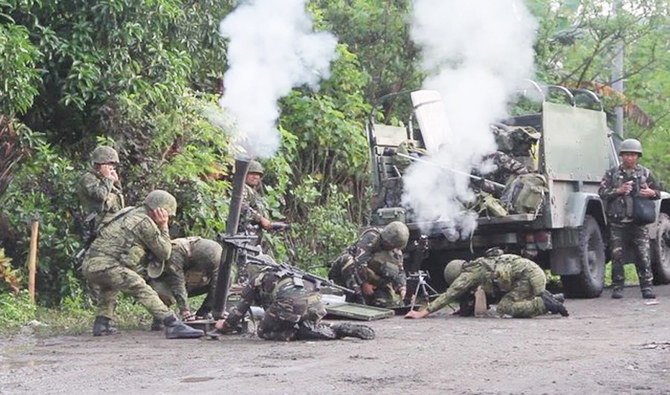
The Philippine Army confirmed new fighting between government troops and the Bangsamoro Islamic Freedom Fighters (BIFF) broke out. (AN file photo)
2 / 2
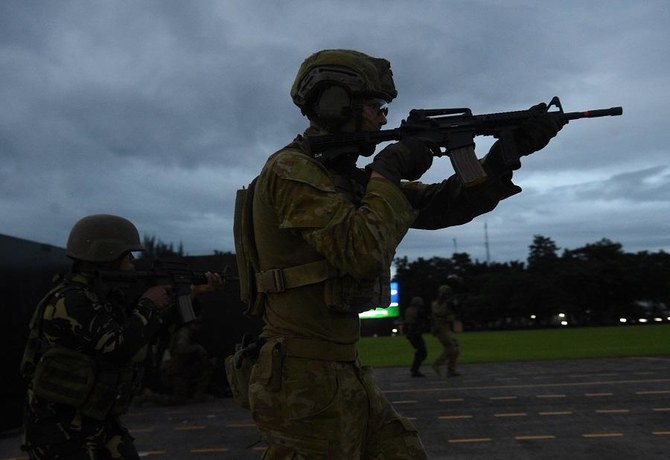
Separately, Philippine troops have been fighting one of the world’s longest communist insurgencies. (File/AFP)
Short Url
Updated 31 July 2020
Follow

12 killed in Philippine army clash with Daesh-linked group

  • An army infantry force raided a remote camp belonging to the Dawlah Islamiyah on Wednesday near Datu Salibo town in Maguindanao province
  • Two soldiers were killed and 13 others were slightly wounded in the clash

MANILA: New fighting between government forces and the Daesh-inspired Bangsamoro Islamic Freedom Fighters (BIFF) broke out in the southern Philippines on Wednesday, killing two soldiers and 10 members of the militant group.

Lt. Col. Dingdong Atilano, spokesman for the Philippine Army’s 6th Infantry Division, confirmed that the firefight, which lasted about six hours, broke out around 5:30 a.m. on Wednesday. He said that soldiers from the army’s 57th Infantry Battalion were in the village of Penditen to verify reports on the presence of BIFF members in the area. The village is located in the municipality of Datu Salibo, in the province of Maguindanao.

“Our troops were conducting law enforcement operations in the area. The target of their operation were members of the Daulah Islamiyah led by Hassan Indal, and they were actually able to get near the target,” Atilano said.

While the operation was ongoing, he added, a large group of BIFF gunmen of the Karialan faction arrived to reinforce Indal and, owing to the terrain, the army troops were at a disadvantaged position.

The official said that the soldiers were just about 20 meters away from Indal when the fight broke out.

“At the first burst of gunfire, our men managed to kill four from the enemy and six more (later), as the fighting lasted until around 11:30 a.m.,” he said. “Based on the accounts of civilians in the village, they saw at least 10 dead from the enemy.”

Two soldiers were killed, and 13 were wounded during the encounter. The injured are in stable condition, Atilano added, explaining that the troops had to immediately leave the area as more BIFF members were arriving with backup.

On Tuesday, eight BIFF members of the Karialan faction surrendered to the 57th Infantry Battalion. The militants came from Datu Saudi Ampatuan, in Maguindanao, and brought along with them three M16 rifles, one M14 rifle, one carbine, two caliber-30 Garand rifles, two rocket propelled grenade launchers, one caliber 7.62 Mauser rifle, and one M79 grenade launcher.

Lt. Col. Jonathan Pondanera, commanding officer of the 57th Infantry Battalion, said the militants renounced their BIFF membership because they wanted to live peaceful lives with their families. Each of them received cash aid amounting to 200,000 pesos ($4,000) from the local government of Datu Saudi Ampatuan.

BIFF was originally led by Ameril Umbra Kato, who bolted out from the Moro Islamic Liberation Front. After Kato’s death in 2015, the BIFF splintered into three factions led by Karialan, Bongos, and Toraife.


Coast Guard is pursuing another tanker helping Venezuela skirt sanctions, US official says

Updated 4 sec ago
Follow

Coast Guard is pursuing another tanker helping Venezuela skirt sanctions, US official says

  • US oil companies dominated Venezuela’s petroleum industry until the country’s leaders moved to nationalize the sector, first in the 1970s and again in the 21st century under Maduro and his predecessor, Hugo Chávez

WEST PALM BEACH, Florida: The US Coast Guard on Sunday was pursuing another sanctioned oil tanker in the Caribbean Sea as the Trump administration appeared to be intensifying its targeting of such vessels connected to the Venezuelan government.
The pursuit of the tanker, which was confirmed by a US official briefed on the operation, comes after the US administration announced Saturday it had seized a tanker for the second time in less than two weeks.
The official, who was not authorized to comment publicly about the ongoing operation and spoke on the condition of anonymity, said Sunday’s pursuit involved “a sanctioned dark fleet vessel that is part of Venezuela’s illegal sanctions evasion.”
The official said the vessel was flying a false flag and under a judicial seizure order.
The Pentagon and Department of Homeland Security, which oversees the US Coast Guard, deferred questions about the operation to the White House, which did not offer comment on the operation.
Saturday’s predawn seizure of a Panama-flagged vessel called Centuries targeted what the White House described as a “falsely flagged vessel operating as part of the Venezuelan shadow fleet to traffic stolen oil.”
The Coast Guard, with assistance from the Navy, seized a sanctioned tanker called Skipper on Dec. 10, another part of the shadow fleet of tankers that the US says operates on the fringes of the law to move sanctioned cargo. It was not even flying a nation’s flag when it was seized by the Coast Guard.
President Donald Trump, after that first seizure, said that the US would carry out a “blockade” of Venezuela. It all comes as Trump has ratcheted up his rhetoric toward Venezuelan President Nicolás Maduro.
This past week Trump demanded that Venezuela return assets that it seized from US oil companies years ago, justifying anew his announcement of a “blockade” against oil tankers traveling to or from the South American country that face American sanctions.
Trump cited the lost US investments in Venezuela when asked about his newest tactic in a pressure campaign against Maduro, suggesting the Republican administration’s moves are at least somewhat motivated by disputes over oil investments, along with accusations of drug trafficking. Some sanctioned tankers already are diverting away from Venezuela.
US oil companies dominated Venezuela’s petroleum industry until the country’s leaders moved to nationalize the sector, first in the 1970s and again in the 21st century under Maduro and his predecessor, Hugo Chávez. Compensation offered by Venezuela was deemed insufficient, and in 2014, an international arbitration panel ordered the country’s socialist government to pay $1.6 billion to ExxonMobil.
Maduro said in a message Sunday on Telegram that Venezuela has spent months “denouncing, challenging and defeating a campaign of aggression that goes from psychological terrorism to corsairs attacking oil tankers.”
He added: “We are ready to accelerate the pace of our deep revolution!”
Sen. Rand Paul, R-Kentucky, who has been critical of Trump’s Venezuela policy, called the tanker seizures a “provocation and a prelude to war.”
“Look, at any point in time, there are 20, 30 governments around the world that we don’t like that are either socialist or communist or have human rights violations,” Paul said on ABC’s’ “This Week.” ”But it isn’t the job of the American soldier to be the policeman of the world.”
The targeting of tankers comes as Trump has ordered the Defense Department to carry out a series of attacks on vessels in the Caribbean and eastern Pacific Ocean that his administration alleges are smuggling fentanyl and other illegal drugs into the United States and beyond.
At least 104 people have been killed in 28 known strikes since early September. The strikes have faced scrutiny from US lawmakers and human rights activists, who say the administration has offered scant evidence that its targets are indeed drug smugglers and that the fatal strikes amount to extrajudicial killings.
Trump has repeatedly said Maduro’s days in power are numbered. White House chief of staff Susie Wiles said in an interview with Vanity Fair published last week that Trump “wants to keep on blowing boats up until Maduro cries uncle.”
Sen. Tim Kaine, D-Virginia, told NBC’s “Meet the Press” on Sunday that Trump’s use of military to mount pressure on Maduro runs contrary to Trump’s pledge to keep the United States out of unnecessary wars.
Democrats have been pressing Trump to seek congressional authorization for the military action in the Caribbean.
“We should be using sanctions and other tools at our disposal to punish this dictator who is violating the human rights of his civilians and has run the Venezuelan economy into the ground,” Kaine said. “But I’ll tell you, we should not be waging war against Venezuela. We definitely should not be waging war without a vote of Congress.