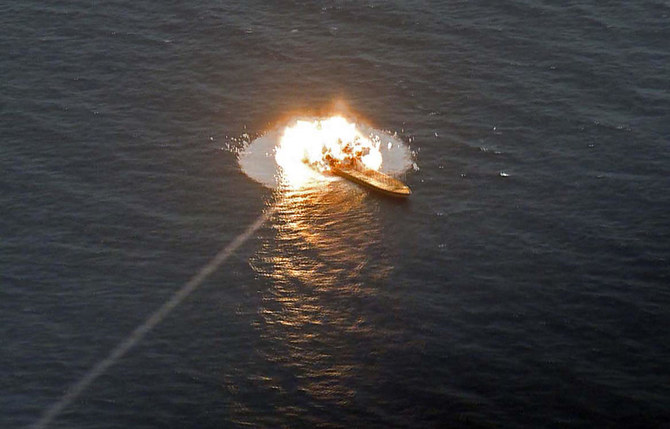
TEHRAN, Iran: Iran’s paramilitary Revolutionary Guard launched underground ballistic missiles as part of an exercise involving a fake aircraft carrier in the Strait of Hormuz, state television reported Wednesday, the latest barrage in a drill that saw two American bases temporarily go on alert over the launches.
Drones separately targeted the bridge of the fake aircraft carrier, according to the state TV report. The TV did not immediately air footage of the launches or the drone attack, nor did it identify the missiles used in the drill.
However, the message of the drill was clearly targeted at the United States.
A semiofficial news agency close to the Guard published a graphic overnight that photoshopped the image of an American carrier into the shape of a casket, with a caption quoting Supreme Leader Ayatollah Ali Khamenei pledging to seek revenge for the US drone strike that killed a top Iranian general in January.
The drill — and the American response to it — underlined the lingering threat of military conflict between Iran and the US after a series of escalating incidents last year led to the January drone strike. Tehran responded to that strike by firing ballistic missiles that wounded dozens of American forces in Iraq.
While the coronavirus pandemic has engulfed both Iran and the US for months, there has been a growing confrontation as America argues to extend a yearslong UN weapons embargo on Tehran that is due to expire in October. A recent incident over Syria involving an American jet fighter approaching an Iranian passenger plane also has renewed tensions.
Iranian commandos fast-roped down from a helicopter onto the replica in the footage aired Tuesday from the exercise called “Great Prophet 14.” Anti-aircraft guns opened fire on a target drone near the port city of Bandar Abbas.
State television footage also showed a variety of missiles being fired from fast boats, trucks, mobile launchers and a helicopter, some targeting the fake carrier. A commander said the Guard, a force answerable only to Khamenei, planned to fire “long-range ballistic missiles” as well during the drill that continued Wednesday.
Ballistic missile fire detected from the drill resulted in American troops being put on alert at Al-Dhafra Air Base in Abu Dhabi in the United Arab Emirates and Al-Udeid Air Base, the forward headquarters of the US military’s Central Command in Qatar, the military said. Troops sought cover during that time.
“The incident lasted for a matter of minutes and an all clear was declared after the threat ... had passed,” said US Army Maj. Beth Riordan, a Central Command spokeswoman.
Both bases are hundreds of kilometers (miles) away from where Iran put the replica aircraft carrier.
Al-Dhafra also is temporarily home to five French-built Rafale fighter jets on their way to India for that country’s air force.
Other footage from the exercise aired by Iran’s state television showed fast boats encircling the mock-up carrier, kicking up white waves in their wake. While Iran’s naval forces are dwarfed by the US Navy, its commanders practice so-called “swarm” tactics aimed at overwhelming the US carriers that pass through the strait on their way in and out of the Arabian Gulf.
It wasn’t immediately clear if all the footage was from Tuesday, as one overhead surveillance image that appeared to be shot by a drone bore Monday’s date. The exercise had been expected as satellite photos released Monday showed the fake carrier being moved into place by a tugboat.
A black-and-white satellite photo taken Tuesday by Colorado-based firm Maxar Technologies showed damage to the replica’s bow and several of its fake jet fighters.

Iran launches underground ballistic missiles during exercise
https://arab.news/5bvuy
Iran launches underground ballistic missiles during exercise
- Drones separately targeted the bridge of a fake aircraft carrier, according to the state TV report
- Two US bases were placed temporarily on alert during the exercise
Sudan defense minister dismisses ‘intelligence document’ as fabrication after convoy strike
- Gen. Hassan Kabroun tells Arab News claims that army hid weapons in aid convoy are “completely false”
RIYADH: Sudan’s defense minister has firmly denied reports attributed to Sudanese intelligence alleging that a convoy targeted in North Kordofan was secretly transporting weapons under the cover of humanitarian aid.
Gen. Hassan Kabroun described the claims as “false” and an attempt to distract from what he called a militia crime.
The controversy erupted after news reports emerged that a document attributed to Sudan’s General Intelligence Service claimed the convoy struck in Al-Rahad on Friday was not a purely humanitarian mission, but was instead carrying “high-quality weapons and ammunition” destined for Sudanese Armed Forces units operating in the state.
The report further alleged that the convoy had been outwardly classified as humanitarian in order to secure safe passage through conflict zones, and that the Rapid Support Forces had destroyed it after gathering intelligence on its route and cargo.
Kabroun categorically rejected the narrative.
“First of all, we would like to stress the fact that this news is false,” he told Arab News. “Even the headline that talks about the security of the regions, such as Al-Dabbah, is not a headline the army would use.”
He described the document as fabricated and politically motivated, saying it was designed to “cover up the heinous crime they committed.”
The minister affirmed that the area targeted by drones is under full control of the Sudanese Armed Forces and does not require any covert military transport.
“Second, we confirm that the region that was targeted by drones is controlled by the army and very safe,” Kabroun said. “It does not require transporting any military equipment using aid convoys as decoys because it is a safe area controlled by the army, which has significant capabilities to transport humanitarian aid.”
According to the minister, the Sudanese military has both the logistical capacity and secure routes necessary to move equipment openly when needed.
“The army is professional and does not need to deliver anything to Kadugli or Dalang on board aid convoys,” he said. “The road between Dalang and Kadugli is open. The Sudanese forces used that road to enter and take control of the region. The road is open and whenever military trucks need to deliver anything, they can do so without resorting to any form of camouflage.”
Kabroun further rejected any suggestion that the military uses humanitarian operations as cover.
“Aid is transported by dedicated relief vehicles to the areas in need of this assistance,” he said. “Aid is not transported by the army. The army and security apparatus do not interfere with relief efforts at all, and do not even accompany the convoys.”
He stressed that the Sudanese Armed Forces maintains a clear institutional separation between military operations and humanitarian work, particularly amid the country’s crisis.
“These are false claims,” he said. “This fake news wanted to cover up the heinous crime they committed.”
Sudan has been gripped by conflict since April 2023, when fighting broke out between the Sudanese Armed Forces and the Rapid Support Forces, plunging the country into what the United Nations has described as one of the world’s worst humanitarian disasters.
The latest dispute over the convoy comes amid intensified fighting in South Kordofan, a strategically sensitive region linking central Sudan with the contested areas of Darfur and Blue Nile.
The false report suggested that intelligence monitoring had enabled the RSF to strike what it described as a military convoy disguised as humanitarian aid. But Kabroun dismissed that version outright.
“The intelligence agency is well aware of its duties,” he said. “The Sudanese Army has enough weapons and equipment to use in the areas of operations. These claims are completely false.”
He argued that the narrative being circulated seeks to shift blame for attacks on civilian infrastructure and humanitarian movements.
“This shows that they are trying to cover up the atrocities,” he added, referring to the militia.
Kabroun maintained that the army has regained momentum on multiple fronts and remains fully capable of sustaining its operations without resorting to deception.
“The region is secure, the roads are open, and the army does not need camouflage,” he said. “We are operating professionally and transparently.”
“These claims are completely false,” Kabroun said. “The Sudanese Army does not use humanitarian convoys for military purposes.”


