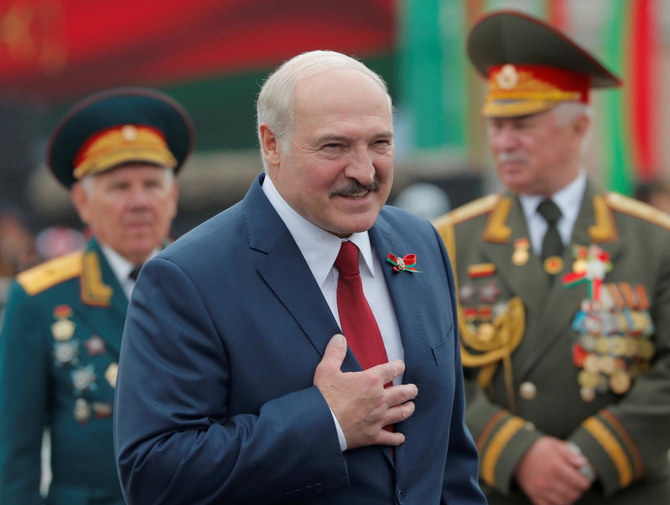
MINSK: Belarusian President Alexander Lukashenko said on Tuesday he caught the coronavirus and recovered “on his feet” without showing any symptoms, sounding a defiant tone as he addressed military leaders in Minsk.
Lukashenko, 65, has resisted calls for strict lockdown measures to contain the pandemic, dismissing fears about COVID-19 as a “psychosis” and suggesting remedies such as drinking vodka, taking saunas and playing ice hockey.
Public frustration over his handling of the pandemic has fueled the biggest protests in years against his rule ahead of a presidential election on Aug. 9. He has jailed two of his main electoral rivals in a widening crackdown on dissent.
“Today you are meeting a man who managed to survive the coronavirus on his feet. This is what doctors concluded yesterday. Asymptomatic,” Lukashenko said.
“As I said, 97% of our population carry this infection asymptomatically,” he added. He did not give a source for that figure.
Belarus, with a population of 9.5 million, has registered 67,366 coronavirus infections with 543 deaths.
Lukashenko did not say when or how he might have contracted the virus. He met Russian President Vladimir Putin at a military parade in Moscow last month. Putin was fine, TASS news agency quoted Kremlin spokesman Dmitry Peskov as saying.
Lukashenko, a former Soviet collective farm boss, said in April that no one would die from the coronavirus in Belarus, and that any deaths would be a result of underlying conditions, such as heart disease or diabetes.
In stark contrast to other European countries, Belarus kept its borders open and even allowed soccer matches in the national league to be played in front of spectators.
His attitude sharpened discontent against the president, whose iron-fisted rule since 1994 saw him dubbed “Europe’s last dictator” by Washington.
Lukashenko was speaking on Tuesday at a military base, after overseeing televised drills by special police who fired tear gas and used a water cannon in a practice crackdown on street protests. Lukashenko urged police to be tough.
“Under no circumstances should you create provocations,” he instructed the riot police chief. “But you also should not allow (the protesters) to insult the guys.”
Lukashenko has made several such visits to military units and the army staged exercises with tanks last weekend on the streets of Minsk.
Political analyst Alexander Klaskovsky said Lukashenko’s campaign was taking place in an atmosphere of “repression and intimidation.”
“The authorities hope that the display of muscle and threats will keep people from going out into the streets,” he said.
Human rights groups say more than 1,100 people have been detained in recent weeks. Protesters have rallied behind Svetlana Tikhanouskaya, the wife of one of the jailed candidates, who is campaigning in her husband’s place.
On Tuesday, several journalists were briefly arrested outside the state security service (KGB) headquarters, taken to a local police station and then released.
Lukashenko has compared the opposition to criminal gangs and accuses protesters of wanting to stage a violent revolution with the help of foreign backers.


Belarus president says he survived coronavirus ‘on his feet’
https://arab.news/5guse
Belarus president says he survived coronavirus ‘on his feet’

- Lukashenko, 65, has resisted calls for strict lockdown measures to contain the pandemic, dismissing fears about COVID-19 as a “psychosis”
- Public frustration over his handling of the pandemic has fueled the biggest protests in years against his rule ahead of a presidential election on Aug. 9


Rubio says technical talks with Denmark, Greenland officials over Arctic security have begun
- US Secretary of State on Wednesday appeared eager to downplay Trump’s rift with Europe over Greenland
WASHINGTON: Technical talks between the US, Denmark and Greenland over hatching an Arctic security deal are now underway, Secretary of State Marco Rubio said on Wednesday.
The foreign ministers of Denmark and Greenland agreed to create a working group aimed at addressing differences with the US during a Washington meeting earlier this month with Vice President JD Vance and Rubio.
The group was created after President Donald Trump’s repeated calls for the US to take over Greenland, a Danish territory, in the name of countering threats from Russia and China — calls that Greenland, Denmark and European allies forcefully rejected.
“It begins today and it will be a regular process,” Rubio said of the working group, as he testified before the Senate Foreign Relations Committee. “We’re going to try to do it in a way that isn’t like a media circus every time these conversations happen, because we think that creates more flexibility on both sides to arrive at a positive outcome.”
The Danish Foreign Ministry said Wednesday’s talks focused on “how we can address US concerns about security in the Arctic while respecting the red lines of the Kingdom.” Red lines refers to the sovereignty of Greenland.
Trump’s renewed threats in recent weeks to annex Greenland, which is a semiautonomous territory of a NATO ally, has roiled US-European relations.
Trump this month announced he would slap new tariffs on Denmark and seven other European countries that opposed his takeover calls, only to abruptly drop his threats after a “framework” for a deal over access to the mineral-rich island was reached, with NATO Secretary-General Mark Rutte’s help. Few details of the agreement have emerged.
After stiff pushback from European allies to his Greenland rhetoric, Trump also announced at the World Economic Forum in Davos, Switzerland, last week that he would take off the table the possibility of using American military force to acquire Greenland.
The president backed off his tariff threats and softened his language after Wall Street suffered its biggest losses in months over concerns that Trump’s Greenland ambitions could spur a trade war and fundamentally rupture NATO, a 32-member transatlantic military alliance that’s been a linchpin of post-World War II security.
Rubio on Wednesday appeared eager to downplay Trump’s rift with Europe over Greenland.
“We’ve got a little bit of work to do, but I think we’re going to wind up in a good place, and I think you’ll hear the same from our colleagues in Europe very shortly,” Rubio said.
Rubio during Wednesday’s hearing also had a pointed exchange with Sen. Tim Kaine, D-Virginia, about Trump repeatedly referring to Greenland as Iceland while at Davos.
“Yeah, he meant to say Greenland, but I think we’re all familiar with presidents that have verbal stumbles,” Rubio said in responding to Kaine’s questions about Trump’s flub — taking a veiled dig at former President Joe Biden. “We’ve had presidents like that before. Some made a lot more than this one.”


