

Duterte eyes reinstating death penalty by lethal injection for drug crimes

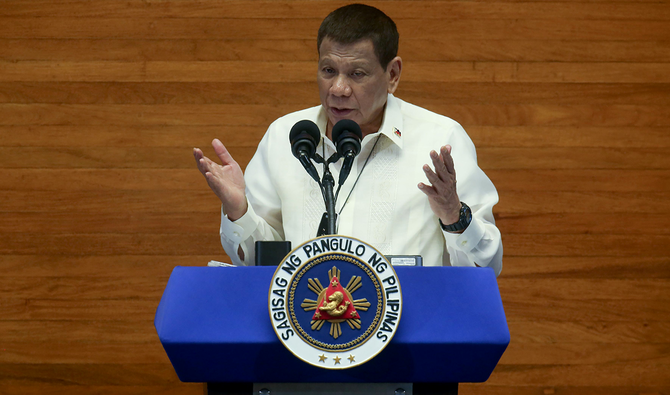
Philippines President Rodrigo Duterte delivering his annual State of the Nation Address in congress in Manila on Monday. (AFP)
Short Url
Updated 28 July 2020
Follow

Duterte eyes reinstating death penalty by lethal injection for drug crimes

  • Philippines’ leader says move will ‘deter criminality’ and save country’s youth

MANILA: Philippines President Rodrigo Duterte on Monday pushed for the revival of the death penalty through lethal injection for drug crimes.

The comments were part of his fifth annual  State of the Nation Address. Duterte urged Congress to pass the bill “to deter criminality in the country.”

“I reiterate the swift passage of a law reviving the death penalty by lethal injection for crimes specified under the Comprehensive Dangerous (Drugs) Act of 2002,” the 75-year-old former mayor of Davao City said, adding that the law would also “save the nation’s youth from the dangers posed by illegal and dangerous drugs.”

However, even as he pushed for the punishment to be brought back, Duterte said that his administration would not dodge its responsibility in fighting for human rights.

“My administration always believed that freedom from illegal drugs, terrorism, corruption, and criminality is itself a human right,” he said.

Since the start of his administration in 2016, Duterte has waged a bloody campaign against drugs that has been widely criticized by local groups and the international community.

In June this year the Philippines once again came under scrutiny when the UN Human Rights Council convened in Geneva.

During the session, UN High Commissioner for Human Rights Michele Bachelet gave the stark findings of her office’s report, which described widespread abuses as a result of Duterte’s war on drugs.

Also at the session, the Philippines Commission on Human Rights denounced the government’s “strong-arm” approach to enforce its brutal “drug war” which has reportedly killed thousands of people.

It led to groups such as Human Rights Watch and Amnesty International highlighting their own findings of serious rights violations in the country.

Philippine authorities say that around 5,600 people have died in Duterte’s drug war, but the country’s human rights commission claims the number could exceed 27,000.

In his address Duterte also gave telecom companies in the country, particularly SMART and GLOBE Telecom, until December to improve their services or “have their properties expropriated.”

“Find a way because if you are not ready to improve, I might just as well close all of you and we revert back to the line telephone and I will expropriate your (properties),” he warned. 

“Kindly improve the services before December. I want to call Jesus Christ in Bethlehem. Better have that line cleared, ” he said.


‘Doomsday Clock’ moves closer to midnight over threats from nukes, climate change, AI

Updated 28 January 2026
Follow

‘Doomsday Clock’ moves closer to midnight over threats from nukes, climate change, AI

  • At the end of the Cold War, the clock was as close as 17 minutes to midnight. In the past few years, to address rapid global changes, the group has changed from counting down the minutes until midnight to counting down the seconds

WASHINGTON: Earth is closer than it’s ever been to destruction as Russia, China, the US and other countries become “increasingly aggressive, adversarial, and nationalistic,” a science-oriented advocacy group said Tuesday as it advanced its “Doomsday Clock” to 85 seconds till midnight.

The Bulletin of the Atomic Scientist members had an initial demonstration on Friday and then announced their results on Tuesday.

The scientists cited risks of nuclear war, climate change, potential misuse of biotechnology and the increasing use of artificial intelligence without adequate controls as it made the annual announcement, which rates how close humanity is from ending.

Last year the clock advanced to 89 seconds to midnight.

Since then, “hard-won global understandings are collapsing, accelerating a winner-takes-all great power competition and undermining the international cooperation” needed to reduce existential risks, the group said.

They worry about the threat of escalating conflicts involving nuclear-armed countries, citing the Russia-Ukraine war, May’s conflict between India and Pakistan and whether Iran is capable of developing nuclear weapons after strikes last summer by the US and Israel.

International trust and cooperation is essential because, “if the world splinters into an us-versus-them, zero-sum approach, it increases the likelihood that we all lose,” said Daniel Holz, chair of the group’s science and security board.

The group also highlighted droughts, heat waves and floods linked to global warming, as well as the failure of nations to adopt meaningful agreements to fight global warming — singling out US President Donald Trump’s efforts to boost fossil fuels and hobble renewable energy production.

Starting in 1947, the advocacy group used a clock to symbolize the potential and even likelihood of people doing something to end humanity. 

At the end of the Cold War, it was as close as 17 minutes to midnight. In the past few years, to address rapid global changes, the group has changed from counting down the minutes until midnight to counting down the seconds.

The group said the clock could be turned back if leaders and nations worked together to address existential risks.