

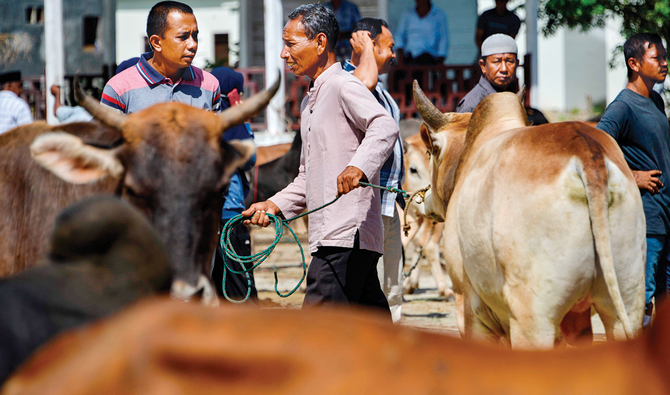

JAKARTA: A few weeks before Eid Al-Adha is usually a busy time for Dudi Rustandi, an employee of a private information technology firm based in Indonesia’s capital city of Jakarta.
For the past 20 years, Rustandi has volunteered at his local mosque in South Tangerang, south of Jakarta, to organize the Qurbani, or annual sacrifice ritual, held on the holiday to mark the end of the Hajj season.
With fellow members of the mosque’s management board, Rustandi coordinates a Qurbani-saving program, by which a household can save between Rp200,000 ($13.7) and Rp500,000 ($34.3) per month.
Ahead of Eid, the board informs each participating household of their savings balance and confirms their choice of animal for the Qurbani. A cow or bull is sold for a price ranging between $1,000 and $15,000, depending on its weight and breed. Later, the board purchases the animals accordingly before slaughtering them at the mosque complex.
“Residents of the complex sacrifice at least five cattle in total during Eid Al-Adha every year,” Rustandi told Arab News in a phone interview.
However, the outbreak of the coronavirus disease (COVID-19) this year has changed the process for Rustandi, his neighbors, and a majority of Muslims in the country.
Following a quiet celebration of Eid Al-Fitr in May and the cancellation of plans to send a Hajj contingent to Saudi Arabia in June, the Indonesian government has now called on the public to avoid mass gatherings during Eid Al-Adha to limit the spread of the deadly disease.
Rustandi said members of the management board decided to abide by the government’s recommendation, and while three out of 10 members earlier insisted on performing the Qurbani as usual, eventually everyone agreed that the risk involved was far higher than the benefits.
“Anyone can be a carrier of the virus. We cannot guarantee strict physical distancing if we hold the Qurbani at the mosque,” Rustandi said, adding that an insistence on doing so may also propagate fitna (defamation) over an unfounded accusation should anyone involved in the ritual become infected with the virus.
Instead of being performed at the mosque’s complex, the Qurbani will now be held at the Al-Kautsar Mosque, a larger mosque in the area, Rustandi said.
There are concerns, however, that the mosque’s management will be overwhelmed with a sudden increase in Qurbani animals.
Therefore, Rustandi and his colleagues devised an alternative option to hold the Qurbani online by using services provided by various zakat (charity) organizing bodies.
“Personally, I have conducted Qurbani through the online platform since 2017. It’s easy; I just have to transfer a certain amount of money and let the agency do its job,” he said.
Rustandi added that now was not the time to launch into a debate “over the principle of correctness or fiqh in committing the ritual,” before stressing the importance of “working together to reduce the risk of a wider transmission.”
Indonesia continues to see more than 1,000 new COVID-19 cases daily, while the total number of confirmed cases stood at more than 97,286 as of Sunday, the highest in East Asia. As many as 4,714 fatalities have been recorded.
Qurban poses a huge risk for infection as the ritual attracts crowds in the thousands in the country with the world’s largest Muslim population.
According to the Indonesian Agriculture Ministry’s 2019 data, there are 30,359 Qurban sites in 26 out of 34 provinces across the country. An average of 56 people work at each location, slaughtering up to 1.87 million cattle, sheep and goats nationwide.
To avoid a spike in infection numbers, the ministry and the government-backed National Zakat Agency (Baznas) have urged Muslims to conduct the Qurban through an online platform this year.
Most zakat organizing institutions, as well as major e-commerce players such as Tokopedia and Bukalapak, are now offering online Qurban services for Indonesian Muslims, based on the official recommendation.
Irvan Nugraha, chief marketing officer of Rumah Zakat, a Bandung, West Java-based zakat institution, told Arab News that there is an increase in demand for the agency’s online Qurban services. Rumah Zakat offers two online Qurban options — SuperQurban and Desaku Berqurban — in addition to the standard Qurban services.
Last year, about 85 percent of Rumah Zakat’s 13,000 clients performed Qurban online, said Nugraha. This year, he said that the agency aimed to serve 25,000 clients. Nearly 9,000 customers have been registered as of July 22. “Around 90 percent of them chose our online services,” he said.
During a webinar hosted by Tokopedia on July 22, EcoQurban CEO Zaenal Arifin said that a majority of Muslims have become more confident in performing the sacrifice through online platforms. This is partially due to improved credibility of organizing agencies as they provide customers with comprehensive reports about the ritual and the meat distribution afterwards, he said.
Arifin said that online Qurban services provide ease for the Muslim community over the ongoing social restrictions amid the COVID-19 outbreak.
As usual, the meat from the slaughtered animals will be distributed to people in need this year, with the addition of those who are affected by the pandemic, Arifin added.


