

UN says thousands of anti-Pakistan militants in Afghanistan

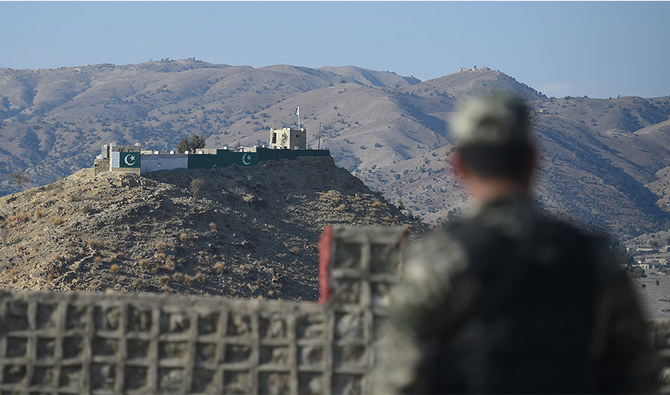
A Pakistani army soldier stands guard at a border terminal in Ghulam Khan in North Waziristan on the Pakistani-Afghan border on Jan. 27, 2019. (AFP/File)
Short Url
Updated 26 July 2020
Follow

UN says thousands of anti-Pakistan militants in Afghanistan

  • Total number of Pakistani militants in Afghanistan is estimated at between 6,000 and 6,500
  • They are linked to Tehreek-e-Taliban Pakistan (TTP), Jamaat-al Ahrar or Lashkar-e-Islam

ISLAMABAD: A UN report says more than 6,000 Pakistani insurgents, most belonging to the outlawed Tehreek-e-Taliban Pakistan (TTP) group attacking Pakistani military and civilian targets, are hiding in Afghanistan.

The report released this week said the organization has linked up with the Afghan-based Daesh (Islamic State) affiliate and some of its members have even joined the group, which has its headquarters in eastern Afghanistan.

The Afghan government did not respond to The Associated Press requests Sunday for comment.

The report said the Daesh in Afghanistan, known as IS in Khorasan province, has been hit hard by the Afghan Security Forces, as well as US and NATO forces and even on occasion by the Taliban. The report was prepared by the UN analytical and sanctions monitoring team, which tracks terrorist groups around the world.

The report estimated the membership of the Islamic State affiliate in Afghanistan at 2,200 and while its leadership has been depleted it still counts among its leaders a Syrian national Abu Said Mohammad Al-Khorasani.

The report also said the monitoring team had received information that two senior Islamic State commanders, Abu Qutaibah and Abu Hajjar Al-Iraqi, had recently arrived in Afghanistan from the Middle East.

“Although in territorial retreat, (the Islamic State) remains capable of carrying out high-profile attacks in various parts of the country, including Kabul. It also aims to attract Taliban fighters who oppose the agreement with the United States,” said the report referring to a US peace deal signed with the Taliban in February.

That deal that was struck to allow the US to end its 19 year involvement in Afghanistan also calls on the Taliban to guarantee its territory will not be used by terrorist groups. The deal is also expected to guarantee Taliban all-out participation in the fight against the Islamic State.

The second and perhaps the most critical part of that agreement calls for talks between the Taliban and Kabul’s political leadership.

Late on Saturday the US State Department issued a statement saying its peace envoy Zalmay Khalilzad was again shuttling through the region seeking to jump start those negotiations which have been repeatedly postponed as both sides squabble over a prisoner release program.

The US-backed deal calls for the Afghan government to release 5,000 Taliban prisoners and the Taliban to free 1,000 government and military personnel as a so-called good will gesture ahead of talks. Until now the government is refusing to release nearly 600 Taliban prisoners it calls high-profile criminals and have offered to free alternatives. The Taliban has refused.

“The parties are closer than ever to the start of intra-Afghan negotiations, the key next step to ending Afghanistan’s 40-year long war,” said the US State Department statement. “Although significant progress has been made on prisoner exchanges, the issue requires additional effort to fully resolve.”

The Taliban’s political spokesman earlier this week said it was ready to hold talks with Kabul’s political leaders after the Islamic holiday of Eid Al-Adha which is at the end of the month, providing the prisoner release is completed.

A big worry for Pakistan is the presence in Afghanistan of militants, particularly linked to the TTP or Jamaat-al Ahrar or Lashkar-e-Islam, as well as those with the Baloch Liberation Army (BLA), which has taken responsibility for high profile attacks this month in the southern Sindh province as well as in southwestern Balochistan Province. Several Pakistan military personnel have been killed this month in southwestern Baluchistan province in battle with insurgents.

The TTP took responsibility for one of the most horrific attacks in Pakistan in 2014 when a Pakistani army school was attacked and 140 were killed. Most were students and some were as young as five.

“The total number of Pakistani foreign terrorist fighters in Afghanistan, posing a threat to both countries, is estimated at between 6,000 and 6,500, most of them with TTP,” the report said.


Islamabad dismisses claims about paying up to 8 percent interest on foreign loans as ‘misleading’

Updated 22 February 2026
Follow

Islamabad dismisses claims about paying up to 8 percent interest on foreign loans as ‘misleading’

  • Pakistan has long relied on external loans to help bridge persistent gaps in public finances and foreign exchange reserves
  • Pakistan’s total external debt, liabilities stand at $138 billion at an overall average cost of around 4 percent, ministry says

KARACHI: Pakistan’s finance ministry on Sunday dismissed as “misleading” claims that the country is paying up to 8 percent interest on external loans, saying the overall average cost of external public debt is approximately 4 percent.

Pakistan has long relied on external loans to help bridge persistent gaps in public finances and foreign exchange reserves, driven largely by a narrow tax base, chronic trade deficits, rising debt-servicing costs and repeated balance-of-payments pressures.

Over the decades, successive governments have turned to multilateral and bilateral lenders, including the International Monetary Fund, the World Bank and the Asian Development Bank, to support budgetary needs and shore up foreign exchange reserves.

The finance ministry on Sunday issued a clarification in response to a “recent press commentary” regarding the country’s external debt position and associated interest payments, and said the figures required contextual explanation to ensure accurate understanding of Pakistan’s external debt profile.

“Pakistan’s total external debt and liabilities currently stand at $138 billion. This figure, however, encompasses a broad range of obligations, including public and publicly guaranteed debt, debt of Public Sector Enterprises (both guaranteed and non-guaranteed), bank borrowings, private-sector external debt, and intercompany liabilities to direct investors. It is therefore important to distinguish this aggregate figure from External Public (Government) Debt, which amounts to approximately $92 billion,” it said.

“Of the total External Public Debt, nearly 75 percent comprises concessional and long-term financing obtained from multilateral institutions (excluding the IMF) and bilateral development partners. Only about 7 percent of this debt consists of commercial loans, while another 7 percent relates to long-term Eurobonds. In light of this composition, the claim that Pakistan is paying interest on external loans ‘up to 8 percent’ is misleading.

The overall average cost of External Public Debt is approximately 4 percent, reflecting the predominantly concessional nature of the borrowing portfolio.”

With respect to interest payments, public external debt interest outflows increased from $1.99 billion in Fiscal Year (FY) 2022 to $3.59 billion in FY2025, representing an increase of 80.4 percent, not 84 percent as reported. In absolute terms, interest payments rose by $1.60 billion over this period, not $1.67 billion, it said.

According to the State Bank of Pakistan’s records, Pakistan’s total debt servicing payments to specific creditors during the period under reference were as follows: the IMF received $1.50 billion, of which $580 million constituted interest; Naya Pakistan Certificates payments totaled $1.56 billion, including $94 million in interest; the Asian Development Bank received $1.54 billion, including $615 million in interest; the World Bank received $1.25 billion, including $419 million in interest; and external commercial loans amounted to nearly $3 billion, of which $327 million represented interest payments.

“While interest payments have increased in absolute terms, this rise cannot be attributed solely to an expansion in the debt stock,” the ministry said. “Although the overall debt stock has increased slightly since FY2022, the additional inflows have primarily originated from concessional multilateral sources and the IMF’s Extended Fund Facility (EFF) under the ongoing IMF-supported program.”

Pakistan secured a $7 billion IMF bailout in Sept. 2024 as part of Prime Minister Shehbaz Sharif’s efforts to stabilize the South Asian economy that narrowly averted a default in 2023. The government has since been making efforts to boost trade and bring in foreign investment to consolidate recovery.

“It is also important to note that the increase in interest payments reflects prevailing global interest rate dynamics. In response to the inflation surge of 2021–22, the US Federal Reserve raised the federal funds rate from 0.75-1.00 percent in May 2022 to 5.25–5.50 percent by July 2023. Although rates have since moderated to around 3.75 percent, they remain significantly higher than 2022 levels,” the finance ministry said.

“The government remains committed to prudent debt management, transparency, and the continued strengthening of Pakistan’s macroeconomic stability,” it added.