


LAHORE: Afghanistan’s government said on Saturday that there remained an opportunity for peace in the war-ravaged country, but that the Taliban needed to shun violence first to engage in direct talks with Kabul.
“There is an opportunity for peace, provided that the Taliban abandon violence and agree to direct negotiations with the Afghan government,” Sediq Seddiqi, chief spokesman for President Ashraf Ghani, told Arab News.
His comments came a day after US Special Representative for Afghanistan Zalmay Khalilzad said that intra-Afghan talks had “never” been as close as they currently were.
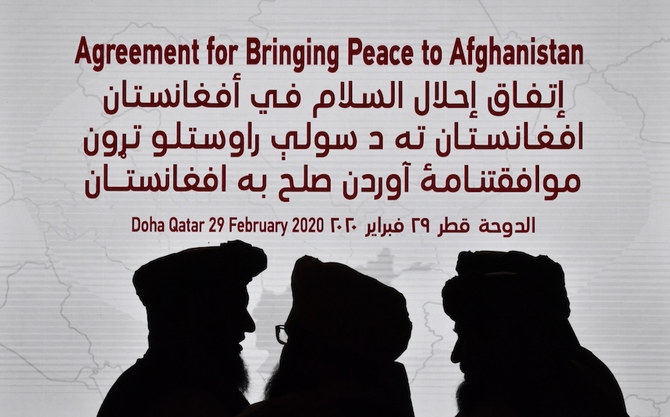
“This is an important moment for Afghanistan and for the region — perhaps a defining moment,” Khalilzad, who struck a historic deal with the Taliban in Doha, Qatar in late February this year, said on Friday while addressing a virtual event organized by the Washington-based US Institute of Peace.
On Thursday, the Taliban announced, for the first time, a timetable for the start of talks with Kabul after delaying them twice due to pre-conditions set by the group and Ghani’s government.
Confirming the reports, Suhail Shaheen, spokesman for the Taliban’s Qatar office, said that the talks could start after Eid Al-Adha, which will be celebrated by Muslims across the world in 10 days, as long as “Kabul freed the remaining Taliban inmates,” the list for which is with the government.
Ghani’s government, which was sidelined from the Qatar talks, has refused to free hundreds of Taliban prisoners, as demanded by the group, considering over 4,000 militants have already been released from Afghan jails in recent months, and said that the Taliban needed to stop committing violence “to show their sincerity” for the talks.
“The release of more than 4,000 Taliban prisoners ... created this opportunity and should be considered a big step and must be reciprocated by the Taliban ceasing violence. The world and the Afghan people want peace and are tired of war,” Seddiqi said.
The Taliban, for their part, freed nearly 1,000 government inmates as part of the prisoner exchange program outlined in the Qatar accord which, according to the agreement, should have been completed by the end of March to pave the way for the departure of all foreign troops from Afghanistan by next spring.
However, despite Khalilzad’s optimism that the talks could materialize soon, some Afghan analysts believe the Taliban’s insistence on further releases, and the government’s emphasis on a halt in insurgent activity, could block dialogue.
“Both sides have repeated their past pre-conditions. Unless there is leniency from them, it is tough to be optimistic like Khalilzad has been,” Taj Mohammad, a Kabul-based analyst and a former journalist, told Arab News.
Nasratullah Haqpal, a political analyst for Central and South Asian affairs, agreed, adding that the delay in the start of the intra-Afghan talks was putting pressure on both Khalilzad and US Secretary of State Mike Pompeo who appointed Khalilzad to the role two years ago.
US President Donald Trump, who is standing for re-election in November, is keen to withdraw all US troops from Afghanistan after 19 years of war, despite opposition from several former and current US generals over the move, and from Ghani, who is in his second term of office following last year’s controversial elections.
Haqpal said Khalilzad and some other US diplomats had been “putting pressure on Ghani” to free the remaining Taliban prisoners and engage in talks with the Taliban, while “Ghani was against the peace process … because it endangers his power and presidency.”
With mistrust on all sides and each using the peace process to its advantage, Haqpal said there would be no clarity on the start of the peace talks until the US presidential elections.
“Until then, we will not have any tangible developments,” he told Arab News.
Mohammad said that, instead, there could be further escalation of violence in the coming months as both sides “seek to use the supremacy in the battlefield for their advantage on the negotiations table” when and if the talks start.
There has been a surge in attacks and counter-attacks from the Taliban and Afghan government in recent months, causing hundreds of casualties on both sides with Sediqqi saying earlier this month that the “intensification of violence by the Taliban lately,” which also claimed civilian lives, “damages hopes for the start of the talks and stable peace in the country.”
He did not give an estimate of casualties sustained by government forces. However, official data released last month showed that hundreds of army and police personnel died during Taliban attacks in June.
The Taliban has rejected the claims, with spokesman Zabihullah Mujahid blaming Kabul for several strikes which “led to the fatalities among non-combatants.”


