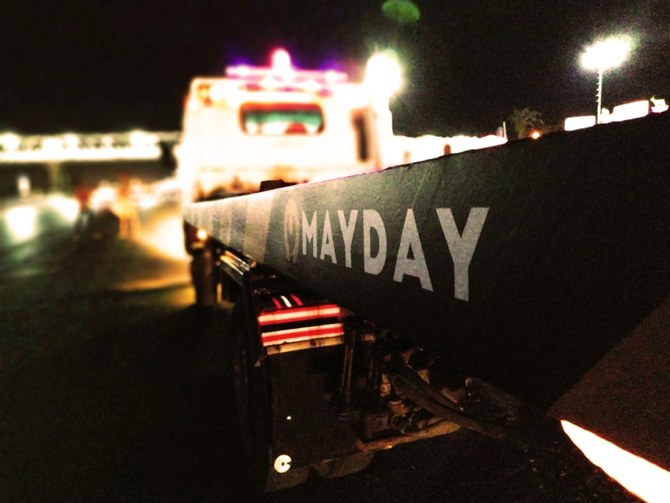
A roadside assistance app cuts through Egypt’s traffic congestion

At a time when people feel the need to be extra safe due to the pandemic, Mayday, a startup by Egyptian entrepreneurs is a much-welcomed solution that is able to solve many car issues on the spot. (Supplied)
Short Url
Updated 24 July 2020
Follow

A roadside assistance app cuts through Egypt’s traffic congestion

  • Cairo’s average waiting time for towing help is about two hours, with the prices variable and inflated
  • Mayday offers roadside assistance to over 30,000 clients through partners like banks and insurance companies

CAIRO: It is estimated that traffic issues in the capital Cairo alone cost Egypt’s economy $7 billion every year. This figure comprises health costs from air pollution; lost productivity due to extra time in traffic; and costs of road injuries and fatalities.

At a time when people feel the need to be extra safe due to the pandemic, Mayday, a startup by Egyptian entrepreneurs Mohamed Aboelfotouh, Islam Ahmed and Amr Essam, is a much-welcomed solution that is able to solve many car issues on the spot.

“We surveyed around 300 people to understand more about the market. People really welcomed the idea of an app to help them if they encountered roadside trouble,” Aboelfotouh, 34, said.

According to the survey, the average waiting time for towing help was around two hours, and the prices were always variable and inflated. People also highlighted safety concerns and the lack of proper customer care for such services.

“We wanted to create a platform in a similar model to ride-hailing apps, with a large network of providers,” Aboelfotouh added.

Mayday faced several roadblocks after its soft launch in November 2018. For starters, the service was available for only eight hours a day. Moreover, the initial subscription-based business model via the app proved unsuccessful as people did not know the company well enough to subscribe.
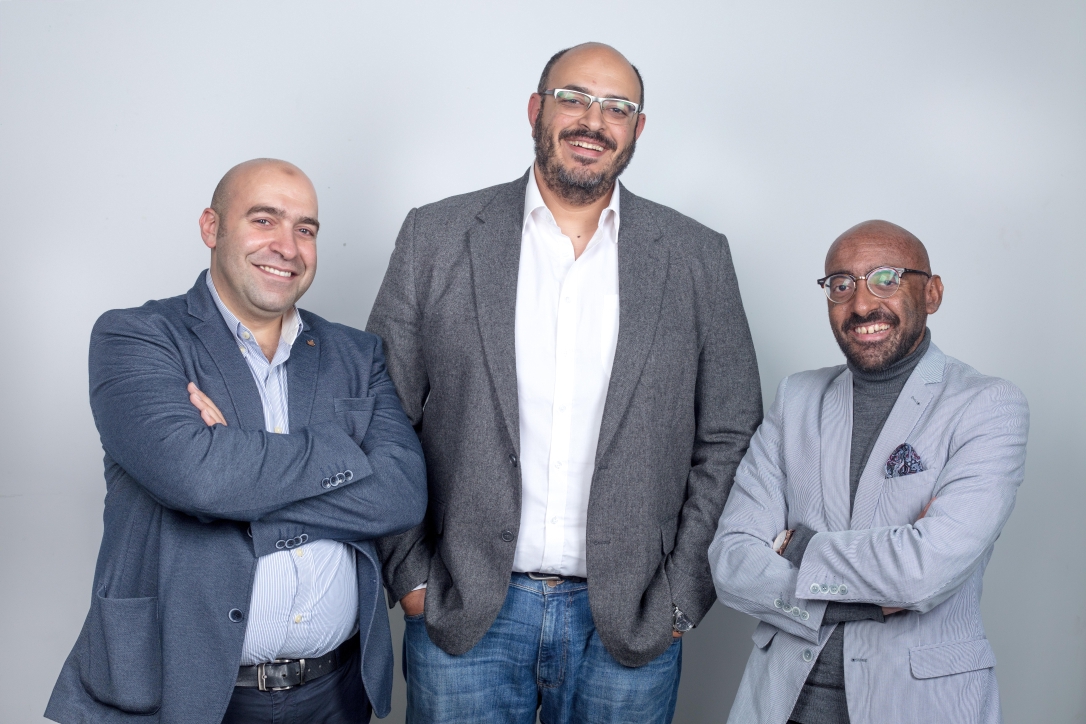


Mayday is a startup by Egyptian entrepreneurs Mohamed Aboelfotouh, Islam Ahmed and Amr Essam. (Supplied)

“We started exploring an on-demand option. So, we added a hotline to streamline the orders we get while keeping the app for subscriptions and businesses,” Aboelfotouh said.

When a person calls in, a Mayday agent responds, liaising between customers and tow truck drivers and then informing the caller of the estimated time of arrival and the service cost.

The hotline gradually became available 24 hours per day, but it was signing one of the country’s biggest ride-hailing companies as a client that pushed the company in the right direction in early 2019 and provided much-needed cash.

Mayday soon struck more deals and currently offers roadside assistance to over 30,000 clients through various business partners, from banks to insurance companies.

The official launch of the app was in January 2019, and Mayday soon expanded beyond servicing Cairo and Giza, currently offering its services across all highways nationwide.

Most of the service providers contracted by Mayday are tracked through GPS, with plans to include the rest soon.

-------

READ MORE: Coronavirus crisis opens new vistas for Middle East’s 3D printing pioneers

-------

“Now, our platform has 1,200 service providers, between tow trucks, cars and motorbikes. If a person just needs a hand changing the tires, we can send a motorbike rider with the necessary tools to help in their backpack,” Aboelfotouh said.

Despite not offering significantly lower prices than independent tow truck operators, Mayday has kept growing in popularity because of its speedy service, quality control and fixed prices with no hidden fees. The company gets a commission from the orders, and its partners get to enjoy a steady flow of work through the company.

One of the main challenges Mayday encountered early on was hiring talented personnel to ensure this level of quality. The founding partners tackled the issue by creating a healthy work environment rather than opting for the grueling conditions imposed by many startups.

Despite not being completely reliant on the app, the company also faced some challenges with technology.

“In 2020, we’re investing in technology. We want our app to have an on-demand option, too. So, we’re releasing a new one in a few months,” Aboelfotouh said.

Mayday will leverage a recent six-figure investment to achieve that goal.

“We have a unique position to present our company as the go-to brand for roadside assistance in the country. One of the main areas where we plan on investing this money is in marketing and raising awareness about our brand and services.”

Commenting on other plans, Aboelfotouh said: “We’re considering adding simple maintenance services, like car checks and quick repairs while people are on the road. We also want to expand within the next few months. We’re currently exploring and meeting suppliers, as well as doing market research. Soon, we will have settled on our next market in a new country.”

-------------

This report is being published by Arab News as a partner of the Middle East Exchange, which was launched by the Mohammed bin Rashid Al-Maktoum Global Initiatives to reflect the vision of the UAE prime minister and ruler of Dubai to explore the possibility of changing the status of the Arab region.


Syrian church marks Christmas and reaffirms faith months after deadly attack

Updated 2 sec ago
Follow

Syrian church marks Christmas and reaffirms faith months after deadly attack

DWEIL’A: At a church in Syria where a suicide attack killed 25 people in June, hundreds of worshippers gathered before Christmas to remember those they lost and reaffirm their faith.
With a small detail of security forces standing guard outside, members of Mar Elias Church held Mass on Tuesday evening and lit an image of Christmas tree made of neon lights on the wall of the courtyard outside. The tree was hung with pictures of those who were killed in the attack.
They include three men the congregation hails as heroes for tackling the bomber, potentially averting a much higher death toll in the June 22 attack.
A man opened fire then detonated an explosive vest inside the Greek Orthodox church in Dweil’a on the outskirts of Damascus as it was filled with people praying on a Sunday.
Before he detonated the vest, brothers Boutros and Gergis Bechara and another congregant, Milad Haddad, tackled the shooter and pushed him out of the center of the church, congregants said.
“If it weren’t for the three of them, maybe not one person would remain out of 400 people,” said Imad Haddad, the brother of Milad Haddad, who attended Tuesday’s Christmas tree lighting.
He hasn’t decorated for Christmas or put up a tree at home, but gathering at the church was “is a message of peace and love” and a message that “we are believers and we are strong and we are steadfast in spite of everything,” he said.
Thana Al-Masoud, the widow of Boutros Bechara, recalled searching frantically for her husband after the explosion but she never found him, alive or dead. His body had been ripped apart by the blast.
“There’s no holiday, neither this year nor next year nor the one after it,” she said.
She takes comfort in the belief that her husband and the two other men who confronted the attacker are martyrs for their faith.
“Our Lord chose them to be saints and to spread His word to all the world,” she said. “But the separation is difficult.”
Attack stoked Christian fears
The attack on the church was the first of its kind in Syria in years and came as a new Sunni Islamist- dominated government in Damascus sought to win the confidence of religious minorities following the ouster of former President Bashar Assad.
Interim President Ahmad Al-Sharaa has struggled to exert authority across the country, even in the ranks of allied groups. There have been several deadly outbreaks of sectarian violence in the country in the past year.
While the new government has condemned attacks on minorities, many accuse it of failing to act to control the armed factions it is trying to absorb into the new state army and security forces.
The June attack was blamed on a Daesh cell, which authorities said had also planned to target a Shiite shrine. IS did not claim responsibility for the attack, while a little-known group called Saraya Ansar Al-Sunna said one of its members had carried out the attack. The government said the group was a cover for IS.
Christians made up about 10 percent of Syria’s population of 23 million before mass anti-government protests in 2011 were met by a brutal government crackdown and spiraled into a brutal 14-year civil war that saw the rise of IS and other extremist groups.
Hundreds of thousands of Christians fled during the war, during which there were sectarian attacks on Christians including the kidnapping of nuns and priests and destruction of churches. Now many are once again seeking to leave.
Solidifying faith and seeking peace
Since losing her husband in the church attack, Juliette Alkashi feels numb.
The couple had been sweethearts before she left Syria with her mother and brother to emigrate to Venezuela. In 2018, when Emile Bechara asked her to marry him, Alkashi moved back to Syria even though it was still in the midst of a civil war.
“Whatever is going to happen will happen, and I’ve surrendered to it,” she said. “If one goes to pray and dies in the church — whatever God has written is what will be.”
The only thing that matters now, Alkashi said, is that she and her 3-year-old son remain together.
Some congregants said the attack only strengthened their faith.
“I saw a column of smoke rising from the ground to the ceiling, and I heard a voice saying, ‘I will not forsake you and I will not leave you,’” said Hadi Kindarji, who described an intense spiritual experience in the moment of the explosion.
He believes today that even the seemingly senseless violence was part of God’s plan.
“Our God is present, and He was present in the church,” he said.
Yohanna Shehadeh, the priest of Mar Elias church, acknowledged many in the congregation are afraid of more deadly violence.
“Fear is a natural state. I’m not going to tell you there is no fear, and I’m not only talking about the Christians but about all the Syrian people, from all sects,” Shehadeh said.
As Christmas approaches, he said, they are praying for peace.