Pakistan ranked 'most improved country' in new Nuclear Security Index

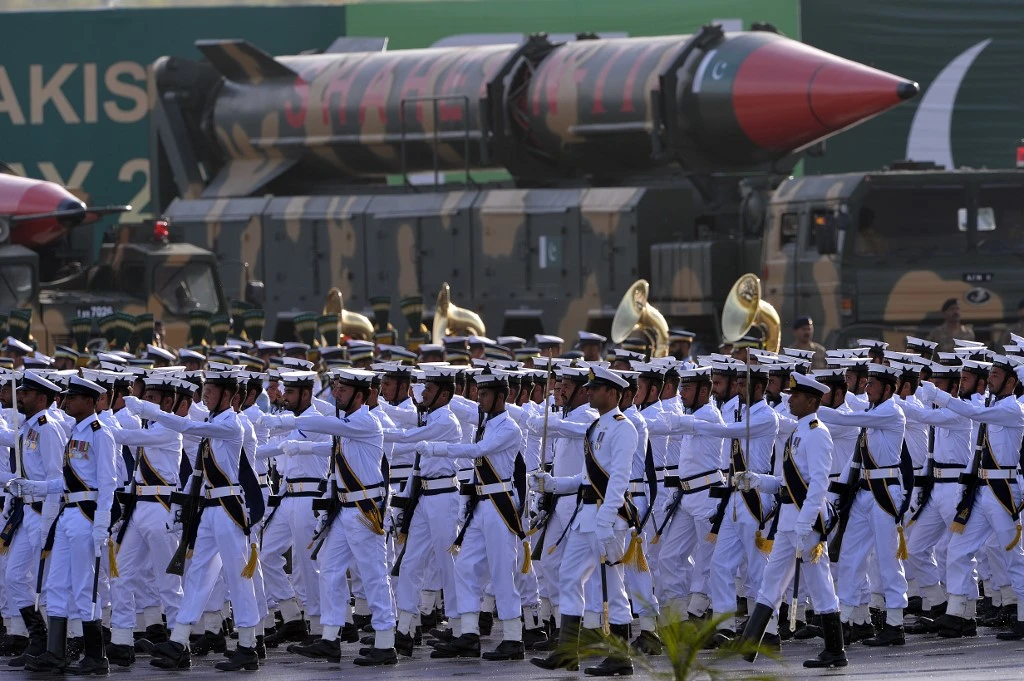
Pakistani Naval soldiers march past long-range ballistic Shaheen III missiles during the Pakistan Day military parade in Islamabad on March 23, 2016. (AFP/File)
Short Url
Updated 23 July 2020
Follow

Pakistan ranked 'most improved country' in new Nuclear Security Index

  • US-based Nuclear Threat Initiative says Pakistan's score improvement second largest improvement for regulations since 2012
  • Pakistan improved overall score through several measures like new on-site physical protection, cybersecurity regulations

ISLAMABAD: The United States-based Nuclear Threat Initiative (NTI) has ranked Pakistan as the “most improved among countries with materials” in its Nuclear Security Index 2020 report published on Wednesday.
Pakistan began a program to obtain nuclear weapons after a war with arch-rival and neighboring India in 1971. It tested nuclear weapons in May 1998, shortly after India announced it had done so.
“Most improved among countries with materials in 2020 is Pakistan, which improved its overall score by adopting new on-site physical protection and cybersecurity regulations, improving insider threat protection measures, and more,” the NTI index said. 
Pakistan had improved its overall score, the index report said, by adopting "new on-site physical protection and cybersecurity regulations, improving insider threat protection measures, and more."
“Pakistan’s score improvement for regulatory measures is the second largest improvement for regulations in the Index since 2012,” the report said. 
Pakistan and India both faced international sanctions as a result of conducting nuclear tests in 1998, although India has since won effective recognition as a nuclear power following an accord negotiated with the United States.
In February this year, at the third International Conference on Nuclear Security (ICONS) organized by the International Atomic Energy Agency (IAEA) in Vienna, Pakistan said it had established a comprehensive and effective national nuclear security regime at par with international standards and guidelines.
“The regime is based on an extensive legislative and regulatory framework governing the security of nuclear materials, radioactive substances, associated facilities and activities,” Pakistan’s foreign ministry had said in a statement.  
Neither India or Pakistan have signed the international Treaty on the Non-Proliferation of Nuclear Weapons, adhered to by most nuclear powers. Consequently, they are not obliged to submit to International Atomic Energy Agency oversight over all of their facilities.
Pakistan opposition to hold protest today over jailed ex-PM Khan’s deteriorating eye condition

Updated 6 sec ago
Follow

Pakistan opposition to hold protest today over jailed ex-PM Khan’s deteriorating eye condition

  • A court-appointed lawyer this week visited Imran Khan at prison and recommended independent ophthalmology review of his right eye
  • Information Minister Attaullah Tarar said Khan party’s narrative has ‘fallen flat on its face’ after ex-PM voiced ‘satisfaction’ with facilities

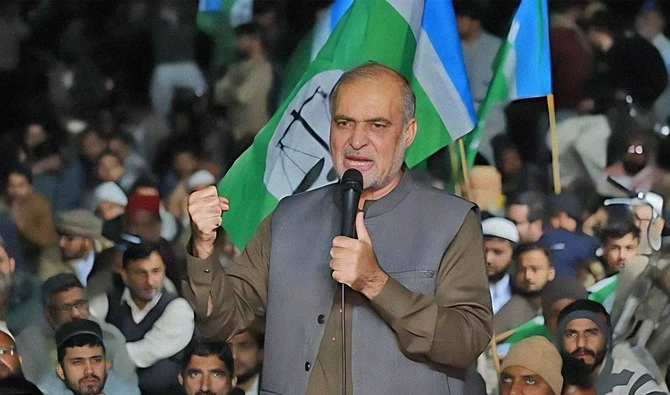
ISLAMABAD: Pakistan’s opposition alliance has announced a sit-in outside the Parliament House in Islamabad today, Friday, over jailed former prime minister Imran Khan’s deteriorating eye condition, following a rare prison visit by a Supreme Court-appointed lawyer this week.

Barrister Salman Safdar, who was appointed ‘amicus curiae,’ or friend of the court, visited Khan at Rawalpindi’s Adiala jail on Feb. 10 and filed a detailed report on his living conditions and health, which was made public on Thursday.

The report stated that in view of the seriousness of Khan’s ocular condition, “it is imperative that the seriousness of the condition be independently ascertained without delay.” There was no immediate response from prison authorities on the findings.

The Tehreek-e-Tahafuz-e-Ayin-e-Pakistan opposition alliance late Thursday demanded that Khan be transferred to Al-Shifa Hospital and announced a sit-in outside parliament until the former prime minister is allowed treatment in the presence of his personal physicians.

“The sit-in will be held tomorrow,” Mahmood Khan Achakzai, the head of the opposition alliance, told reporters in Islamabad, adding that they will peacefully lay down all demands at the sit-in. “If, God forbids, something happens, then the government will be responsible for that.”

Khan, 73, has been in custody since August 2023 in connection with multiple cases that he and his party describe as politically motivated. The government denies the allegation.

Concerns about Khan’s health have resurfaced in recent weeks after authorities confirmed he had been briefly taken from prison to a hospital in Islamabad for an eye procedure. The government said at the time his condition was stable, while Khan’s family and his Pakistan Tehreek-e-Insaf (PTI) political party complained they had not been informed in advance and alleged he was being denied timely and independent medical access.

The issue was then taken up by the Supreme Court earlier this week, which tasked Safdar, who has represented Khan in the past, with visiting the ex-premier and submitting a written report.

According to a medical condition report from the Pakistan Institute of Medical Sciences (PIMS), dated Feb. 6, 2026 and referenced in Safdar’s court filing, Khan was diagnosed with “right central retinal vein occlusion” after reporting reduced vision in his right eye.

The report states that he underwent anti-VEGF intravitreal injection treatment at PIMS and was discharged with follow-up advice.

However, in his interaction with Safdar, Khan said he had experienced “rapid and substantial loss of vision over the preceding three months” and claimed his complaints had not been addressed promptly while in custody. He further stated that despite treatment, he had been left with “only 15 percent vision in his right eye.”

Safdar’s report notes that the former premier appeared “visibly perturbed and deeply distressed by the loss of vision and the absence of timely and specialized medical intervention.” The amicus also recommended that the Supreme Court consider directing involvement of Khan’s personal physicians or other specialists of his choice, warning that “any further delay poses a serious risk to the Petitioner’s well-being.”

Beyond medical concerns, the report addressed Khan’s confinement conditions, noting that he expressed “satisfaction regarding his safety and security within the cell-block,” as well as contentment with basic amenities and food provisions.

Responding to the report, Information Minister Attaullah Tarar rejected claims of mistreatment, saying the “narrative being propagated to international media” by Khan’s family had “fallen flat on its face.”

He said the prison report on Khan’s daily routine and diet had removed any ambiguity and maintained that all facilities were available to the former premier, who he said enjoyed privileges “more than any other prisoner.” His X post did not address the allegations on Khan’s health issues.