

Warriors coach Steve Kerr recounts life in Lebanon with his father, slain AUB president Malcolm Kerr

Steve Kerr, the eight-time NBA champion with the Chicago Bulls and San Antonio Spurs, fondly remembers the influence of his father Malcolm H. Kerr on his life growing up in the Middle East. (AFP/File Photo)
Short Url
Updated 30 July 2020
Follow

Warriors coach Steve Kerr recounts life in Lebanon with his father, slain AUB president Malcolm Kerr

  • Head coach of Golden State Warriors recalls influence of his father who was killed in Beirut in 1984
  • Steve Kerr’s rise in basketball has been featured in ESPN docudrama on the Chicago Bulls and Michael Jordan

CHICAGO: Steve Kerr, the eight-time NBA champion with the Chicago Bulls and San Antonio Spurs, fondly remembers the influence of his father Malcolm H. Kerr on his life while growing up in the Middle East.
In an exclusive interview with Arab News via Zoom, Steve recalled how his father, a political scientist who served as president of the American University of Beirut (AUB) beginning in 1982, helped forge his love for basketball. Malcolm was killed by terrorists on Jan. 18, 1984, at his AUB office.
Now head coach for the Golden State Warriors, Steve lamented that his father never got to see his rise in basketball, which was recently featured in an ESPN docudrama on the Chicago Bulls and his friend and colleague Michael Jordan.
“It was fun to watch with my kids and my wife. It was a good reminder of what our life was like back then, and what an incredibly special team that was, and an era that was to be a part of,” said Steve, who played for the Chicago Bulls from 1993 until 1998, when the team won four of its seven championships.


“Just the experience of playing on that team, playing in Chicago and being part of a team that was so historic was pretty amazing when I really stop and think about it. To just be a part of that was incredible.”
Steve said his love for basketball began when his father took him to his first games. “My first experience with basketball was watching UCLA at Pauley Pavilion. My dad had a couple of Season Tickets, being a professor there,” said Steve, whose father was chairman of UCLA’s political science department specializing in the Middle East and Lebanon at the time.
“I’ll never forget walking into Pauley Pavilion when I was probably 5 or 6 years old. The place was sold out and Bill Walton was on the floor for UCLA. They hadn’t lost for about three years. The place was just going crazy and the band was playing,” Steve added.
“I remember just falling in love with the sport through each play. I couldn’t have been in a better situation as a kid, to be right there in (UCLA head coach) John Wooden’s backyard, and to watch those teams, and to learn about basketball during one of the greatest eras of American sports.”
After his father, who studied with Arab historian Albert Hourani, left UCLA in 1982 to accept the AUB post, Steve attended the University of Arizona, where he began playing basketball.
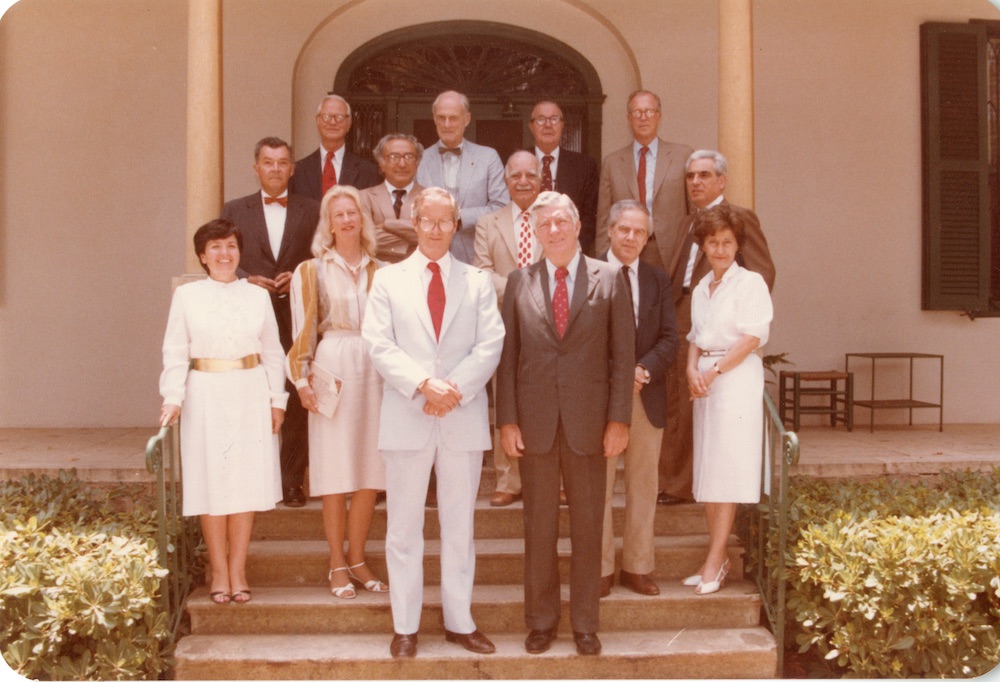


Steve Kerr recalls how his father, a political scientist who served as president of the American University of Beirut (AUB) beginning in 1982, helped forge his love for basketball. (AUB Archives)

“My mom and younger brother Andrew were living with him there on campus. He was killed outside his office coming out of an elevator. He was shot by a gunman. An act of terrorism just devastated our family,” Steve said.
“We forged ahead and everybody in our family has done well. I give my mom amazing credit for how strong she has been, continuing to live her life in a really productive and positive manner. We all miss our dad every day,” he added.
“When you lose a parent at an early age, you think about everything — how much my dad would’ve enjoyed watching me play basketball professionally. It was something we wouldn’t have even dreamt of.
“My dad loved to play basketball. He loved watching me play. We used to play in the driveway together with my older brother John. We’d watch UCLA games together and cheer for UCLA.


“It was an amazing childhood. I think all the time about how nice it would’ve been for us to share our career together and then my family, for him to have been a grandfather for my kids, and my wife to have known him.
“Those are all things that you lament. The loss is so deep and so profound, it affects you in so many ways. You think of all those things when you lose someone at that age.”

-------

READ MORE: How Lebanon saw the 1984 killing of Middle East scholar and AUB President Malcolm Kerr

-------

Steve, who was born in Beirut, attended school in Cairo when his dad taught at the American University there.
“I played (basketball) in Cairo when I was in high school, and I was there for my freshman and sophomore years. I played for the Cairo American College Eagles and we played against all of the Egyptian local teams,” he said.
“Then at the end of each season we’d go to Athens to play against the other American schools in the Mediterranean region. It was an amazing experience to be able to do that at the age of 14 and 15,” he added.


“I remember playing soccer also against the Egyptian kids at our school, and they were running circles around the American kids because that’s what they grew up with. But we grew up with basketball and we had the advantage in basketball. It was fun to play sports … with people and build bridges.
“We didn’t have a gym at the school. They ended up building one a few years after I left. We played all of our games outdoors. The club games on the road in Cairo we played on clay … like a clay tennis court with hoops at each end, and sometimes at night under a string of lightbulbs. You can’t make it up.”

Steve said his life in the Middle East and his father helped define his career as a basketball star and as a coach.
“I just think my dad was a very humble person. He was a brilliant man. He was brilliant in his knowledge of his field, but also in his social awareness and emotional intelligence,” Steve added.
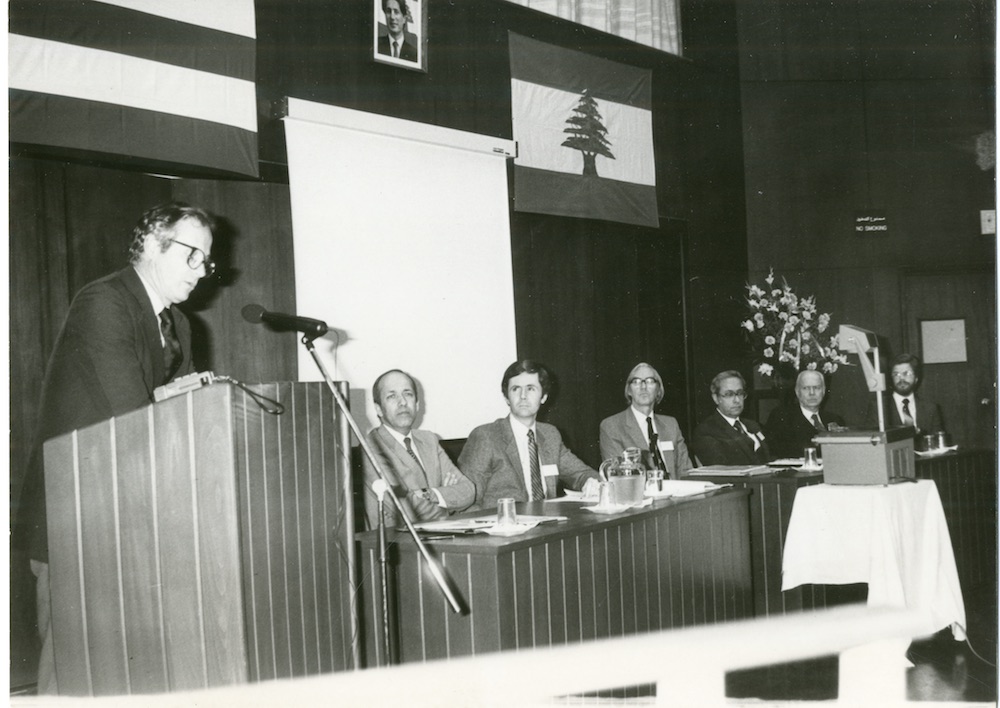


Steve Kerr said his life in the Middle East and his father helped define his career as a basketball star and as a coach. (AUB Archives)

“He had a lot of patience, and I think he understood how to have conversations with people from every background and every different point of view.
“I learned from that. I learned how important it is to be humble and to listen. I think about that a lot because our country has a lot of problems.
“In many ways we’re a great country, and in many ways we have huge problems. We really have to solve some of our issues.”
Steve said he is very proud of what his father accomplished and the influence he had on his life.
“I tried to carry on that legacy with the way I carry myself as a coach. But I wish he were here to help me kind of sift through the latest in … what’s happening all the time,” Steve added.
“I think my whole life events and my childhood learning from my parents have prepared me to become a coach and to become a public figure. I was very fortunate.”

------------
@rayhanania


Autopsy finds Cuban immigrant in ICE custody died of homicide due to asphyxia

Updated 2 sec ago
Follow

Autopsy finds Cuban immigrant in ICE custody died of homicide due to asphyxia

  • Witness: Lunas Campos was handcuffed as at least five guards held him down and one put an arm around his neck and squeezed until he was unconscious
  • The US Immigration and Customs Enforcement said Diaz was detained by ICE earlier this month during the immigration crackdown in Minneapolis
WASHINGTON: A Cuban migrant held in solitary confinement at an immigration detention facility in Texas died after guards held him down and he stopped breathing, according to an autopsy report released Wednesday that ruled the death a homicide.
Geraldo Lunas Campos died Jan. 3 following an altercation with guards. US Immigration and Customs Enforcement said the 55-year-old father of four was attempting suicide and the staff tried to save him.
But a witness said last week that Lunas Campos was handcuffed as at least five guards held him down and one put an arm around his neck and squeezed until he was unconscious.
His death was one of at least three reported in little more than a month at Camp East Montana, a sprawling tent facility in the desert on the grounds of Fort Bliss, an Army base.
The autopsy report by the El Paso County Medical Examiner’s Office found Lunas Campos’ body showed signs of a struggle, including abrasions on his chest and knees. He also had hemorrhages on his neck. The deputy medical examiner, Dr. Adam Gonzalez. determined the cause of death was asphyxia due to neck and torso compression.
The report said witnesses saw Lunas Campos “become unresponsive while being physically restrained by law enforcement.” It did not elaborate on what happened during the struggle but cited evidence of injuries to his neck, head and torso associated with physical restraint. The report also noted the presence of petechial hemorrhages — tiny blood spots from burst capillaries that can be associated with intense strain or injury — in the eyelids and skin of the neck.
Dr. Victor Weedn, a forensic pathologist who reviewed the autopsy report for AP, said the presence of petechiae in the eyes support the conclusion that asphyxia caused the death. Those injuries suggest pressure on the body and are often associated with such deaths, he said.
He said the contusions on Lunas Campos’ body may reflect physical restraint and the neck injuries were consistent with a hand or knee on the neck.
The autopsy also found the presence of prescription antidepressant and antihistamine medications, adding that Lunas Campos had a history of bipolar disorder and anxiety. It made no mention of him attempting suicide.
Government provided changing accounts of what happened
ICE’s initial account of the death, which included no mention of an altercation with guards, said Lunas Campos had become disruptive and staff moved him into a cellblock where detainees are held away from others.
“While in segregation, staff observed him in distress and contacted on-site medical personnel for assistance,” the agency said in its Jan. 9 statement. “Medical staff responded, initiated lifesaving measures, and requested emergency medical services.”
Lunas Campos was pronounced dead after paramedics arrived.
Last Thursday, after Lunas Campos’ family was first informed the death was likely to be ruled a homicide, Department of Homeland Security spokesperson Tricia McLaughlin amended the government’s account, saying he had attempted suicide and guards tried to help him.
“Campos violently resisted the security staff and continued to attempt to take his life,” she said. “During the ensuing struggle, Campos stopped breathing and lost consciousness.”
After the final autopsy report was released Wednesday, McLaughlin issued a statement emphasizing that Lunas Campos was “a criminal illegal alien and convicted child sex predator.”
New York court records show Lunas Campos was convicted in 2003 of sexual contact with a person under 11, a felony for which he was sentenced to one year in jail and placed on the state’s sex offender registry. Lunas Campos was also sentenced to five years in prison and three years of supervision in 2009 after being convicted of attempting to sell a controlled substance, according to the New York corrections records. He completed the sentence in January 2017.
“ICE takes seriously the health and safety of all those detained in our custody,” McLaughlin said Wednesday, adding that the agency was investigating the death. DHS has not responded to questions about whether any outside law enforcement agency was also investigating.
Deaths put a spotlight on Camp East Montana
The AP reported in August that the $1.2 billion contract to build and operate Camp East Montana, expected to become the largest detention facility in the US, was awarded to a private contractor headquartered in a single-family home in Richmond, Virginia. The company, Acquisition Logistics LLC, had no prior experience running a corrections facility and has subcontracted with other companies to help operate the camp.
It was not immediately clear whether the guards present when Lunas Campos died were government employees or those of a private contractor.
A final determination of homicide by the medical examiner would typically be critical in determining whether any guards are held criminally or civilly liable. The fact that Lunas Campos died on an Army base could limit state and local officials’ legal jurisdiction to investigate.
Lunas Campos was among the first detainees sent to Camp Montana East, arriving in September after ICE arrested him in Rochester, New York, where he lived for more than two decades. He was legally admitted to the US in 1996, part of a wave of Cuban immigrants seeking to reach Florida by boat.
ICE said he was picked up in July as part of a planned immigration enforcement operation due to criminal convictions that made him eligible for removal.
In addition to Lunas Campos, ICE announced that on Dec. 3 an immigrant from Guatemala held in Camp East Montana died after being transferred to a El Paso hospital for care. While the cause of death was still pending, the agency said Francisco Gaspar-Andres, 48, was suspected to have died of liver and kidney failure.
On Sunday, ICE announced that Victor Manuel Diaz, a 36-year-old immigrant from Nicaragua, died at Camp East Montana on Jan. 14 of a “presumed suicide.” The agency said Diaz was detained by ICE earlier this month during the immigration crackdown in Minneapolis.
Unlike with the two prior deaths, Diaz’s body wasn’t sent to the county medical examiner in El Paso. McLaughlin said Wednesday that the autopsy for Diaz is being performed at the Army medical center at Fort Bliss. DHS again did not respond to questions about whether any agency other than ICE will investigate the death.
Rep. Veronica Escobar, a Democrat whose district includes El Paso, called on DHS Secretary Kristi Noem and acting ICE Director Todd M. Lyons to brief Congress about the recent deaths.
“DHS must preserve all evidence — including halting their effort to deport the witnesses,” Escobar said Wednesday. “I reiterate my call for Camp East Montana to be shut down and for the contract with the corporation running it to be terminated.”