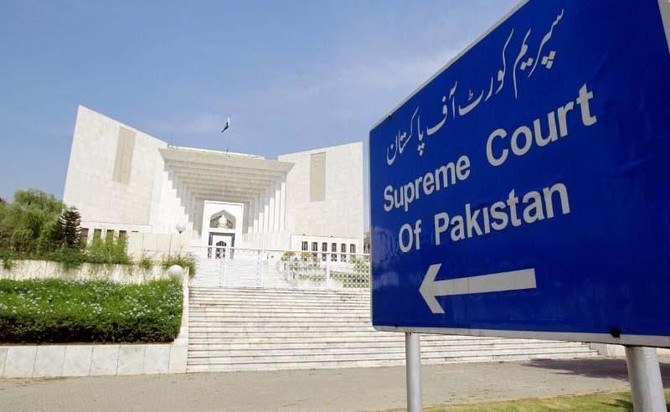
ISLAMABAD: In a landmark judgment passed this week, the Pakistani Supreme Court said the country’s anti-corruption watchdog was reluctant to crack down on politicians on “one side of the political divide,” a veiled reference to the government of Prime Minister Imran Khan, but was misusing its powers to take action against others.
The much-awaited 87-page verdict on a bail petition filed by senior leaders of the Pakistan Muslim League-Nawaz (PMLN) opposition party comes amid rising concerns that an anti-graft crusade promoted by Khan, and spearheaded by the National Accountability Bureau (NAB), was being used against the government’s political opponents.
Khan and NAB have repeatedly denied this.
“The [National Accountability] Bureau seems reluctant in proceeding against people on one side of the political divide even in respect of financial scams of massive proportion while those on the other side are being arrested and incarcerated for months and years without providing any sufficient cause even when the law mandates investigations to be concluded expeditiously and trial to be concluded within 30 days,” the court verdict read.
Referring to the post-arrest bail plea of PMLN leaders Khawaja Saad Rafique and his brother Khawaja Suleman Rafique in a corruption case involving a housing society, the judgment said: “NAB’s conduct throughout this case is a clear manifestation of their utter disregard for law, fair play, equity and propriety.”
It added: “Indeed, curbing loot, plunder and combating corruption is a noble cause. Nonetheless, the means, process and mechanism employed therefor should be within the parameters as prescribed and mandated by the law and not in derogation thereof.”
Leader of the opposition in the National Assembly and PMLN President Shahbaz Sahrif took to the Twitter to comment on the court verdict:
“SC judgment in the case against Khawaja brothers is a stinging indictment of the NAB & so-called accountability process which was more of a witch-hunt against them than accountability. Their perseverance & determination is laudable.”
NAB has not yet commented on the judgment.
Khan won power last year vowing to root out corruption among what he cast as a venal political elite and views the probes into veteran politicians, including jailed former PM Nawaz Sharif and ex-President Asif Ali Zardari, as long overdue.
While few dispute the need to clean up Pakistani politics, the NAB campaign has become a topic of fierce political debate.
Some in the business community also worry the anti-graft drive is hurting an ailing economy, which has received a $6 billion International Monetary Fund bailout. And the focus of the NAB so far on the Khan government’s political foes and critical voices in the media has prompted accusations of a one-sided purge.


![]()

Pakistan top court says anti-graft bureau misusing powers in ‘one-sided’ political purge
Short Url
https://arab.news/5cr4s
Pakistan top court says anti-graft bureau misusing powers in ‘one-sided’ political purge
- National Accountability Bureau is widely accused of going after the government’s political opponents, it denies the charges
- PM Khan won power in 2018 vowing to end corruption and views probes into opposition politicians as long overdue
Latest updates


Recommended


© 2026 SAUDI RESEARCH & PUBLISHING COMPANY, All Rights Reserved And subject to Terms of Use Agreement.