

Poland rules out ‘rule of law’ demands for EU cash

1 / 2
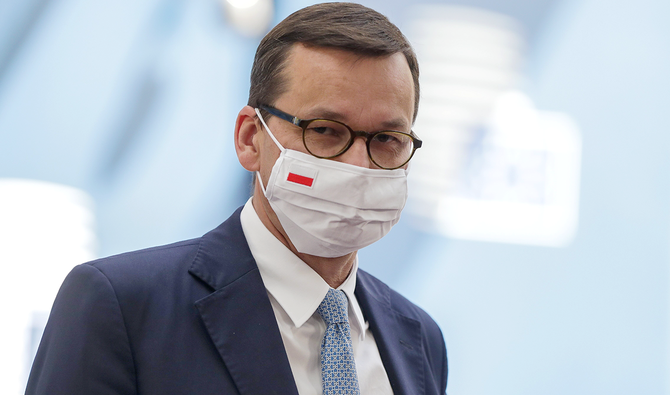
Poland’s Prime Minister Mateusz Morawiecki. (AFP)
2 / 2
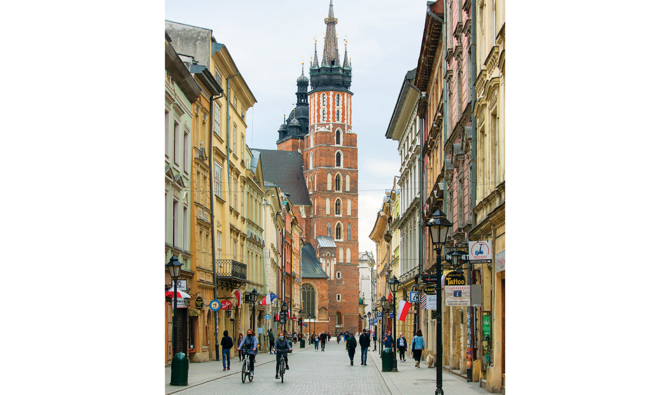
A street in Krakow, Poland. The country has been pilloried for years for undermining EU values. (Shutterstock/File)
Short Url
Updated 21 July 2020
Follow

Poland rules out ‘rule of law’ demands for EU cash

  • Deadlocked European leaders try to save marathon virus rescue conference

BRUSSELS: Polish Prime Minister Mateusz Morawiecki on Monday said he would not allow the EU to put “rule of law” conditions on Poland receiving EU budget cash.

Morawiecki spoke as he arrived to the fourth day of an EU summit that has seen the bloc’s 27 leaders unable to agree a post-coronavirus rescue deal.

“For (the compromise) to be acceptable to Poland, we must obtain what we’ve asked for from the beginning: No discretionary powers for EU bodies, EU institutions regarding the rule of law,” Mateusz Morawiecki told Polish media in Brussels.

Like Hungary, Poland has been pilloried for years for undermining EU values such as freedom of the press and independence of the judiciary.

Meanwhile, EU leaders cautiously tried to get the summit back on track.

They began to gather for another session after three days and nights of prolonged wrangling failed to agree a €750 billion ($860 billion) bundle of loans and grants to drag Europe out of the recession caused by the pandemic.

Arriving for the session, France’s President Emmanuel Macron said he saw “the possible hopes of a compromise,” but added: “Nothing has been agreed yet, so I will remain extremely cautious.”

Germany’s Angela Merkel was also careful not to inspire hopes of a rapid result. “Last night ... we put in place a framework for a possible agreement,” she said. “This is a step forward and it gives hope that an agreement can be reached today — or at least that an agreement is possible.”

The wrangling pits a coalition of “frugals” — the Netherlands, Sweden, Austria, Denmark and Finland — which wants to cut the package back and impose strict rules on how it is used, against virus-ravaged powers like Italy and Spain seeking EU support.

France and Germany are backing efforts by European Council president Charles Michel to broker a compromise by cutting the grant portion of the deal to €390 billion — down from his initial proposal of €500 billion — and increasing the loan part.

But a European source said the new proposition might not reach Michel’s initial total target of €750 billion target and that the host had managed to convince the frugals to start negotiating the recovery grants only by putting a “knife to their throats” in a showdown late Sunday.

“Until we agree to define the amount of the recovery fund, we can’t advance,” he said. France had been holding out for at least €400 billion in grants, already less than the €500 billion in the first draft.

After Sunday’s raucous dinner Macron clashed personally with the Netherlands’ Mark Rutte and Austria’s Sebastian Kurz, accusing them of putting the entire European project in danger through “egotism” and threatening to storm off if they do not listen to his and Merkel’s advice.

Rutte told reporters he was in Brussels to take care of his own country, not to befriend leaders and “go to each other’s birthdays” — Merkel turned 66 on Friday, the first day of the talks, and received gifts from some fellow leaders. But he also said that, despite the tension, a deal was “very close.”

“We haven’t yet found the way through, and it could still fail, but I’m more optimistic than I was last night when, at one moment, I told myself, ‘It’s over’,” Rutte told reporters.

According to witnesses, at one point Macron thumped the table, berated Kurz for leaving to take a call and accused Rutte of behaving like former British Premier David Cameron — who took a hard line at EU summits and ended up leading his country into a referendum to quit the bloc.


Gulf-EU value chain integration signals shift toward long-term economic partnership: GCC secretary general

Updated 03 February 2026
Follow

Gulf-EU value chain integration signals shift toward long-term economic partnership: GCC secretary general

RIYADH: Value chains between the Gulf and Europe are poised to become deeper and more resilient as economic ties shift beyond traditional trade toward long-term industrial and investment integration, according to the secretary general of the Gulf Cooperation Council.

Speaking on the sidelines of the World Governments Summit 2026 in Dubai, Jasem Al-Budaiwi said Gulf-European economic relations are shifting from simple commodity trade toward the joint development of sustainable value chains, reflecting a more strategic and lasting partnership.

His remarks were made during a dialogue session titled “The next investment and trade race,” held with Luigi Di Maio, the EU’s special representative for external affairs.

Al-Budaiwi said relations between the GCC and the EU are among the bloc’s most established partnerships, built on decades of institutional collaboration that began with the signing of the 1988 cooperation agreement.

He noted that the deal laid a solid foundation for political and economic dialogue and opened broad avenues for collaboration in trade, investment, and energy, as well as development and education.

The secretary general added that the partnership has undergone a qualitative shift in recent years, particularly following the adoption of the joint action program for the 2022–2027 period and the convening of the Gulf–European summit in Brussels.

Subsequent ministerial meetings, he said, have focused on implementing agreed outcomes, enhancing trade and investment cooperation, improving market access, and supporting supply chains and sustainable development.

According to Al-Budaiwi, merchandise trade between the two sides has reached around $197 billion, positioning the EU as one of the GCC’s most important trading partners.

He also pointed to the continued growth of European foreign direct investment into Gulf countries, which he said reflects the depth of economic interdependence and rising confidence in the Gulf business environment.

Looking ahead, Al-Budaiwi emphasized that the economic transformation across GCC states, driven by ambitious national visions, is creating broad opportunities for expanded cooperation with Europe. 

He highlighted clean energy, green hydrogen, and digital transformation, as well as artificial intelligence, smart infrastructure, and cybersecurity, as priority areas for future partnership.

He added that the success of Gulf-European cooperation should not be measured solely by trade volumes or investment flows, but by its ability to evolve into an integrated model based on trust, risk-sharing, and the joint creation of economic value, contributing to stability and growth in the global economy.

GCC–EU plans to build shared value chains look well-timed as trade policy volatility rises.

In recent weeks, Washington’s renewed push over Greenland has been tied to tariff threats against European countries, prompting the EU to keep a €93 billion ($109.7 billion) retaliation package on standby. 

At the same time, tighter US sanctions on Iran are increasing compliance risks for energy and shipping-related finance. Meanwhile, the World Trade Organization and UNCTAD warn that higher tariffs and ongoing uncertainty could weaken trade and investment across both regions in 2026.