

Pakistan announces tax incentives for wheat imports to meet shortage

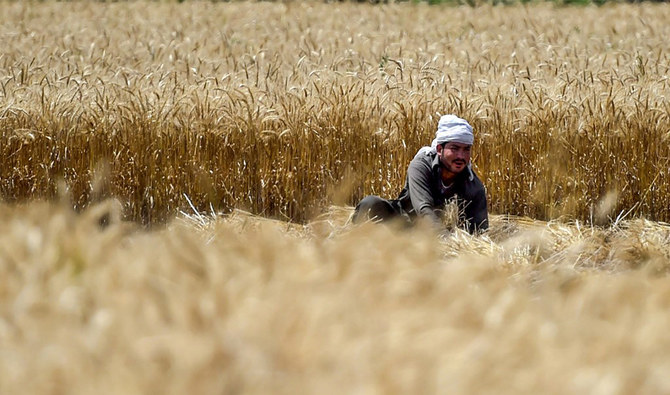
A farmer harvests wheat crops in a field in Peshawar on May 2, 2020. In 2020, Pakistan registered wheat production deficit of 1.5 million metric tons, which officials say has pushed the commodity's price up in the open market. (AFP)
Short Url
Updated 20 July 2020
Follow

Pakistan announces tax incentives for wheat imports to meet shortage

  • Pakistan registers wheat production deficit of 1.5 million metric tons, which officials say has pushed the commodity’s price up in the open market
  • Wheat importers will be exempt from the 60 percent regulatory duty, 11 percent customs duty, 17 percent sales tax and 6 percent withholding tax

ISLAMABAD: The government has abolished various taxes and duties on Pakistan’s imports of wheat to bring down its price in the local market and ensure smooth supply of subsidized wheat flour to the public, officials said on Saturday.

Wheat is one of the main agricultural crops in Pakistan, with around 80 percent of farmers growing it on an area of about 9 million hectares — close to 40 percent of the country’s total cultivated land. For the last couple of years, experts say, Pakistan has been facing wheat shortages driven mainly by a rapid population growth and climate change.

“We have offered multiple incentives to wheat importers including exemption from the anti-hoarding act, sales tax and withholding tax,” Dr. Javed Humayun, senior joint secretary at the Ministry of National Food Security and Research, told Arab News on Saturday. 

Dr. Javed Ahmad, director Wheat Research Institute talks to Arab News.

With the new policy that was unrolled on Wednesday, wheat importers will be exempt from the 60 percent regulatory duty, 11 percent customs duty, 17 percent sales tax and 6 percent withholding tax. Exemption from the anti-hoarding act means the government will allow them to store as much of the imported wheat as they want to.
Humayun said Pakistan had failed to achieve its wheat production target this year due to multiple reasons, including unexpected torrential rains from February to April, which destroyed the crop.
Against the production target of 27 million metric tons, Pakistan’s yield was 25.5 million tons, while it could procure only 6 million tons from growers to release the commodity at a subsidized rate — the target was 8.25 million tons, according to official data.

The wheat subsidy is in place to maintain official rates for wheat flour in the market. Failure to meet the procurement target results in price hikes and shortage of the staple.

The government has been under public pressure for the past two years for being unable to maintain wheat flour prices in the market and blamed growers and businessmen for hoarding the commodity to create artificial shortage.
Encouraged by the new wheat import policy, the private sector has already booked 270,000 metric tons of wheat for August and September. This, according to the government, will help make wheat flour available in the open market at affordable rates.

“Once the imported wheat hits the local market, this artificial shortage and price hike of the wheat flour will be over,” Humayun said.

According to members of the opposition, however, the government should first improve its procurement procedures as its failure to meet the target for subsidized wheat is due to the low rates it offers to farmers, who in turn choose to sell the commodity to businessmen, instead of government agencies.

“The private sector would buy more wheat from farmers by offering attractive rates against the government’s support price of Rs1,400 ($8.36) per 40 kilograms,” Syed Muzafar Hussain Shah, an opposition lawmaker and chairman of the Senate committee on food security, told Arab News.

“The government needs to focus on improving the per hectare yield of the crop to meet the required demand with the rapidly growing population,” Shah said, adding that the country’s demand for wheat was expected to increase to 34 million tons by 2028 with the population growth rate of 2.4 percent.
The government’s research institutes have been struggling to introduce new seed varieties to enhance the yield and fight adverse impacts of the changing climate.
“We are encouraging farmers to plant new seed varieties which give better yield along with resistance to rust disease,” Dr. Javed Ahmad, director at Wheat Research Institute in Faisalabad, told Arab News.
The process is complex and while the Faisalabad institute has developed around 70 seed varieties of wheat, Ahmad said only 10 of them have so far been recommended for cultivation.


Pakistan hails Bangladesh’s ‘historic democratic transition’ as ties gather momentum

Updated 6 sec ago
Follow

Pakistan hails Bangladesh’s ‘historic democratic transition’ as ties gather momentum

  • Ahsan Iqbal visits Dhaka for the swearing-in of PM-elect Tarique Rahman after recent elections
  • Islamabad calls for building connectivity, expanding trade and shaping a stable region together

ISLAMABAD: Pakistan’s Planning Minister Ahsan Iqbal on Tuesday congratulated Bangladesh on a “historic democratic transition,” as he pointed to positive momentum in Pakistan-Bangladesh relations during a visit to Dhaka for the oath-taking of Prime Minister-elect Tarique Rahman.

Bangladesh’s parliament was sworn in earlier in the day, marking the first elected legislature since a deadly 2024 uprising that toppled the government of Sheikh Hasina. Rahman, 60, is chief of the Bangladesh Nationalist Party (BNP) and won a landslide victory in the February 12 elections.

He is set to formally take office later on Tuesday after lawmakers pledged loyalty before their country’s chief election commissioner.

The Pakistani minister said in a social media post on X he met Bangladesh’s Chief Adviser, Muhammad Yunus, and congratulated him “on the successful conduct of elections and the historic democratic transition.”

“Our discussions focused on opening a new, forward-looking chapter in Pakistan-Bangladesh relations,” he said. “I expressed appreciation for the positive momentum in bilateral ties, including growing trade engagement, revival of direct air connectivity, and renewed people-to-people contacts.”

Pakistan’s Minister for Planning, Development and Special Initiatives, Ahsan Iqbal (left), paid a courtesy call on Chief Adviser Professor Muhammad Yunus (right) at the State Guest House Jamuna in Dhaka, Bangladesh, on February 17, 2026. (AhsanIqbal/X)

“We agreed that the current regional and geopolitical environment demands greater economic cooperation, connectivity, and collaboration between our two countries,” he added.

Iqbal also extended an invitation to Yunus to visit Pakistan to institutionalize cooperation in youth empowerment, innovation and sustainable development.

“Pakistan and Bangladesh share deep cultural, historical, and social affinities,” he said. “It is time to transform these affinities into structured economic partnerships, academic exchanges, and regional cooperation. Our future lies in building connectivity, expanding trade, empowering youth, and shaping a stable and prosperous South Asia together.”

Bangladesh’s Prime Minister-elect Rahman has pledged to restore economic stability and revive growth after months of turmoil that rattled investor confidence in the world’s second-largest garment exporter. In his victory speech, he described the outcome as a win for democracy but warned of challenges, including a fragile economy and weakened institutions.

Pakistan and Bangladesh have improved bilateral ties amid a recent thaw in relations. The two countries were part of the same state until Bangladesh’s secession following a bloody civil war in 1971, an event that long cast a shadow over ties.

Relations have warmed since August 2024, after the ouster of Hasina, who was widely viewed as close to India. While Islamabad and Dhaka have moved closer, ties between Bangladesh and New Delhi remain strained over India’s decision to grant asylum to Hasina.