

Houthis using decaying tanker as ‘bargaining chip:’ Yemen FM

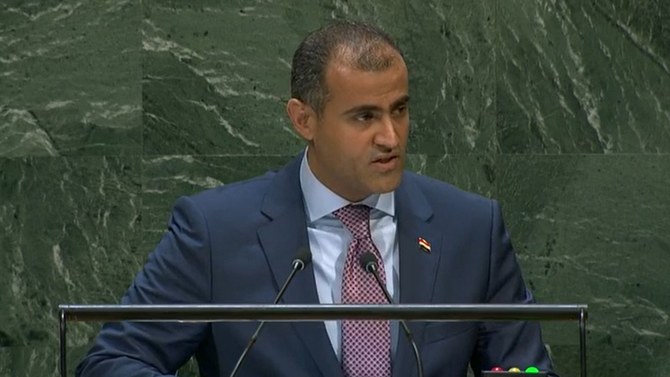
Yemen’s foreign minister Mohammed Al-Hadrahmi said the Houthis have been using the decaying Safer tanker as leverage in the peace process, having realized the importance it holds. (Screen grab)
Short Url
Updated 16 July 2020
Follow

Houthis using decaying tanker as ‘bargaining chip:’ Yemen FM

  • The Houthis have refused for more than five years to allow international engineers to carry out maintenance on the vessel
  • Saudi Arabia said it was ready to take necessary steps – with the support of the United Nations Security Council – to deal with the Safer oil tanker crisis

DUBAI: The Houthis have been using the decaying Safer tanker as leverage in the peace process, having realized the importance it holds, Yemen’s foreign minister Mohammed Al-Hadrahmi said.

The Houthis have refused for more than five years to allow international engineers to carry out maintenance on the vessel which is moored off the coast of Yemen.

The Yemeni government has been asking the United Nations to intervene to prevent a major environmental disaster. 

Al-Hadhrami reiterated its call to the Security Council on Wednesday saying it should “send the Houthis a strong signal that this time they must comply,” as reported by state-owned Saba.

The statement comes as the minister explained how the militia had been using the tanker as a bargaining chip in the ongoing peace process “with a complete disregard for the potential drastic consequences of this unethical behavior.”

Experts said 138 million liters of crude oil could leak into the Red Sea from the rusty tanker, which will result in a number of environmental and economic damages not only on Yemen, but the whole region.

“We believe that the best course of action supports the latest stand-alone detailed proposal on Safer which we received from the UN Envoy to Yemen, Mr. Martin Griffiths, last month to which we agreed given that it would not be linked to any other issues or processes under discussion,” Al Hadhrami said.

The proposal outlined three steps to resolve the tanker issue – necessary repairs, basic maintenance to facilitate oil extraction and the eventual disposal of the tanker.

It also stated all potential revenue from the sale of extracted oil will be used to pay the salaries of civil servants in Yemen.

Saudi Arabia ready to take ‘necessary steps’

Meanwhile, Saudi Arabia said it was ready to take necessary steps – with the support of the United Nations Security Council – to deal with the Safer oil tanker crisis.

Permanent Representative of Saudi Arabia to the UN, Ambassador Abdullah Al-Muallami, told the council on Wednesday to “remain vigilant” and to be ready to announce “strong and decisive measures” to deal with the tanker and eliminate the threat it poses.

“We would like to draw the Council’s attention to the record of the Houthis non-compliance with United Nations resolutions,” Al-Muallami said during virtual meeting on the situation in Yemen.

Al-Muallami pointed out that the oil tanker posed grave risks that threaten to cause serious harm to the south of the Red Sea. It also threated regional security and international maritime navigation between Asia and Europe due to its location near Bab Al-Mandab, he added.


First Ramadan after truce brings flicker of joy in devastated Gaza

Updated 5 sec ago
Follow

First Ramadan after truce brings flicker of joy in devastated Gaza

  • Ramadan lanterns and string lights appear on streets lined with collapsed buildings and piles of rubble in Gaza City
  • The first holy month since the October ceasefire brings mixed feelings for the many still living in tents
GAZA CITY: Little Ramadan lanterns and string lights appeared on streets lined with collapsed buildings and piles of rubble in Gaza City, bringing joy and respite as Islam’s holiest month began — the first since October’s ceasefire.
In the Omari mosque, dozens of worshippers performed the first Ramadan morning prayer, fajr, bare feet on the carpet but donning heavy jackets to stave off the winter cold.
“Despite the occupation, the destruction of mosques and schools, and the demolition of our homes... we came in spite of these harsh conditions,” Abu Adam, a resident of Gaza City who came to pray, told AFP.
“Even last night, when the area was targeted, we remained determined to head to the mosque to worship God,” he said.
A security source in Gaza told AFP Wednesday that artillery shelling targeted the eastern parts of Gaza City that morning.
The source added that artillery shelling also targeted a refugee camp in central Gaza.
Israel does not allow international journalists to enter the Gaza Strip, preventing AFP and other news organizations from independently verifying casualty figures.

‘Stifled joy’

In Gaza’s south, tens of thousands of people still live in tents and makeshift shelters as they wait for the territory’s reconstruction after a US-brokered ceasefire took hold in October.
Nivin Ahmed, who lives in a tent in the area known as Al-Mawasi, told AFP this first Ramadan without war brought “mixed and varied feelings.”
“The joy is stifled. We miss people who were martyred, are still missing, detained, or even traveled,” she said.
“The Ramadan table used to be full of the most delicious dishes and bring together all our loved ones,” the 50-year-old said.
“Today, I can barely prepare a main dish and a side dish. Everything is expensive. I can’t invite anyone for Iftar or suhoor,” she said, referring to the meals eaten before and after the daily fast of Ramadan.
Despite the ceasefire, shortages remain in Gaza, whose battered economy and material damage have rendered most residents at least partly dependent on humanitarian aid for their basic needs.
But with all entries into the tiny territory under Israeli control, not enough goods are able to enter to bring prices down, according to the United Nations and aid groups.

‘Still special’

Maha Fathi, 37, was displaced from Gaza City and lives in a tent west of the city.
“Despite all the destruction and suffering in Gaza, Ramadan is still special,” she told AFP.
“People have begun to empathize with each other’s suffering again after everyone was preoccupied with themselves during the war.”
She said that her family and neighbors were able to share moments of joy as they prepared food for suhoor and set up Ramadan decorations.
“Everyone longs for the atmosphere of Ramadan. Seeing the decorations and the activity in the markets fills us with hope for a return to stability,” she added.
On the beach at central Gaza’s Deir el-Balah, Palestinian artist Yazeed Abu Jarad contributed to the holiday spirit with his art.
In the sand near the Mediterranean Sea, he sculpted “Welcome Ramadan” in ornate Arabic calligraphy, under the curious eye of children from a nearby tent camp.
Nearly all of Gaza’s 2.2 million residents were displaced at least once during the more than two years of war between Israel and Hamas, sparked by the latter’s unprecedented October 7 attack on Israel.
Mohammed Al-Madhoun, 43, also lives in a tent west of Gaza City, and hoped for brighter days ahead.
“I hope this is the last Ramadan we spend in tents. I feel helpless in front of my children when they ask me to buy lanterns and dream of an Iftar table with all their favorite foods.”
“We try to find joy despite everything,” he said, describing his first Ramadan night out with the neighbors, eating the pre-fast meal and praying.
“The children were as if they were on a picnic,” he said.