

Houthis using decaying tanker as ‘bargaining chip:’ Yemen FM

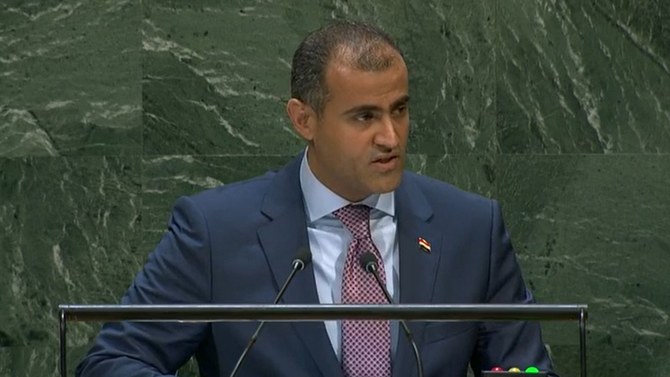
Yemen’s foreign minister Mohammed Al-Hadrahmi said the Houthis have been using the decaying Safer tanker as leverage in the peace process, having realized the importance it holds. (Screen grab)
Short Url
Updated 16 July 2020
Follow

Houthis using decaying tanker as ‘bargaining chip:’ Yemen FM

  • The Houthis have refused for more than five years to allow international engineers to carry out maintenance on the vessel
  • Saudi Arabia said it was ready to take necessary steps – with the support of the United Nations Security Council – to deal with the Safer oil tanker crisis

DUBAI: The Houthis have been using the decaying Safer tanker as leverage in the peace process, having realized the importance it holds, Yemen’s foreign minister Mohammed Al-Hadrahmi said.

The Houthis have refused for more than five years to allow international engineers to carry out maintenance on the vessel which is moored off the coast of Yemen.

The Yemeni government has been asking the United Nations to intervene to prevent a major environmental disaster. 

Al-Hadhrami reiterated its call to the Security Council on Wednesday saying it should “send the Houthis a strong signal that this time they must comply,” as reported by state-owned Saba.

The statement comes as the minister explained how the militia had been using the tanker as a bargaining chip in the ongoing peace process “with a complete disregard for the potential drastic consequences of this unethical behavior.”

Experts said 138 million liters of crude oil could leak into the Red Sea from the rusty tanker, which will result in a number of environmental and economic damages not only on Yemen, but the whole region.

“We believe that the best course of action supports the latest stand-alone detailed proposal on Safer which we received from the UN Envoy to Yemen, Mr. Martin Griffiths, last month to which we agreed given that it would not be linked to any other issues or processes under discussion,” Al Hadhrami said.

The proposal outlined three steps to resolve the tanker issue – necessary repairs, basic maintenance to facilitate oil extraction and the eventual disposal of the tanker.

It also stated all potential revenue from the sale of extracted oil will be used to pay the salaries of civil servants in Yemen.

Saudi Arabia ready to take ‘necessary steps’

Meanwhile, Saudi Arabia said it was ready to take necessary steps – with the support of the United Nations Security Council – to deal with the Safer oil tanker crisis.

Permanent Representative of Saudi Arabia to the UN, Ambassador Abdullah Al-Muallami, told the council on Wednesday to “remain vigilant” and to be ready to announce “strong and decisive measures” to deal with the tanker and eliminate the threat it poses.

“We would like to draw the Council’s attention to the record of the Houthis non-compliance with United Nations resolutions,” Al-Muallami said during virtual meeting on the situation in Yemen.

Al-Muallami pointed out that the oil tanker posed grave risks that threaten to cause serious harm to the south of the Red Sea. It also threated regional security and international maritime navigation between Asia and Europe due to its location near Bab Al-Mandab, he added.


Algeria inaugurates strategic railway to giant Sahara mine

President Tebboune attended an inauguration ceremony in Bechar. (AFP file photo)
Updated 02 February 2026
Follow

Algeria inaugurates strategic railway to giant Sahara mine

  • The mine is expected to produce 4 million tons per year during the initial phase, with production projected to triple to 12 million tons per year by 2030
  • The project is financed by the Algerian state and partly built by a Chinese consortium

ALGEIRS: Algerian President Abdelmadjid Tebboune on Sunday inaugurated a nearly 1,000-kilometer (621-mile) desert railway to transport iron ore from a giant mine, a project he called one of the biggest in the country’s history.
The line will bring iron ore from the Gara Djebilet deposit in the south to the city of Bechar located 950 kilometers north, to be taken to a steel production plant near Oran further north.
The project is financed by the Algerian state and partly built by a Chinese consortium.
During the inauguration, Tebboune described it as “one of the largest strategic projects in the history of independent Algeria.”
This project aims to increase Algeria’s iron ore extraction capacity, as the country aspires to become one of Africa’s leading steel producers.
The iron ore deposit is also seen as a key driver of Algeria’s economic diversification as it seeks to reduce its reliance on hydrocarbons, according to experts.
President Tebboune attended an inauguration ceremony in Bechar, welcoming the first passenger train from Tindouf in southern Algeria and sending toward the north a first charge of iron ore, according to footage broadcast on national television.
The mine is expected to produce 4 million tons per year during the initial phase, with production projected to triple to 12 million tons per year by 2030, according to estimates by the state-owned Feraal Group, which manages the site.
It is then expected to reach 50 million tons per year in the long term, it said.
The start of operations at the mine will allow Algeria to drastically reduce its iron ore imports and save $1.2 billion per year, according to Algerian media.