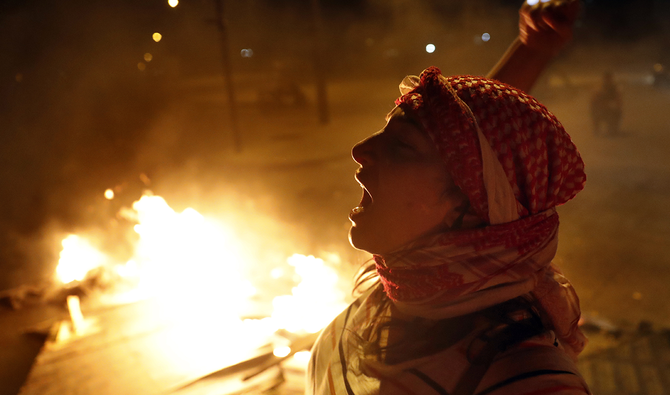

BEIRUT: Activists and prominent figures in Lebanon launched a new platform on Wednesday to help the various factions of protestors from the ongoing uprising that began October 17, 2019, to coordinate and communicate.
The group, which calls itself the National Civil Front, issued a document outlining its initial demands: “To form a government of independents, hold early parliamentary elections, ensure the independence of the judiciary, implement structural and sectoral reforms, ensure Lebanese sovereignty and regional and international legitimacy, set the path for the establishment of a civil state, and build a productive and sustainable national economy.”
Dr. Ziad Abdel Samad, a public affairs expert and advisor to the group, told Arab News, “This initiative is one of a series that will be launched in the forthcoming days to call for the resignation of this government because it failed.”
He continued: “We do not need to form new parties nor a unified leadership for the civil movement. Rather, these initiatives that will be gradually announced can help us coordinate and propose plans of economic reform, call for social justice, and form an independent government. People do not need any (official group) to take to the streets. People go out on their own because they feel pain.”
Protestors carried out a mass sit-in on Wednesday in front of the headquarters of the Ministry of Tourism, calling for the resignation of the Minister of Tourism Ramzi Musharrafieh, following a vicious assault on activist and lawyer Wassef Harakeh on July 3 in Beirut’s Achrafieh neighborhood. Police arrested six attackers, five of whom are members of Musharrafieh’s security team. Harakeh had reportedly been part of an earlier protest at the ministry.
The Head of the Beirut Bar Association Melhem Khalaf said that “attacks over the past few weeks on doctors, judges, journalists, lawyers, and civil activists” reflect “an unprecedented failure on the security level, especially since these attacks undermine the rule of law.”
“The aggressors are part of a much larger gang,” Khalaf said. “It is armed and uses state facilities and automobiles. It performs assassination attempts, shuts off free expression, and commits acts of terror and intimidation.” He claimed that Harakeh’s assailants had monitored the lawyer’s movements for a week prior to the attack — making it clear that the assault was premeditated. He called on Musharrafieh to resign, “regardless of whether he was implicated in the act or not.”
“While there are questions about the perpetrator of the attack, it is enough that they are part of (Musharrafieh’s) security team,” Khalaf said. “They used a car belonging to the ministry, and they were armed.”
Khalaf continued: “The assaults that are taking place undermine the role of the state. We cannot allow (Lebanon) to slip into becoming a police state, we need to rectify (its) direction (and protect) the rule of law, justice, the constitution, and the state. People’s rights are highly important and should be protected. The Bar Association aims very high and will not allow the people’s demands to be ignored.”
The National Civil Front is not Lebanon’s only new group fighting for civil rights. On July 13, journalists and activists announced the formation of a “coalition to defend freedom of expression in Lebanon” — a reaction to authorities’ attempts to stifle free speech and opinion, particularly online.
Activist Bashir Abu Zaid was assaulted two months ago in the southern town of Kfar Roummane and no suspects have yet been arrested. He said that he received no protection from the state agencies.
Mohamad Najm of the Lebanese NGO Social Media Exchange (SMEX) said that since 2015 the Informatics Crimes Office had registered more than 4,000 summonses for allegations of defamation and cyber defamation.
He claimed that the aim of these summonses is to intimidate activists and force them to retract social-media posts and pledge not to post anything similar in future, which — he stressed — goes against the principles of freedom of expression in Lebanon.
The newly formed coalition called on the public prosecutor and security services “to stop summoning people against the background of exercising freedom of expression and exposing corruption, and not to exceed its limits by asking activists to remove their posts or sign illegal pledges before obtaining a fair trial.”
It also called on parliament “to decriminalize the acts of defamation, cyber defamation and insults, cancel penalties of imprisonment, and prohibit government institutions, including the army and security services, from filing cases of defamation and cyber defamation.”