

Manila calms fears over police ‘house-to-house’ searches for COVID-19 patients

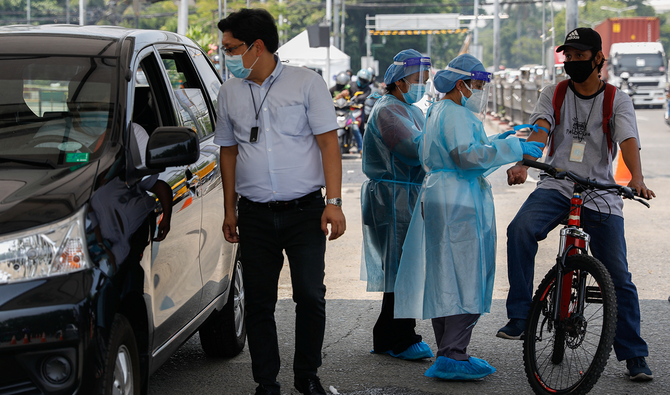
Healthcare workers take blood samples from a bike rider at a coronavirus disease (COVID-19) drive-thru testing center in Manila, Philippines, July 15, 2020. (Reuters)
Short Url
Updated 15 July 2020
Follow

Manila calms fears over police ‘house-to-house’ searches for COVID-19 patients

  • Patients moved to isolation centers should treat quarantine stay as ‘paid vacation’: Government official

MANILA: Filipinos with the coronavirus disease (COVID-19) forced to quarantine in government centers have been urged to treat their isolation stays as being “like a paid vacation.”

Government officials on Wednesday dismissed fears among sections of the population that police would be conducting house-to-house searches to root out COVID-19 patients.

Following an announcement on isolation measures by the country’s Department of the Interior and Local Government (DILG), Malacanang issued reassurances that strong-armed tactics would not be used against infected individuals.

However, President Rodrigo Duterte’s office pointed out that the state had inherent powers to move individuals – especially those who had contracted highly communicable diseases such as COVID-19 – to an isolation center to limit the spread of the virus.

Presidential spokesman, Harry Roque, said: “Let me make it clear: There will be no house-to-house searches for COVID-19-positive patients. They (patients) will have to be reported by the persons themselves, other members of the household, or their barangay (village) officials.”

He added that if patients were unable to self-quarantine, they would “be fetched” from their homes and “transferred to a government facility.” Local health workers would lead the initiative and the police presence would merely be “to provide support or assistance in the transport of patients and the implementation of lockdown in the affected area.”

In a television interview, the official urged patients who were asymptomatic or had only mild symptoms to “voluntarily surrender and confine themselves in isolation centers,” adding that they had nothing to worry about as it would be “like a paid vacation.”

Roque said: “We are enticing them with the fact that these are air-conditioned centers, free lodging, free meals three times a day and with free Wi-Fi, and with a graduation ceremony to prove, after the 14-day quarantine period.”

However, he noted that if a patient refused to be moved to a quarantine center, the state had the authority to isolate them.

“There’s inherent police power that is essential to the establishment of the state. It is to protect public health and I think isolation can be justified. But I don’t think it will go to that extent.”

On Tuesday Filipino Interior Secretary Eduardo Ano said police would conduct house-to-house searches for COVID-19 patients to prevent the spread of the virus in a country that has so far reported 58,850 COVID-19 cases and 1,614 deaths.

But the following day, Justice Secretary Menardo Guevarra said he was “not aware” of the move. “We have not discussed this matter in the IATF (Inter-Agency Task Force on Emerging Infectious Diseases), nor have I been consulted about it.

“Still, there is ample legal basis for transferring COVID-19-infected persons to government quarantine facilities if they are incapable of voluntarily isolating themselves,” he told reporters.

“Should the IATF agree there is a need for a house-to-house search for COVID-19-infected persons, it should be the barangay health workers, and not police officers, who should do that. Health workers are in a better position to determine if transfer to a government quarantine facility is appropriate,” Guevarra added.

The Commission on Human Rights (CHR), however, cautioned the government against assigning state security forces to do house-to-house searches to look for and transfer COVID-19 patients under home quarantine to isolation facilities managed by the government.

The CHR said such a move would be “susceptible to overreach in terms of guaranteeing the right to privacy and right of individuals to be secure in their abode.”

Senate Minority Leader Franklin Drilon said: “We have reached a crossroads in our fight against the (COVID-19) pandemic that our very government is set to flagrantly violate the very rights that we, the people, have always held to be sacred.”

Senator Risa Hontiveros said any such actions would discourage people from reporting their status. “We need to improve home and community-based healthcare,” she added.


Epstein files reveal links to cash, women, power in Africa

Updated 26 February 2026
Follow

Epstein files reveal links to cash, women, power in Africa

  • Documents attest to Epstein’sclose ties with Karim Wade, son of former Senegalese president Abdoulaye Wade
  • They also reveal his ties to Nina Keita, niece of Ivorian president Alassane Ouattara

PARIS: Jeffrey Epstein built close ties with powerful figures in Senegal and Ivory Coast, files released by the US government last month show, detailing the late sex offender’s influence network across Africa.
Emails, scheduled meetings, investment projects, and loans reviewed by AFP attest to the disgraced New York financier’s close relationship with Karim Wade, son of former Senegalese president Abdoulaye Wade.
They also reveal his ties to Nina Keita, niece of Ivorian president Alassane Ouattara.
Wade and Epstein met in 2010 through Emirati businessman Sultan Ahmed bin Sulayem, who recently resigned as CEO of port giant DP World after mounting pressure over his close friendship with Epstein.
The pair quickly struck up a rapport.
“Thanks for coming. I think there are many things to consider... I feel confident that we will have fun,” Epstein wrote to Wade on November 15, 2010 after their first meeting in Paris.
“Have a safe trip back to your paradise Island,” Wade replied.
While Wade’s exchanges show no link to Epstein-related sex trafficking crimes, they do reveal conversations on potential business ventures in various sectors, such as finance and energy.
Nicknamed the “Minister of Heaven and Earth” for the multiple portfolios he held including international cooperation, energy, and air transport, Wade was a powerful figure in Senegal until April 2012, when his father’s bid for a third term sparked deadly riots.
Epstein saw him as “one of the most important players in africa” and invited him to meet close contacts such as Ehud Barak, then Israel’s defense minister.
He also put him in touch with Chinese businessman Desmond Shum to discuss “offshore banking.”
The US Department of Justice documents show Shum and Wade met in Beijing on May 9, 2011.
That same month, Wade planned an African tour through Senegal, Mali, and Gabon for Epstein.

‘You will not suffer’ 

Epstein and Wade’s relationship became even more apparent after the latter’s fortunes reversed when his father left office in 2012.
That autumn, Epstein proposed that his “friend” — under the Dakar authorities’ scrutiny over his assets — use his house in Florida.
“You and your family are welcome to use my house in palm beach, staff is there, pool etc. you will not suffer,” Epstein wrote.
“Txs a lot Brother for the advise,” Wade replied a few weeks later to another email, in which Epstein urged him to “stay mentally strong.”
Numerous files suggest Epstein became financially involved on Karim Wade’s behalf after his arrest in 2013 and his 2015 sentencing to six years in prison for corruption.
Karim Wade’s lawyer, Mohamed Seydou Diagne, sent two invoices in May 2014 and July 2015 of $500,000 to one of Epstein’s companies.
Contacted by AFP on Monday, Diagne said he “did not consider it useful to comment.”
Other archives suggest that Epstein covered at least $50,000 in fees for the US lobbying firm Nelson Mullins, hired by Wade’s entourage to secure his release.
Epstein regularly exchanged emails with Robert Crowe, a partner at the firm who kept him informed of their efforts in the US and Senegal.
In a June 16, 2016 email thread where Epstein and Crowe discussed whether then Senegalese president Macky Sall would pardon Wade, Crowe writes: “He has told my friends high up at State that he was going to do it. They have been putting pressure on him!“
Karim Wade was released from prison eight days later, on June 24, and went into exile in Qatar, which he credited for efforts toward his release.
Jeffrey Epstein was told by Sultan Ahmed bin Sulayem and Nina Keita.

‘A very interesting person!’

The DOJ documents show Nina Keita was close to both Epstein and Karim Wade and that she acted as a regular intermediary while Wade was in prison.
Keita also helped put Epstein in contact with her uncle, president of Ivory Coast since May 2011, and his team.
“He thought you were a very interesting person! ... they were all very happy to have you here,” she wrote on January 20, 2012, after the financier’s visit to Abidjan.
She had booked him the “ministerial suite” of the luxury Hotel Ivoire for that trip.
Ahead of the visit, Epstein had said he hoped to see “very pretty girls there, as well as interesting places.”
“You will!” Keita replied.
Emails show Keita, a former model, at least once sent photos and the phone number of a young woman to Epstein.
He then met this woman at the Ritz hotel in Paris on August 31, 2011.
“ask sadia to send pictures of her sister. i prefer under 25,” Epstein wrote to Keita after the meeting.
Now the deputy general director of Ivorian petroleum stocks company GESTOCI, Keita also appears in a February 2019 will in which Epstein requested that debts owed to him by a number of people be canceled upon his death.
AFP received no response to its requests for comment from both Keita and the Ivorian presidency, or from Karim Wade, who was contacted through his entourage.
The mere mention of a person’s name in the Epstein files does not in itself imply wrongdoing.