

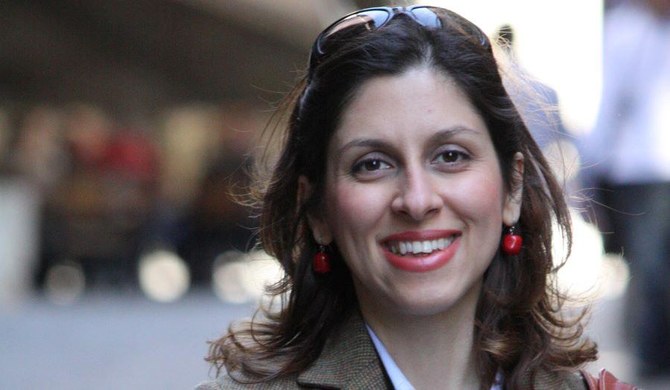
Time running out for Nazanin Zaghari-Ratcliffe’s hopes of adding to family, says husband

Iranian-British aid worker Nazanin Zaghari-Ratcliffe has been incarcerated in Evin Prison, north of Tehran, since her arrest at the city’s airport in 2016. (Reuters)
Short Url
Updated 15 July 2020
Follow

Time running out for Nazanin Zaghari-Ratcliffe’s hopes of adding to family, says husband

  • Richard Ratcliffe: There remains a little girl growing up without her mother still. I hope not a little girl without a sibling
  • UK Foreign Office: We have consistently urged Iran to make Nazanin’s furlough permanent so she can return to her family in the UK

LONDON: Nazanin Zaghari-Ratcliffe, the British-Iranian national imprisoned by Tehran on charges of espionage, is running out of time if she is to have another child, according to her husband Richard Ratcliffe, who has appealed to Iran’s Foreign Minister Mohammad Javad Zarif to release her on compassionate grounds.

Zaghari-Ratcliffe, 41, has been incarcerated in Evin Prison, north of Tehran, since her arrest at the city’s airport in 2016, during which time she has allegedly been denied access to medical treatment.

She has one child, her 6-year-old daughter Gabriella, who was with her when she was arrested and was repatriated to the UK last year.

Zaghari-Ratcliffe was released on temporary furlough to stay with her parents in Tehran as part of wider efforts to halt the spread of COVID-19 in Iran’s prisons earlier this year, where she has since undergone a series of private medical tests on the recommendation of a former cellmate who had worked as a doctor. 

Ratcliffe said the results of his wife’s tests showed she had a less than 15 percent chance of conceiving another child.

“The discovery left her devastated. She spent the day crying looking at pictures of Gabriella,” Ratcliffe said. “She reflected, ‘I always used to tell myself in Evin that they can’t take my future away. But now they have’.”

He appealed to Zarif for his wife’s release, saying: “Her hostage experience risks having a permanent legacy for our whole family. It is one thing to recover from losing over four years of your life to someone else’s fights, but it will be quite a different recovery journey for us all if it also means we can never have another baby.”

Ratcliffe added: “It is time to end this. Quite literally every month counts. There remains a little girl growing up without her mother still. I hope not a little girl without a sibling. This has been cruel enough.”

Zaghari-Ratcliffe supposedly qualifies for permanent release under the terms of an amnesty for 3,000 prisoners to mark the end of Ramadan in May, declared by Iran’s Supreme Leader Ali Khamenei.

But her appeal for clemency has been postponed, with fears that it will only be raised when a hearing in a debt case between the UK and Iran over the canceled sale of tanks in the 1970s begins in November. Zaghari-Ratcliffe’s imprisonment has been linked to the dispute. 

Iranian prosecutors, meanwhile, have warned that a second case, linked to comments made by UK Prime Minister Boris Johnson when he was foreign secretary about her being in Iran to train journalists, could be brought against her in the future. Those allegations could see a further sentence of five years were she to be convicted.

The UK Foreign Office said in a statement: “We have consistently urged Iran to make Nazanin’s furlough permanent so she can return to her family in the UK.

“We will continue to do everything we can to help secure the release of all UK dual nationals arbitrarily detained in Iran.”


Survival in Gaza ‘on the edge,’ living conditions ‘brutal’ despite easing of hunger, UN officials warn

Updated 5 sec ago
Follow

Survival in Gaza ‘on the edge,’ living conditions ‘brutal’ despite easing of hunger, UN officials warn

  • ‘The situation remains extremely precarious … Having an entire population living on the brink is just not acceptable,’ says UNICEF deputy executive director
  • ‘Hundreds of thousands of people are shivering in fabric tents that don’t keep the heat in or the rain out,’ adds World Food Programme deputy executive director

NEW YORK CITY: Survival in Gaza remains “on the edge” and the conditions there are “extremely brutal,” senior UN officials said on Monday, despite some easing of the situation compared with last year.

They warned that the entire population of the battered enclave is living on the brink, in what they described as an unacceptable situation. Urgent decisions are needed to ensure humanitarian access remains open, and to prevent fragile gains from being reversed they added.

“The situation remains extremely precarious, with survival at the edge,” the deputy executive director of UNICEF, Ted Chaiban, told reporters after returning from a visit to Gaza and the West Bank.

“Having an entire population living on the brink is just not acceptable.”

Carl Skau, the World Food Programme’s deputy executive director, who accompanied Chaiban on the visit, said the living conditions for hundreds of thousands of displaced people were “just brutal,” with families sheltering in flimsy tents or heavily damaged buildings in Gaza as winter storms batter the territory.

“Hundreds of thousands of people are shivering in fabric tents that don’t keep the heat in or the rain out,” Skau said.

“I met a woman, who had given birth just 10 days earlier, sitting on a wet mattress in a cold tent on the beach. It was absolutely brutal.”

Both officials said the situation had improved compared with a year ago, when Gaza was on the brink of famine, but stressed that the gains were fragile and could easily be reversed.

“The ceasefire has allowed us to rein in famine,” Skau said. “Most people I spoke to were eating at least once a day. But there is still a very long way to go. The situation is extremely fragile.”

Chaiban said that more aid and commercial goods were entering Gaza and the availability of food had improved, but he warned that the humanitarian crisis remained deadly, for children in particular.

“More than 100 children have been reported killed since the ceasefire,” he said, adding that about 100,000 youngsters are still acutely malnourished and require long-term care.

About 1.3 million people, many of them children, still lack proper shelter, Chaiban added, as families continue to live in flimsy tents or bombed-out buildings, exposed to heavy rain, strong winds and freezing temperatures.

At least 10 children reportedly have died of hypothermia since winter began.

“It really is miserable in those tents,” Chaiban said.

Skau said hundreds of thousands of people remain displaced, unable to return to homes that had been reduced to rubble, and struggling to survive with little protection from the elements.

“I spoke to a woman who had lost her husband, most of her relatives and her home,” he said. “She was left with four children and absolutely nothing.”

Both officials highlighted moments of resilience amid the devastation, including children who had returned to learning and families who were attempting to rebuild fragments of normal life, but said such signs of hope should not obscure the sheer scale of the ongoing suffering.

“The gains we’ve made can easily be reversed,” Skau said. “So much more needs to be done now.”

Both of the officials said further progress would depend on the continuation of the ceasefire agreement and predictable humanitarian access, including the opening and sustained operation of multiple border crossings, and routes into and within Gaza. Aid workers need safe conditions in which to operate at scale, they added.

Shelter remains the most urgent need as winter storms continue; Skau said the immediate priority was to “flood the strip with shelter,” while Chaiban said decisions were urgently needed to ensure access for essential supplies and to restore basic services.

The coming weeks will be critical, Chaiban said, adding: “We have a window to change the trajectory for children in Gaza. We can’t waste it.”