


DUBAI: When the Institut du Monde Arabe launched its immersive exhibition “AlUla: Wonder of Arabia” in October 2019, more than 10,000 Parisians and international visitors experienced a rare opportunity to discover a little-known slice of Arab archaeological history in the French capital.
Co-curated by the Saudi archaeologist and Royal Commission for AlUla consultant, Dr. Abdulrahman Alsuhaibani, the exhibition was the first of its kind, designed to showcase the multiple histories and remarkably preserved Nabatean architecture of the city of AlUla through a diverse display of 265 artifacts and interactive screens.
In a dimly lit atmosphere, visitors laid eyes on sandy-toned human and animal sculptures, inscribed rocks, delicate coins and incense burners that have been unearthed by Saudi-French excavation teams and King Saud University. A feast for the eyes, a majority of what was on display was made accessible to the public for the first time.
After being extended for almost six weeks past its closing date on Jan. 19 this year, the museum was able to attract everyone, from children and parents to curious tourists, along with members of the international press. Even President Emmanuel Macron was treated to a private guided tour of the exhibition, which was spread across two floors of the museum.
Almost every detail of the exhibition — from its significant venue to the choice of expertise invited to take part and loans coming from other French museums — marked a renewed strengthening of Saudi-Franco cultural relations.
“Culturally speaking, I believe the exhibition broke many barriers,” said Alsuhaibani in an interview with Arab News. “Culture is usually the fastest, strongest, and most efficient way of breaking barriers between nations in general. The exhibition was a success and an excellent platform to not only introduce people to AlUla but also, in the bigger picture, the land of the Kingdom.”
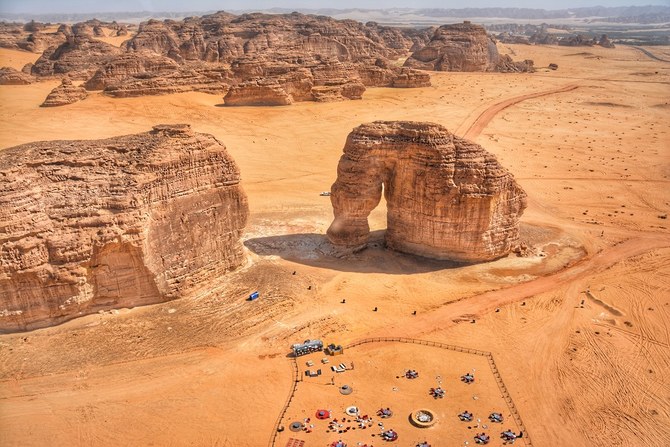
One of the highlights of the exhibition was when the French aerial photographer Yann Arthus-Bertrand was invited to film AlUla’s natural scenery, notably the massive tombs of Hegra and Dadan’s lush green oasis. The detailed animated films were projected onto large screens, transporting the viewer to the heart of AlUla.
“The rich environment of AlUla was a key point and we wanted to display it,” recalled Alsuhaibani. “Yann Arthus-Bertrand was a world-renowned professional, who was capable of allowing the visitor to virtually experience this place. Given his prior relations with the Institut du Monde Arabe, we were able to sign a contract with him and he did an amazing job.”
History shows, however, that this was not the first time the French (including other European nationals) expressed interest in the history of Hejaz (now part of modern-day Saudi Arabia). In fact, during the 19th century, several French travellers made their way to the area, documenting what they encountered.
Chief of them was Charles Huber, who Alsuhaibani described as one of the first Frenchmen to visit in 1878. Collecting rock specimens from the area, Huber’s travels to Hejaz and northern Najd were supported by the French government, which also sponsored publishing his maps and travel accounts, “Journal d’un voyage en Arabie, 1883-1884.”
Other important travelers to AlUla, specifically, were the French priests and archaeologists Antonin Jaussen (1871-1962) and Raphael Savignac (1874-1951). Residing in Jerusalem as members of the French Biblical School, the pair’s visit to Madain Saleh (Hegra) in 1907 was facilitated by the then newly established Hejaz Railway, stretching from Damascus to Madinah.
“The existence of trains meant that Jaussen and Savignac were able to take their photographic equipment with them. So, they took the very first images that we have of AlUla,” commented Alsuhaibani. Along with their insightful photographs of life in AlUla, the pair published a seminal, five-volume publication on Middle Eastern archaeology, entitled “Mission Archaeologique en Arabie,” in 1909.
Looking back, the genesis of the Paris-based French Agency for the Development of AlUla (AFALULA) in 2018 has led Saudi Arabia and France to work together in transforming AlUla into a leading tourist destination in the Arab region and the world’s largest living museum by 2035.
Aside from carrying out field excavation plans led by 50 French archaeologists, other goals of AFALULA include conservation training for the young generation of Saudis, building a museum complex, developing a sustainable agriculture and security strategy, and designing a sophisticated hotel complex by acclaimed French architect Jean Nouvel at the Shaaran Nature Reserve.
“We want to show that people can live in AlUla,” said Alsuhaibani, who obtained his doctorate in the architecture of the Dadan Kingdom at Paris’ Sorbonne University. “The place itself has been inhabited since pre-historic times until this day. AlUla has a past, a present, and a future. We have a land of historical depth and we want to share it with the world.”
Despite the challenges caused by the coronavirus pandemic, AFALULA’s executive chairman, Gerard Mestrallet has assured that the agency’s teams have continuously been in contact during the confinement period, discussing master plans for AlUla. “In just two years, the cooperation between our two countries has become stronger and more asserted,” he stated. “We are pleased with the work that we accomplished, and enthusiastic about meeting the many challenges ahead together.”


