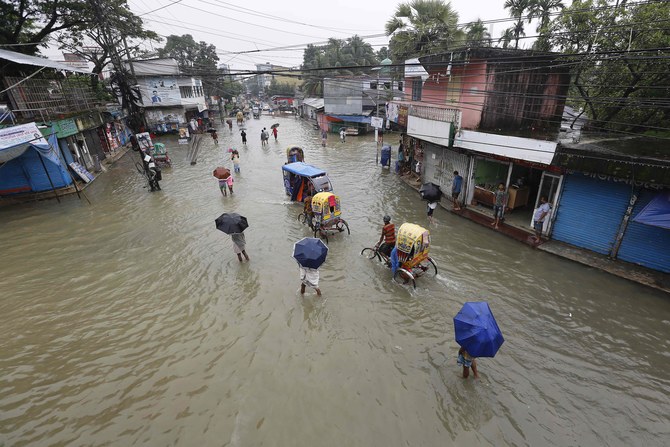
DHAKA, Bangladesh: Heavy flooding is worsening in parts of Bangladesh, with over 1 million villagers marooned or leaving their homes for higher ground along with their cattle and other belongings, officials and volunteers said Tuesday.
Water levels at major rivers were rising Tuesday at around two dozen points in 20 districts. Many new areas in northern, northeastern and central Bangladesh have been affected over last 24 hours, Arifuzzman Bhuiyan, an executive engineer with the Water Development Board, said by phone. Bangladesh has 64 districts.
“The situation is worsening," he said. “The worst thing is that the floods are getting prolonged this year, which is a bad sign.”
Bhuiyan said heavy rainfall and rushing waters from upstream India were the main reasons for the floods in the delta nation of 160 million people, which receives monsoon rains between June and October every year, often leading to flooding.
The floods started late last month, and after briefly easing continued to worsen, affecting many new areas, destroying crops and driving people from their homes in several impoverished regions. Bangladesh is crisscrossed by 230 rivers, including 53 shared with India.
In the northern district of Kurigram, one of the worst-hit areas, thousands of villagers have moved from their homes to higher ground since the weekend, bringing along their cattle and other belongings, said Mizanur Rahman Soikat, project coordinator with the Bidyanondo Foundation, a local charity. The foundation has been distributing both cooked and dry food to the flood-affected villagers, many of whom have lost their crops and livelihood.
Soikat said that over the last few weeks, the charity has distributed food to some 135,000 people in Kurigram, while the government’s relief office was also providing food, cash and cattle food.
“Over last two days, the situation has deteriorated and many villages went underwater in the district," he said by phone. “I have seen thousands taking shelter.”
The International Federation of Red Cross and Red Crescent Societies said in a statement Monday that more than a million Bangladeshis have been marooned by the floods, with the worst of it happening since the weekend.
“Thousands of people are expected to leave their homes throughout the beginning of this week to seek shelter in higher ground as the Water Development Board warned that the onrush of water from upstream would further intensify,” the statement said.
A.T.M. Akhteruzzman, a relief and rehabilitation officer in the northern district of Rangpur, said about 50,000 people who live along the Teesta River basin have been marooned.
“Waters are coming from India, while heavy rainfalls in the region are causing havoc,” he said. “We are trying to do our best to stand by the people, as we have already provided more than 300 tons of rice, cattle food, baby food and a good amount of cash. Our relief operations will continue."


![]()

Over 1 million marooned in Bangladesh as floods worsen
Short Url
https://arab.news/r9cn2
Over 1 million marooned in Bangladesh as floods worsen
- Water levels at major rivers were rising Tuesday at around two dozen points in 20 districts
- Bangladesh is crisscrossed by 230 rivers, including 53 shared with India


Latest updates


Recommended


© 2026 SAUDI RESEARCH & PUBLISHING COMPANY, All Rights Reserved And subject to Terms of Use Agreement.