

OPEC+ close to deal on next phase of oil cuts

1 / 2
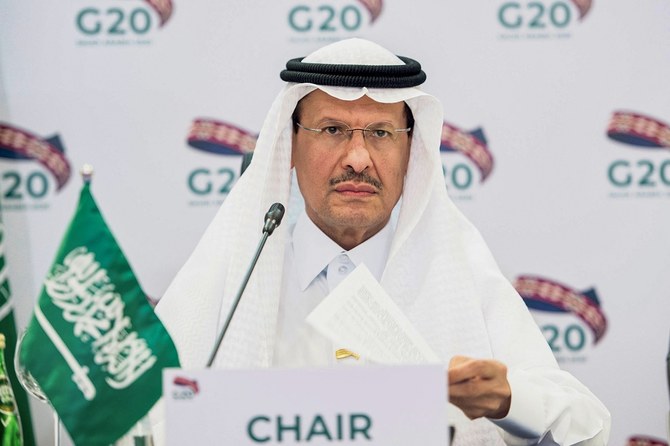
Prince Abdul Aziz bin Salman, the Saudi energy minister, held phone discussions with his counterpart in Iraq. (File/AFP)
2 / 2
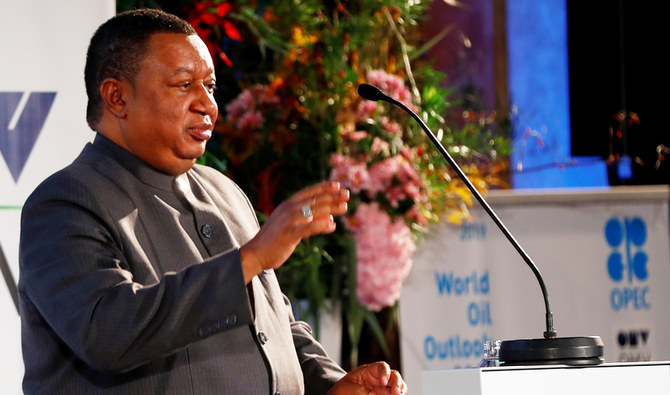
OPEC Secretary General Mohammad Barkindo delivers his speech during the presentation of the World Oil Outlook in Vienna, Austria November 5, 2019. (REUTERS)
Short Url
Updated 14 July 2020
Follow

OPEC+ close to deal on next phase of oil cuts

  • Saudi energy minister stresses importance of alliance members meeting production targets as experts point to markets rebalancing

DUBAI: OPEC+, the oil alliance led by Saudi Arabia and Russia, is close to a deal that will take it to the next stage of the historic agreement signed in April to limit global crude production.

Ministers from the 23 countries of the alliance will meet via webinar on Wednesday to seal the deal, but behind the scenes officials from the Organization of the Petroleum Exporting Countries (OPEC) have been in talks to finalize details of the agreement to add roughly 2 million barrels per day (bpd) of oil to current levels.

Prince Abdul Aziz bin Salman, the Saudi energy minister, held phone discussions with his counterpart in Iraq, Ihsan Ismail, where they affirmed their support for the new phase of the OPEC+ deal, which they agreed would “enhance oil market stability and help accelerate the rebalancing of global oil markets.”

In a call with Timipre Sylva, the Nigerian minister for petroleum resources, Prince Abdul Aziz emphasized the importance for all OPEC+ participants to meet production targets.

Russia has already signaled its desire to implement phase two of the OPEC+ agreement.

Experts believe that global oil markets had made big progress toward rebalancing since the mayhem of March and April, when oil prices collapsed.

Demand has increased as economies around the world come out of lockdown.

FASTFACT

Russia has already signaled its desire to implement phase two of the OPEC+ agreement.

OPEC+ efforts to reduce supply have been effective, and members have been meeting ambitious targets for compliance with the output levels.

The vast majority of producers have hit targets of 100 percent compliance. Some — including Saudi Arabia as the leading OPEC producer — have exceeded their targets.

The next OPEC+ schedule, which will start on Aug. 1, will see cuts in production tapered to 7.7 million bpd from the current level of 9.6 million bpd agreed in April.

OPEC+ policymakers have been encouraged by pledges from some of the countries that had missed earlier targets — such as Nigeria and Iraq — that they would make up those shortfalls by compensatory cuts in production in the summer months. Nigeria has promised 100 percent compliance.

Oil producers in the Middle East traditionally use more fuel oil domestically during the hot summer months, and that will be accentuated this year as people who would have travelled for vacation, stay at home because of the coronavirus disease (COVID-19) pandemic-related travel restrictions.

The OPEC+ agreement, as well as natural declines in other oil-producing countries because of falling demand and crude prices, is credited with rebalancing the global market.

OPEC Secretary-General Mohammed Barkindo said: “If we had not acted in such a decisive way, the market would have been in danger of a near-total collapse.”

Oil prices have more than doubled since the lows of April. Brent crude traded at $43.25 per barrel yesterday.


PIF’s Humain invests $3bn in Elon Musk’s xAI prior to SpaceX acquisition

Updated 18 sec ago
Follow

PIF’s Humain invests $3bn in Elon Musk’s xAI prior to SpaceX acquisition

JEDDAH: Humain, an artificial intelligence company owned by Saudi Arabia’s Public Investment Fund, invested $3 billion in Elon Musk’s xAI shortly before the startup was acquired by SpaceX.

As part of xAI’s Series E round, Humain acquired a significant minority stake in the company, which was subsequently converted into shares of SpaceX, according to a press release.

The transaction reflects PIF’s broader push to position Saudi Arabia as a central hub in the global AI ecosystem, as part of its Vision 2030 diversification strategy.

Through Humain, the fund is seeking to combine capital deployment with infrastructure buildout, partnerships with leading technology firms, and domestic capacity development to reduce reliance on oil revenues and expand into advanced industries.

The $3 billion commitment offers potential for long-term capital gains while reinforcing the company’s role as a strategic, scaled investor in transformative technologies.

CEO Tareq Amin said: “This investment reflects Humain’s conviction in transformational AI and our ability to deploy meaningful capital behind exceptional opportunities where long-term vision, technical excellence, and execution converge, xAI’s trajectory, further strengthened by its acquisition by SpaceX, one of the largest technology mergers on record, represents the kind of high-impact platform we seek to support with significant capital.” 

The deal builds on a large-scale collaboration announced in November at the US-Saudi Investment Forum, where Humain and xAI committed to developing over 500 megawatts of next-generation AI data center and computing infrastructure, alongside deploying xAI’s “Grok” models in the Kingdom.

In a post on his X handle, Amin said: “I’m proud to share that Humain has invested $3 billion into xAI’s Series E round, just prior to its historic acquisition by SpaceX. Through this transaction, Humain became a significant minority shareholder in xAI.”

He added: “The investment builds on our previously announced 500MW AI infrastructure partnership with xAI in Saudi Arabia, reinforcing Humain’s role as both a strategic development partner and a scaled global investor in frontier AI.”

He noted that xAI’s trajectory, further strengthened by SpaceX’s acquisition, exemplifies the high-impact platforms Humain aims to support through strategic investments.

Earlier in February, SpaceX completed the acquisition of xAI, reflecting Elon Musk’s strategy to integrate AI with space exploration.

The combined entity, valued at $1.25 trillion, aims to build a vertically integrated innovation ecosystem spanning AI, space launch technology, and satellite internet, as well as direct-to-device communications and real-time information platforms, according to Bloomberg.

Humain, founded in August, consolidates Saudi Arabia’s AI initiatives under a single entity. From the outset, its vision has extended beyond domestic markets, participating across the global AI value chain from infrastructure to applications.

The company represents a strategic initiative by PIF to diversify the Kingdom’s economy and reduce oil dependence by investing in knowledge-based and advanced technologies.