Google commits $10 billion to accelerate digitization in India

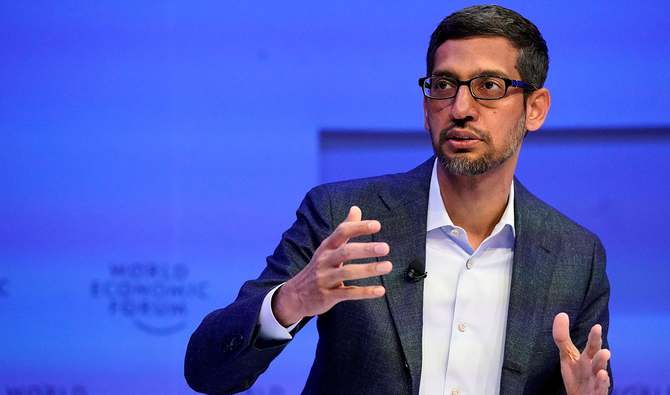
Sundar Pichai, CEO of Alphabet. (Reuters)
Short Url
Updated 14 July 2020
Follow

Google commits $10 billion to accelerate digitization in India

  • The investment will mark the tech company’s biggest commitment to a key growth market

NEW DELHI: Alphabet Inc.’s Google on Monday said it would spend around $10 billion in India over the next five to seven years through equity investments and tie-ups, marking its biggest commitment to a key growth market.

The investments will be done through a so-called digitization fund, highlighting Google’s focus on the rapid pace of growth of apps and software platforms in India, one of the world’s biggest internet services markets.

“We’ll do this through a mix of equity investments, partnerships, and operational, infrastructure and ecosystem investments,” Sundar Pichai, CEO of Alphabet, said on a webcast during an annual “Google for India” event.

“This is a reflection of our confidence in the future of India and its digital economy.”

The new $10 billion investment was the largest Google had done in India, Pichai said.

“We’re particularly focused on making sure the internet expands beyond English and other vernacular languages. That’s an important angle we’ve looked at,” he told Reuters in an interview.

Google wants to bolster the growth of internet in India, which currently has over 500 million active users, and help get another 500 million people online, Pichai said.

Beyond investments via the fund, Google, would also focus on areas like artificial intelligence and education in India, he added.

Google has already made some direct and indirect investments in Indian startups such as local delivery app Dunzo.

Indian-born Pichai joined Google in 2004, and is widely credited for making the Chrome browser. He replaced company co-founder Larry Page as CEO of parent Alphabet Inc. last year.

The US tech group, whose Android mobile operating system powers a bulk of India’s roughly 500 million smartphones, will continue to work with manufacturers to build low-cost devices so that more and more people can access the internet, another Google executive said.


Education spending surges 251% as students return from autumn break: SAMA

Updated 12 December 2025
Follow

Education spending surges 251% as students return from autumn break: SAMA

RIYADH: Education spending in Saudi Arabia surged 251.3 percent in the week ending Dec. 6, reflecting the sharp uptick in purchases as students returned from the autumn break.

According to the latest data from the Saudi Central Bank, expenditure in the sector reached SR218.73 million ($58.2 million), with the number of transactions increasing by 61 percent to 233,000.

Despite this surge, overall point-of-sale spending fell 4.3 percent to SR14.45 billion, while the number of transactions dipped 1.7 percent to 236.18 million week on week.

The week saw mixed changes between the sectors. Spending on freight transport, postal and courier services saw the second-biggest uptick at 33.3 percent to SR60.93 million, followed by medical services, which saw an 8.1 percent increase to SR505.35 million.

Expenditure on apparel and clothing saw a decrease of 16.3 percent, followed by a 2 percent reduction in spending on telecommunication.

Jewelry outlays witnessed an 8.1 percent decline to reach SR325.90 million. Data revealed decreases across many other sectors, led by hotels, which saw the largest dip at 24.5 percent to reach SR335.98 million. 

Spending on car rentals in the Kingdom fell by 12.6 percent, while airlines saw a 3.7 percent increase to SR46.28 million.

Expenditure on food and beverages saw a 1.7 percent increase to SR2.35 billion, claiming the largest share of the POS. Restaurants and cafes retained the second position despite a 12.6 percent dip to SR1.66 billion.

Saudi Arabia’s key urban centers mirrored the national decline. Riyadh, which accounted for the largest share of total POS spending, saw a 3.9 percent dip to SR4.89 billion, down from SR5.08 billion the previous week.

The number of transactions in the capital settled at 74.16 million, down 1.4 percent week on week.

In Jeddah, transaction values decreased by 5.9 percent to SR1.91 billion, while Dammam reported a 0.8 percent surge to SR713.71 million.

POS data, tracked weekly by SAMA, provides an indicator of consumer spending trends and the ongoing growth of digital payments in Saudi Arabia. 

The data also highlights the expanding reach of POS infrastructure, extending beyond major retail hubs to smaller cities and service sectors, supporting broader digital inclusion initiatives. 

The growth of digital payment technologies aligns with the Kingdom’s Vision 2030 objectives, promoting electronic transactions and contributing to the nation’s broader digital economy.