



JEDDAH: Turkey’s controversial decision to reconvert the Hagia Sophia from museum to mosque has further strained its already tense relationship with the EU.
The issue surrounding the Hagia Sophia — the Byzantine cathedral turned Ottoman mosque turned global tourist attraction — follows a previous dispute between Ankara and the leaders of EU countries over Turkey’s continued energy exploration and drilling activities in the eastern Mediterranean.
These two complicated “hot potatoes” risk further disconnecting Turkey from the EU, and feed a growing mistrust between both parties.
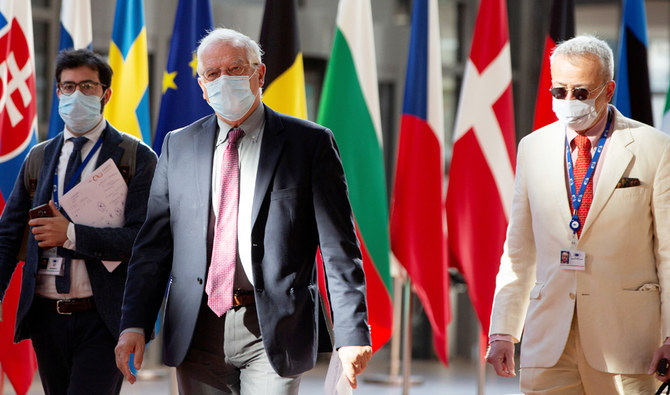
After Monday’s meeting of 27 EU foreign ministers, Josep Borrell, EU foreign affairs chief, who visited Turkey last week to negotiate the eastern Mediterranean disputes, harshly condemned the Hagia Sophia move.
“This decision will inevitably fuel the mistrust, promote renewed division between religious communities, and undermine our efforts at dialogue and cooperation,” he said, urging Turkish authorities to reverse their verdict.
The EU Foreign Affairs Council will also ask its diplomatic European External Action Service to explore options for further measures against Turkey.
In a separate statement on June 10, Borrell said he found the decision regarding Hagia Sophia as “regrettable."
“As a founding member of the Alliance of Civilizations, Turkey has committed to the promotion of interreligious and intercultural dialogue and to fostering tolerance and coexistence,” he said.
The EU is confronted with a deliberately hostile narrative that has very deep electoral and ideological motivations, but has a clear consequence: To widen the gap between Turkey and the EU.
Marc Pierini, Former EU ambassador to Turkey
Marc Pierini, a former EU ambassador to Turkey and now at the Carnegie Europe foundation, told Arab News that there was no tactical justification to take a decision at the EU foreign ministers’ meeting since Turkey’s “adverse narrative is bound to increase in the days and weeks to come.”
He said: “The EU is confronted with a deliberately hostile narrative that has very deep electoral and ideological motivations, but has a clear consequence: To widen the gap between Turkey and the EU.”
According to Pierini, as long as Ankara believes there are more benefits than inconvenience in this strategy, the gap will widen.
“The issue is whether the citizens of Turkey will see a tangible benefit,” he said.
Turkey’s decision to reconvert the Hagia Sophia also angered Pope Francis along with Greek authorities. Greek government spokesman Stelios Petsas said on Monday that the EU was “faced with a challenge and an insult.”
As the EU has no leverage over Turkey’s domestic policy, it clearly can’t influence Turkey’s stance on the Hagia Sophia issue.
Karol Wasilewski, Analyst
However, Karol Wasilewski, a Turkey analyst at the Warsaw-based Polish Institute of International Affairs, believes the Hagia Sophia issue is unlikely to weigh much on EU-Turkey relations compared with other problems in the relationship.
“As the EU has no leverage over Turkey’s domestic policy, it clearly can’t influence Turkey’s stance on the Hagia Sophia issue,” he said.
However, the international criticism concerning the Hagia Sophia and drilling in the eastern Mediterranean drilling appears to carry little weight with Turkish authorities who view the attacks as an intervention into Turkey’s sovereign rights, while Ankara considers drilling in the region as a move to protect its national interests.
At Monday’s meeting, Greece insisted that the presence of Turkish drilling vessels violates international law, and should trigger political, financial and diplomatic sanctions.
Brussels views any attempt to weaken Greece’s borders and rights as an equal affront to the EU, Borrell said on June 27.
The ministers are set to meet again next month in Berlin to discuss both issues.
Wasilewski believes Turkey is prepared for any escalation on the Mediterranean issue, with Mevlut Cavusoglu, Turkey’s foreign minister, seeking to blame Cyprus for the dispute.
Cavusoglu has accused Cyprus of being the “real culprit” of the eastern Mediterranean’s energy issue, saying: “They embarked on their seismic research activities by ignoring the rights of the Turkish Cypriot people.”


