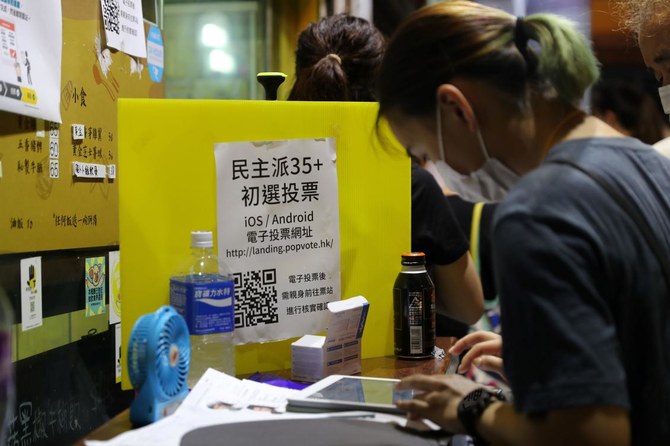
HONG KONG: Hundreds of thousands of Hong Kongers turned up over the weekend to vote in an unofficial two-day primary election held by the city’s pro-democracy camp as it gears up to field candidates for an upcoming legislative poll.
The exercise is being held two weeks after Beijing imposed a sweeping national security law on the semi-autonomous territory in a move widely seen as chipping away at the “one country, two systems” framework under which Britain handed Hong Kong over to China in 1997. It was passed in response to last year’s massive protests calling for greater democracy and more police accountability.
Throngs of people lined up at polling booths in the summer heat to cast their vote despite a warning by Hong Kong’s constitutional affairs minister, Eric Tsang last week that the primaries could be in breach of the new national security law, because it outlaws interference and disruption of duties by the local government.
Organizers have dismissed the comments, saying they just want to hold the government accountable by gaining a majority in the legislature.
The legislation prohibits what Beijing views as secessionist, subversive or terrorist activities or as foreign intervention in Hong Kong affairs. Under the law, police now have sweeping powers to conduct searches without warrants and order Internet service providers and platforms to remove messages deemed to be in violation of the legislation.
On Friday, police raided the office of the Public Opinion Research Institute, a co-organizer of the primary elections. The computer system was suspected of being hacked, causing a data leak, police said in a statement, and an investigation is ongoing.
Hong Kong’s pro-democracy camp, which includes multiple parties, is attempting to join forces and use the primaries as a guide to field the best candidates in the official legislative election in September. Its goal is to win a majority in the legislature, which is typically skewed toward the pro-Beijing camp.
To hold the primary elections, pro-democracy activists had raised money via crowd funding. They pledged to veto the government’s budget if they clinch a majority in the legislature. Under the Basic Law, under which Hong Kong is governed, city leader Carrie Lam must resign if an important bill such as the budget is vetoed twice.
On Saturday alone, nearly 230,000 people voted at polling booths set up across the city, exceeding organizers’ estimates of a 170,000 turnout over the weekend.


![]()


Over 200,000 vote in Hong Kong’s pro-democracy primaries
Short Url
https://arab.news/mt62u
Over 200,000 vote in Hong Kong’s pro-democracy primaries
- Exercise being held two weeks after Beijing imposed a sweeping national security law on the semi-autonomous territory


China is the real threat, Taiwan says in rebuff to Munich speech
- China views democratically governed Taiwan as its own territory, a view the government in Taipei rejects
TAIPEI: China is the real threat to security and is hypocritically claiming to uphold UN principles of peace, Taiwan Foreign Minister Lin Chia-lung said on Sunday in a rebuff to comments by China’s top diplomat at the Munich Security Conference.
China views democratically governed Taiwan as its own territory, a view the government in Taipei rejects, saying only Taiwan’s people can decide their future.
Chinese Foreign Minister Wang Yi, addressing the annual security conference on Saturday, warned that some countries were “trying to split Taiwan from China,” blamed Japan for tensions over the island and underscored the importance of upholding the United Nations Charter.
Taiwan’s Lin said in a statement that whether viewed from historical facts, objective reality or under international law, Taiwan’s sovereignty has never belonged to the People’s Republic of China.
Lin said that Wang had “boasted” of upholding the purposes of the UN Charter and had blamed other countries for regional tensions.
“In fact, China has recently engaged in military provocations in surrounding areas and has repeatedly and openly violated UN Charter principles on refraining from the use of force or the threat of force,” Lin said. This “once again exposes a hegemonic mindset that does not match its words with its actions.”
China’s military, which operates daily around Taiwan, staged its latest round of mass war games near Taiwan in December.
Senior Taiwanese officials like Lin are not invited to attend the Munich conference.
China says Taiwan was “returned” to Chinese rule by Japan at the end of World War Two in 1945 and that to challenge that is to challenge the postwar international order and Chinese sovereignty.
The government in Taipei says the island was handed over to the Republic of China, not the People’s Republic, which did not yet exist, and hence Beijing has no right to claim sovereignty.
The republican government fled to Taiwan in 1949 after losing a civil war with Mao Zedong’s communists, and the Republic of China remains the island’s formal name.
China views democratically governed Taiwan as its own territory, a view the government in Taipei rejects, saying only Taiwan’s people can decide their future.
Chinese Foreign Minister Wang Yi, addressing the annual security conference on Saturday, warned that some countries were “trying to split Taiwan from China,” blamed Japan for tensions over the island and underscored the importance of upholding the United Nations Charter.
Taiwan’s Lin said in a statement that whether viewed from historical facts, objective reality or under international law, Taiwan’s sovereignty has never belonged to the People’s Republic of China.
Lin said that Wang had “boasted” of upholding the purposes of the UN Charter and had blamed other countries for regional tensions.
“In fact, China has recently engaged in military provocations in surrounding areas and has repeatedly and openly violated UN Charter principles on refraining from the use of force or the threat of force,” Lin said. This “once again exposes a hegemonic mindset that does not match its words with its actions.”
China’s military, which operates daily around Taiwan, staged its latest round of mass war games near Taiwan in December.
Senior Taiwanese officials like Lin are not invited to attend the Munich conference.
China says Taiwan was “returned” to Chinese rule by Japan at the end of World War Two in 1945 and that to challenge that is to challenge the postwar international order and Chinese sovereignty.
The government in Taipei says the island was handed over to the Republic of China, not the People’s Republic, which did not yet exist, and hence Beijing has no right to claim sovereignty.
The republican government fled to Taiwan in 1949 after losing a civil war with Mao Zedong’s communists, and the Republic of China remains the island’s formal name.
Latest updates


Recommended



© 2026 SAUDI RESEARCH & PUBLISHING COMPANY, All Rights Reserved And subject to Terms of Use Agreement.