

US ‘disappointed’ by Turkey mosque move on Hagia Sophia

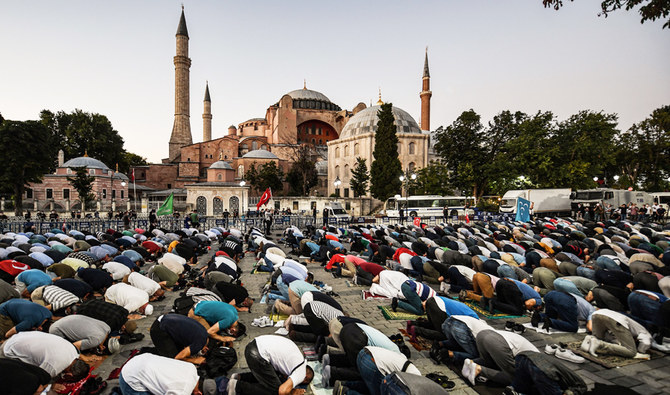
People, some wearing face masks, pray outside the Hagia Sophia museum in Istanbul on July 10, 2020 as they gather to celebrate after a top Turkish court revoked the sixth-century Hagia Sophia's status as a museum, clearing the way for it to be turned back into a mosque. (AFP)
Short Url
Updated 12 July 2020
Follow

US ‘disappointed’ by Turkey mosque move on Hagia Sophia

  • Turkish President Recep Tayyip Erdogan, who has chipped away at the Muslim-majority country’s secularism, announced Muslim prayers on July 24 at the UNESCO World Heritage site

WASHINGTON: The US said it was “disappointed” by Turkey’s decision to turn the Byzantine-era monument Hagia Sophia back into a mosque and urged equal access for all visitors.
“We are disappointed by the decision by the government of Turkey to change the status of the Hagia Sophia,” State Department spokeswoman Morgan Ortagus said.
“We understand the Turkish government remains committed to maintaining access to the Hagia Sophia for all visitors, and look forward to hearing its plans for continued stewardship of the Hagia Sophia to ensure it remains accessible without impediment for all,” she said on Friday.
Turkish President Recep Tayyip Erdogan, who has chipped away at the Muslim-majority country’s secularism, announced Muslim prayers on July 24 at the UNESCO World Heritage site.
A magnet for tourists worldwide, the Hagia Sophia was first constructed as a cathedral in the Christian Byzantine Empire but was converted into a mosque after the Ottoman conquest of Constantinople in 1453.
Erdogan’s announcement came after the cancellation of a decision under modern Turkey’s secularizing founder Mustafa Kemal Ataturk to preserve the church-turned-mosque as a museum.

We understand the Turkish government remains committed to maintaining access to the Hagia Sophia for all visitors, and look forward to hearing its plans for continued stewardship of the Hagia Sophia to ensure it remains accessible without impediment for all.

Morgan Ortagus, State Department spokeswoman

Erdogan went ahead despite an open appeal to the NATO ally by US Secretary of State Mike Pompeo, an evangelical Christian who frequently speaks about religious freedom.
In a statement last week, Pompeo called the museum status an “exemplar” of Turkey’s “commitment to respect the faith traditions and diverse history” of the country and said a change risked “diminishing the legacy of this remarkable building.”
Democratic presidential candidate Joe Biden also said on Friday he deeply regretted Turkey’s decision.
Biden called on Erdogan to reverse it “and instead keep this treasured place in its current status as a museum, ensuring equal access for all.”


More than 80 countries condemn new Israeli rules in West Bank, invoke the ‘New York Declaration’

Updated 6 sec ago
Follow

More than 80 countries condemn new Israeli rules in West Bank, invoke the ‘New York Declaration’

  • Surrounded by nations’ representatives, Palestinian envoy Riyad Mansour reads statement at UN HQ denouncing the measures as ‘contrary to Israel’s obligations under international law’
  • Critics say the steps — including expansion of Israeli settlements, legalization of outposts, direct land purchases by settlers, removal of oversight — amount to de facto annexation

NEW YORK CITY: More than 80 countries and several international organizations on Tuesday condemned what they described as unilateral decisions and measures taken by Israeli authorities with the aim of expanding their “unlawful” presence in the occupied West Bank.
Surrounded by more than 80 representatives of the nations and groups, Riyad Mansour, the permanent observer of the State of Palestine to the UN, read a joint statement in which they said: “Such decisions are contrary to Israel’s obligations under international law and must be immediately reversed.”
Israel this month approved significant new measures that tighten its control of the occupied West Bank, focusing in particular on accelerating the process of registering land in a part of the territory known as Area C as “state property.”
The new steps, which critics say amount to de facto annexation, include the legalization of outposts, expansion of Israeli settlements, authorization for direct land purchases by settlers, and the removal of oversight on such transactions.
In their statement, the countries and organizations stressed their “strong opposition to any form of annexation.”
They continued: “We reiterate our rejection of all measures aimed at altering the demographic composition, character and status of the Palestinian territory occupied since 1967, including East Jerusalem.
“Such measures violate international law, undermine the ongoing efforts for peace and stability in the region, run counter to the comprehensive plan, and jeopardize the prospect of reaching a peace agreement ending the conflict.”
They reaffirmed their determination “to take concrete measures in accordance with international law, and in line with the relevant UN resolutions and the July 19 advisory opinion of the International Court of Justice, to help realize the right of the Palestinian people to self-determination, and to counter the illegal settlement policy in the occupied Palestinian territory, including East Jerusalem, and policies and threats of forcible displacement.”
This stance is reflected, they said, in the 2025 New York Declaration, a UN-endorsed initiative proposed, following a conference in July 2025, by France and Saudi Arabia with the aim of reviving efforts to achieve a two-state solution to the conflict between Israel and Palestine.
“We reiterate that a just and lasting peace on the basis of the relevant UN resolutions, the Madrid terms of reference, including the principle of land for peace, and the Arab Peace Initiative, ending the Israeli occupation that began in 1967 and implementing the two-state solution — where two democratic states, an independent and sovereign Palestine and Israel, live side by side in peace and security within their secure and recognized borders on the basis of the 1967 lines, including with regard to Jerusalem — remains the only path to ensure security and stability in the region,” they added.