
DUBAI: Advances in technology continue to redefine the ways in which we think, work, live and interact with people and our surroundings. As a result, many traditional careers are in decline, which raises important questions for young people in particular.
Will the number of jobs that are rendered obsolete by the rapid pace of technological change be greater than the new opportunities and career options it creates? And, crucially, what are the key subjects to study and skills to learn to keep in step with the times and future-proof career options?
According to Manal Hakim, the founder and CEO of Geek Express, an educational-technology platform, the key to future job security lies in predicting changes in employment roles and learning the skills needed to adapt to them. In the next decade, for example, it is estimated that the increased use of AI in all sectors will eliminate 75 million jobs, but create 133 million, she said.
Many future jobs will be based, to a significant degree, on “coding, robotics and STEM (Science, Technology, Engineering, Mathematics) skills,” said Hakim, adding that demand will grow for workers proficient in jobs such as data analysis, software and app development, robotics, and e-commerce and social media.
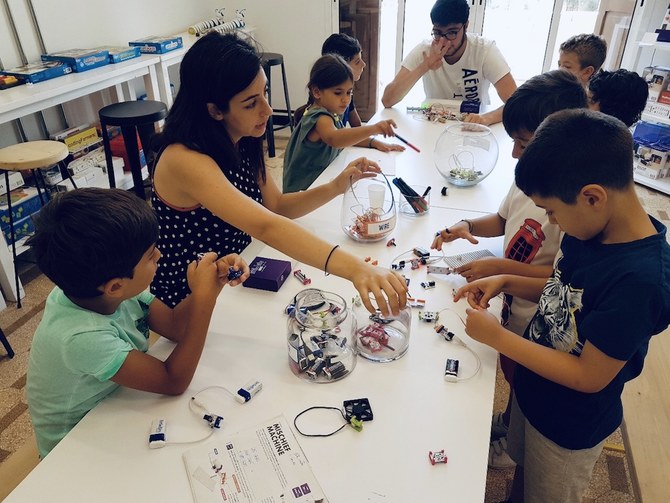
The importance of, and emphasis placed on, STEM education lies in the fact that it focuses on real-world applications of the four disciplines through a cohesive learning approach. Considered by education experts as a driver of sustainable growth in Gulf Cooperation Council countries, STEM-related classes are offered across the region, through workshops in schools and also as standalone courses.
By teaching students as young as five years old the fundamentals of skills such as coding, robotics and design, STEM education is laying the “foundation of both education and innovation,” said Hakim.
She describes coding, robotics and design as the “new universal language,” and an integral part of STEAM (science, technology, engineering, art and mathematics) education, which is an integrated approach to learning designed to encourage students to think more broadly about real-world problems.
There is already a shift underway in education, with a growing emphasis on dedicated lessons on coding and STEM skills for children in the earliest grades, according to Cody Claver, general manager of accredited online school iCademy Middle East.
“Students are drawn to the futuristic skills they see as fun and engaging,” he said.
He believes that students who acquire technological skills in a focused, purposeful way, and also gain familiarity with learning in a technological environment, end up as assets for potential employers.
Currently, Geek Express provides private, live online coaching to 1,200 students between the ages of 5 and 17 in Beirut, Dubai, Jeddah and Doha. It uses a “futuristic school” model that offers a range of learning options, in English and Arabic, that students can work through at their own pace, including hands-on projects, private lessons, semester-long classes and educational holiday camps.
The main focus, said Hakim, is to teach young people how to code so that they become “creators of technology” and not simply passive users. More than 30 courses are available, beginning with block-based coding logic for the youngest students, followed by more complex algorithms, game design, app and web development, and advanced classes on data science and AI.
“A child should be able to design his or her own app, not only use it,” Hakim said.
The importance of preparing young minds to adapt to future job-market demands might transform our ideas about, and approach to, education, said Claver.
“I believe we will see a continued re-imagination on the part of companies such as Google, Amazon and the like, to have students bypass traditional university structures and train directly with them,” he said.
Given the rapid changes in technology, and the resultant evolution of the job market, how prepared are education authorities to ensure students meet future employment demands? This is a particularly important question for the Middle East and North Africa region, where nearly half of the population is under the age of 24, according to data from UNICEF, the United Nations Children’s Fund?
Three main criteria will determine job security in the years ahead, particularly for those born since 1995: flexibility, diversity of qualifications, and technological skills.
Emma Whale, vice president of Schools education company Pearson Middle East, said that educators and regional governments are making concerted efforts to ensure these criteria are recognized as the gateway to future employability, but there are also other factors that create a gap between skills and jobs.
“The gap is also about language proficiency, and those uniquely human skills that will differentiate us in the future from AI,” said Whale.
Hakim said that efforts are already being made to ensure young people learn the skills they need for the future but more can be done.
“There have been great initiatives in the region, such as the UAE’s One Million Arab Coders and the Saudi Vision 2030 for education,” she said.
However, she said that the growing need for STEM skills is outpacing the slow process of change to curricula in the region and around the world.
“I believe the best ways to fill the gap are broader and bolder (education) reforms, and consistent collaboration between the private and public sectors to build momentum for STEM adoption across private and public schools, homes, activity centers, camps and youth programs, with this model as the foundation for all education,” said Hakim.
Proper analysis of employment trends is also important when preparing for the future as it provides valuable pointers for educators and policymakers. A survey by education provider Pearson Global, for example, found that 79 percent of respondents felt they should do more to develop their knowledge of STEM subjects.
“An understanding of in-demand skills such as coding, UX (user experience) design, cloud computing and analytical reasoning helps people to expand their knowledge and capabilities and set themselves apart from other (job) candidates,” said Whale.
She also listed creative thinking, reasoning, collaboration, strong interpersonal communication, emotional quotient, diversity and cultural intelligence as ranking high among sought-after personal skills in the job market.
The half-life of job skills — meaning the amount of time it takes for half of the knowledge associated with those skills to becomes irrelevant — has fallen from 30 years to an average of just six years. As a result, Whale said: “Companies in the future will look at hiring candidates with a desirable mix of hard and soft skills.” Hard skills are related to technical knowledge and training, while soft skills are personality traits such as leadership and communication.
While endorsing the value of a broad academic grounding, she said it is important for students with a clear idea of the industries they might want to work in to follow a clear vocational pathway, which can provide a faster track to employment.
The Fourth Industrial Revolution is being fueled by a fusion of technologies that blur the lines between the physical, digital and biological. The key to success in the job market during this era will be to welcome change and celebrate it, said Whale.
“It’s time for all of us to begin acquiring skills that will make us valuable resources in the future workplace,” she added.
---------------