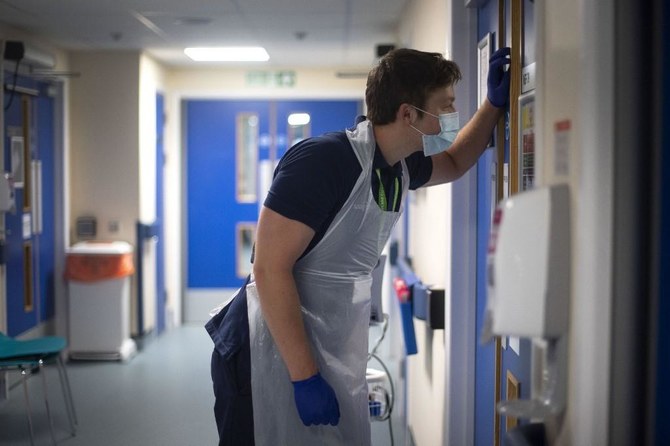
LONDON: Specialists in London have linked COVID-19 to a rare form of brain inflammation. Nine cases in the UK capital are said to have shown signs of “concerning” disseminated encephalomyelitis (Adem), which involves swelling of the brain and spinal cord, leading to weakness in the limbs, loss of balance, fatigue and drowsiness.
So far, the cases have only occurred in adults with confirmed or suspected COVID-19 infections, and represent the number the UK would expect to see nationally over the course of five months.
Adem is usually triggered by a viral infection, causing immune cells to attack the protective coating covering the nervous system.
COVID-19 was not detected in the brain or spinal fluid of any of the patients, according to the study, but evidence suggested that brain inflammation had been caused by an immune response to the disease.
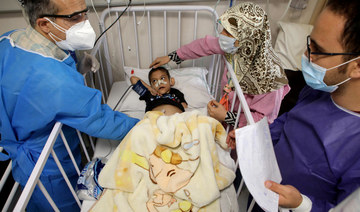
Adem is not the only disorder linked to COVID-19. A study in the medical journal Brain has so far linked the virus to 43 different cases in the UK, including a brain disorder known as encephalopathy with delirium, which has so far affected 10 patients, and which causes confusion and even psychosis and seizures.
“We know from previous viruses that you can get neurological (consequences), so I don’t think we should be terribly surprised, but the range of clinical complications is broad,” said Dr. Ross Paterson of the UCL Queen Square Institute of Neurology, who co-authored the study published in Brain.
“To have cases of delirium with psychosis, completely out of proportion with the respiratory virus, is unusual. The cases we are seeing are perhaps just a small snapshot of the severe end of the spectrum,” he added.
“Given that the disease has only been around for a matter of months, we might not yet know what long-term damage COVID-19 can cause. Doctors need to be aware of possible neurological effects as early diagnosis can improve patient outcomes.”
Patterson’s co-author Dr. Michael Zandi, also of the UCL Queen Square Institute of Neurology, said: “We identified a higher than expected number of people with neurological conditions such as brain inflammation, which did not always correlate with the severity of respiratory symptoms.”
Zandi added: “We should be vigilant and look out for these complications in people who have had COVID-19. Whether we will see an epidemic on a large scale of brain damage linked to the pandemic … remains to be seen.”


COVID-19 linked to severe brain conditions: UK scientists
https://arab.news/jftg9
COVID-19 linked to severe brain conditions: UK scientists

- Nine cases in the UK capital are said to have shown signs of “concerning” disseminated encephalomyelitis (Adem)
- The rare form of brain inflammation involves swelling of the brain and spinal cord


Afghan barbers under pressure as morality police take on short beards
KABUL: Barbers in Afghanistan risk detention for trimming men’s beards too short, they told AFP, as the Taliban authorities enforce their strict interpretation of Islamic law with increasing zeal.
Last month, the Ministry for the Propagation of Virtue and Prevention of Vice said it was now “obligatory” to grow beards longer than a fist, doubling down on an earlier order.
Minister Khalid Hanafi said it was the government’s “responsibility to guide the nation to have an appearance according to sharia,” or Islamic law.
Officials tasked with promoting virtue “are obliged to implement the Islamic system,” he said.
With ministry officials patrolling city streets to ensure the rule is followed, the men interviewed by AFP all spoke on condition of anonymity due to security concerns.
In the southeastern province of Ghazni, a 30-year-old barber said he was detained for three nights after officials found out that one of his employees had given a client a Western-style haircut.
“First, I was held in a cold hall. Later, after I insisted on being released, they transferred me to a cold (shipping) container,” he said.
He was eventually released without charge and continues to work, but usually hides with his clients when the patrols pass by.
“The thing is that no one can argue or question” the ministry officials, the barber said.
“Everyone fears them.”

He added that in some cases where both a barber and clients were detained, “the clients have been let out, but they kept the barber” in custody.
Last year, three barbers in Kunar province were jailed for three to five months for breaching the ministry’s rules, according to a UN report.
‘Personal space’
Alongside the uptick in enforcement, the religious affairs ministry has also issued stricter orders.
In an eight-page guide to imams issued in November, prayer leaders were told to describe shaving beards as a “major sin” in their sermons.
The religious affairs ministry’s arguments against trimming state that by shaving their beards, men were “trying to look like women.”
The orders have also reached universities — where only men study because women have been banned.
A 22-year-old Kabul University student said lecturers “have warned us... that if we don’t have a proper Islamic appearance, which includes beards and head covering, they will deduct our marks.”

In the capital Kabul, a 25-year-old barber lamented that “there are a lot of restrictions” which go against his young clients’ preference for closer shaves.
“Barbers are private businesses, beards and heads are something personal, they should be able to cut the way they want,” he said.
Hanafi, the virtue propagation minister, has dismissed such arguments, saying last month that telling men “to grow a beard according to sharia” cannot be considered “invading the personal space.”
Business slump
In Afghanistan, the majority are practicing Muslims, but before the Taliban authorities returned to power in 2021, residents of major cities could choose their own appearance.
In areas where Taliban fighters were battling US-backed forces, men would grow beards either out of fear or by choice.
As fewer and fewer men opt for a close shave, the 25-year-old Kabul barber said he was already losing business.
Many civil servants, for example, “used to sort their hair a couple of times a week, but now, most of them have grown beards, they don’t show up even in a month,” he said.
A 50-year-old barber in Kabul said morality patrols “visit and check every day.”
In one incident this month, the barber said that an officer came into the shop and asked: “Why did you cut the hair like this?“
“After trying to explain that he is a child, he told us: ‘No, do Islamic hair, not English hair’.”