

Virus-testing rules for air passengers traveling in and out of Dubai, the UAE

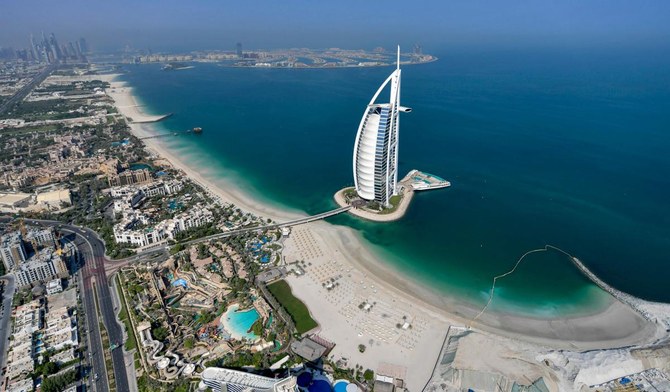
This picture taken on July 8, 2020 shows an aerial view of the Burj Al-Arab hotel in the Gulf emirate of Dubai, during a government-organised plane tour. (AFP)
Short Url
Updated 09 July 2020
Follow

Virus-testing rules for air passengers traveling in and out of Dubai, the UAE

  • UAE residents and citizens can now travel to any destination as long as health and safety measures are met
  • Dubai visa-holders are not required by the emirate’s government or airlines to be tested for COVID-19 before flying

DUBAI: Summer travel in the UAE is set to soar as federal restrictions are eased, students finish school, and tourists return to Dubai.
However, Dubai has its own crisis authority and immigration service, and different rules from the rest of the country.
Travel regulations were updated last Friday by the National Emergency Crisis and Disasters Management Authority (NCEMA), the Federal Authority for Identity and Citizenship (ICA), and the Ministry of Foreign Affairs and International Cooperation.
UAE residents and citizens can now travel to any destination as long as health and safety measures are met.
Before booking flights, Dubai residents traveling abroad this summer are being advised to apply to Dubai’s immigration service, the General Directorate of Residency and Foreigners Affairs (GDRFA), for permission to leave, and also return to, the country.


Passengers flying with the Emirates airline will need to obtain a GDRFA number to book their outbound flight. Dubai visa-holders are not required by the emirate’s government or airlines to be tested for the coronavirus disease (COVID-19) before flying.
This is the main difference between Dubai and federal rules, outlined by the NCEMA.
People living in Dubai but working on a visa from another emirate, must follow federal rules requiring them to gain travel approval via the Tawajudi system. UAE nationals, on the other hand, should register with the Tawajudi system to allow communication with them while traveling.
Residents returning to Dubai will be tested for COVID-19 at the airport and will need to stay at home until receiving their results, which could take up to three days. If results test positive, individuals must self-isolate for 14 days.
Tourists visiting Dubai must take a polymerase chain reaction (PCR) nasal swab test up to four days before flying at a hospital or private clinic in their home country and carry test-result documentation with them to the city.
Travelers with valid, recognized tests, and showing no COVID-19 symptoms, will not be tested in Dubai or quarantined. Those unable to be tested before traveling will be screened by medics on arrival at Dubai airport. Children will also need to be tested in order to enter Dubai.
Residents of Abu Dhabi and the northern emirates must apply to the federal government’s ICA/Tawajudi system for permission to travel abroad and test negative for COVID-19 before leaving Abu Dhabi or other UAE airports. Passengers who fail to present a valid negative COVID-19 test, taken within 72 hours of flying, will not be permitted to board their aircraft.
Once in their home country or destination, travelers will need to be tested before returning to the UAE, this requirement being the major difference from Dubai’s system which does not demand it.
When returning, passengers must show their negative test before boarding their plane back to the UAE and on arrival must quarantine for 14 days as a precaution, even if the test was negative.


Slain son of former Libya ruler Qaddafi to be buried near capital

Seif Al-Islam Qaddafi speaks to the media at a press conference in a hotel in Tripoli, Libya. (File/AP)
Updated 21 min ago
Follow

Slain son of former Libya ruler Qaddafi to be buried near capital

  • The burial will be held on Friday in the town of Bani Walid some 175 kilometers south of Tripoli, two of his brothers said

TRIPOLI: The slain son of former Libyan ruler Muammar Qaddafi will be buried in a town south of the capital that remains loyal to the family, relatives said Thursday.
Seif Al-Islam Qaddafi, once seen by some as Libya’s heir apparent, was shot dead on Tuesday in the northwestern city of Zintan.
The burial will be held on Friday in the town of Bani Walid some 175 kilometers south of Tripoli, two of his brothers said.
“The date and location of his burial have been decided by mutual agreement among the family,” half-brother Mohamed Qaddafi said in a Facebook post.
Mohamed said the plan reflected “our respect” for the town, which has remained loyal to the elder Qaddafi years after he was toppled and killed in the 2011 Arab Spring uprisings.
Each year, the town of about 100,000 celebrates the anniversary of a 1969 coup that brought Muammar to power, parading through the streets holding the ex-leader’s portrait.
Saadi Qaddafi, a younger brother, said his dead sibling will be “buried among the Werfalla,” an influential local tribe, in a grave next to his brother Khamis Qaddafi, who died during the 2011 unrest.
Marcel Ceccaldi, a French lawyer who had been representing Seif Al-Islam, told AFP he was killed by an unidentified “four-man commando” who stormed his house on Tuesday.
Seif Al-Islam had long been widely seen as his father’s heir. Under the elder Qaddafi’s iron-fisted 40-year rule, he was described as the de facto prime minister, cultivating an image of moderation and reform despite holding no official position.
But that reputation soon collapsed when he promised “rivers of blood” in retaliation for the 2011 uprising.
He was arrested that year on a warrant issued by the International Criminal Court for alleged crimes against humanity, and a Tripoli court later sentenced him to death, although he was later granted amnesty.
In 2021 he announced he would run for president but the elections were indefinitely postponed.
He is survived by four out of six siblings: Mohamed, Saadi, Aicha and Hannibal, who was recently released from a Lebanese prison on bail.
Libya has struggled to recover from chaos that erupted after the 2011 uprising. It remains split between a UN-backed government based in Tripoli and an eastern administration backed by Khalifa Haftar.