

Iran admits fire at Natanz nuclear facility caused ‘significant damage’

A view of a damage building after a fire broke out at Iran's Natanz Nuclear Facility, in Isfahan, Iran, July 2, 2020. (Reuters)
Short Url
Updated 06 July 2020
Follow

Iran admits fire at Natanz nuclear facility caused ‘significant damage’

  • Official says damage could slow the development of advanced centrifuges
  • Some Iranian officials have said it may have been caused by cyber sabotage

DUBAI: A fire that broke out at Iran's Natanz nuclear facility on Thursday has caused significant damage that could slow the development of advanced centrifuges, an Iranian nuclear official said on Sunday.
Iran's top security body said on Friday that the cause of an incident and fire at Natanz had been determined and would be announced later. Some Iranian officials have said it may have been caused by cyber sabotage and one warned that Tehran would retaliate against any country carrying out such attacks.
"The incident could slow down the development and production of advanced centrifuges in the medium term ... Iran will replace the damaged building with a bigger one that has more advanced equipment," state news agency IRNA quoted the spokesman for Iran's Atomic Energy Organisation, Behrouz Kamalvandi, as saying.
"The incident has caused significant damage but there were no casualties."
Three Iranian officials who spoke to Reuters on condition of anonymity on Friday said they believed the fire was the result of a cyber attack but did not cite any evidence.
On Thursday, an article by Iran's state news agency IRNA addressed what it called the possibility of sabotage by enemies such as Israel and the United States, although it stopped short of accusing either directly.
Israel's defence minister said on Sunday it was not "necessarily" behind every mysterious incident in Iran.
In 2010, the Stuxnet computer virus, widely believed to have been developed by the United States and Israel, was discovered after it was used to attack Natanz.
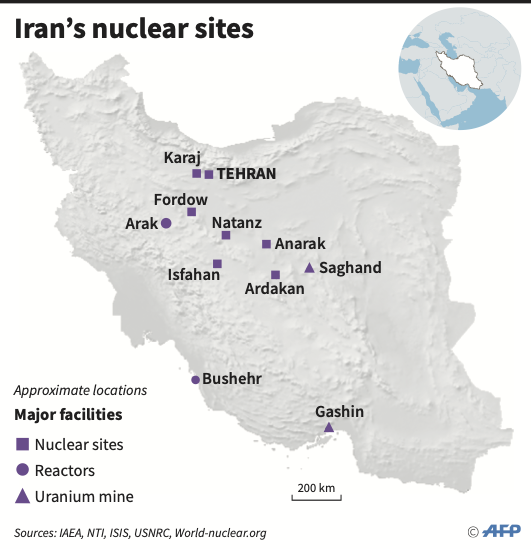
The Natanz Fuel Enrichment Plant (FEP), Iran's main uranium enrichment site which is mostly underground, is one of several Iranian facilities monitored by inspectors of the International Atomic Energy Agency (IAEA), the UN nuclear watchdog.
The IAEA said on Friday the location of the fire did not contain nuclear materials and that none of its inspectors was present at the time.
Natanz is the centrepiece of Iran's enrichment programme, which Tehran says is only for peaceful purposes. Western intelligence agencies and the IAEA believe it had a coordinated, clandestine nuclear arms programme that it halted in 2003.
Tehran denies ever seeking nuclear weapons.
Iran agreed to curb its nuclear programme in exchange for the removal of most international sanctions in a deal reached between Tehran and six world powers in 2015.
But Iran has gradually reduced its commitments to the accord since US President Donald Trump's administration withdrew from the deal in 2018 and reimposed and intensified sanctions that have battered Iran's economy.
The deal only allows Iran to enrich uranium at its Natanz facility with just over 5,000 first-generation IR-1 centrifuges, but Iran has installed new cascades of advanced centrifuges.
Israel has backed Trump's "maximum pressure" policy on Tehran aimed at forcing it to agree a new deal that puts stricter limits on its nuclear work, curbs its ballistic missile programme and ends its regional proxy wars.
Iran says it will not negotiate as long as sanctions remain in place. 


Syria, Kurdish forces race to save integration deal ahead of deadline

Updated 57 min 55 sec ago
Follow

Syria, Kurdish forces race to save integration deal ahead of deadline

  • Discussions have accelerated in recent days despite growing frustrations over delays

AMMAN/RIYADH/BEIRUT/ANKARA: Syrian, Kurdish and US officials are scrambling ahead of a year-end deadline to show some progress in a stalled deal to merge Kurdish forces with the Syrian state, according to several people involved in or familiar with the talks.
Discussions have accelerated in recent days despite growing frustrations over delays, according to the Syrian, Kurdish and Western sources who spoke to Reuters, some of whom cautioned that a major breakthrough was unlikely.
The interim Syrian government has sent a proposal to the Kurdish-led Syrian Democratic Forces (SDF) that controls the country’s northeast, according to five of the sources.
In it, Damascus expressed openness to the SDF reorganizing its roughly 50,000 fighters into three main divisions and smaller brigades as long as it cedes some chains of command and opens its territory to other Syrian army units, according to one Syrian, one ‌Western and three Kurdish ‌officials.

’SAVE FACE’ AND EXTEND TALKS ON INTEGRATION
It was unclear whether the idea would ‌move ⁠forward, ​and several sources downplayed ‌prospects of a comprehensive eleventh-hour deal, saying more talks are needed. Still, one SDF official said: “We are closer to a deal than ever before.”
A second Western official said that any announcement in coming days would be meant in part to “save face,” extend the deadline and maintain stability in a nation that remains fragile a year after the fall of former President Bashar Assad.
Whatever emerges was expected to fall short of the SDF’s full integration into the military and other state institutions by year-end, as was called for in a landmark March 10 agreement between the sides, most of the sources said.
Failure to mend Syria’s deepest remaining fracture risks an armed clash that could derail its emergence from 14 years of war, and ⁠potentially draw in neighboring Turkiye that has threatened an incursion against Kurdish fighters it views as terrorists.
Both sides have accused the other of stalling and acting in bad faith. The SDF ‌is reluctant to give up autonomy it won as the main US ally during ‍the war, after which it controlled Islamic State prisons and rich ‍oil resources.
The US, which backs Syrian President Ahmed Al-Sharaa and has urged global support for his interim government, has relayed messages between ‍the SDF and Damascus, facilitated talks and urged a deal, several sources said.
A US State Department spokesperson said Tom Barrack, the US ambassador to Turkiye and special envoy to Syria, continued to support and facilitate dialogue between the Syrian government and the SDF, saying the aim was to maintain momentum toward integration of the forces.

SDF DOWNPLAYS DEADLINE; TURKEY SAYS PATIENCE THIN
Since a major round of talks in the summer between the sides failed to produce results, frictions ​have mounted including frequent skirmishes along several front lines across the north.
The SDF took control of much of northeast Syria, where most of the nation’s oil and wheat production is, after defeating Daesh militants in 2019.
It said ⁠it was ending decades of repression against the Kurdish minority but resentment against its rule has grown among the predominantly Arab population, including against compulsory conscription of young men.
A Syrian official said the year-end deadline for integration is firm and only “irreversible steps” by the SDF could bring an extension.
Turkiye’s foreign minister, Hakan Fidan, said on Thursday it does not want to resort to military means but warned that patience with the SDF is “running out.”
Kurdish officials have downplayed the deadline and said they are committed to talks toward a just integration.
“The most reliable guarantee for the agreement’s continued validity lies in its content, not timeframe,” said Sihanouk Dibo, a Syrian autonomous administration official, suggesting it could take until mid-2026 to address all points in the deal.
The SDF had in October floated the idea of reorganizing into three geographical divisions as well as the brigades. It is unclear whether that concession, in the proposal from Damascus in recent days, would be enough to convince it to give up territorial control.
Abdel Karim Omar, representative of the Kurdish-led northeastern administration in Damascus, said the proposal, which has not been made public, included “logistical and administrative details that could cause disagreement and ‌lead to delays.”
A senior Syrian official told Reuters the response “has flexibility to facilitate reaching an agreement that implements the March accord.”