
ISLAMABAD: Washington’s envoy to Afghanistan on Saturday emphasized the economic benefits of the peace deal with the Taliban, forging ahead with an agreement that has run into new political obstacles in the US and the region.
Zalmay Khalilzad was wrapping up a week-long trip that included stops in Uzbekistan, Pakistan and the Gulf state of Qatar, where Taliban negotiators are headquartered.
Accompanying Khalilzad for the first time was an economic development team led by US International Development Finance Corporation Chief Executive Officer Adam Boehler.
Khalilzad offered no details about the kinds of economic projects being envisioned to jump-start an economy battered by widespread corruption and currently 75% funded by international donations. However, he did suggest joint economic projects involving Qatar and Pakistan, possibly on infrastructure and trade.
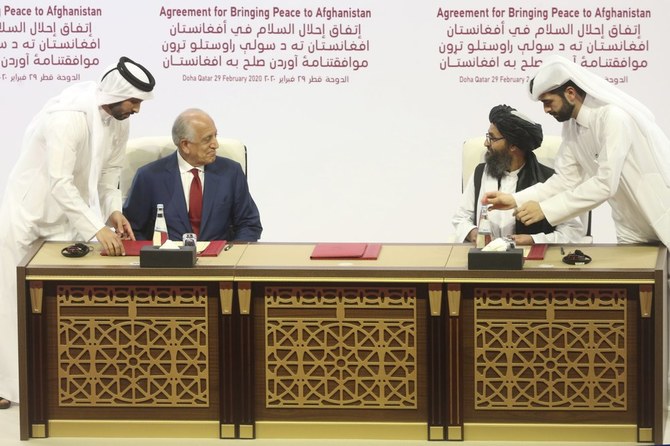
The US signed a peace deal with the Taliban in February to end 19 years of war in Afghanistan.
Khalilzad has sought to stress the economic benefits of the peace deal throughout his tour. In a series of tweets early Saturday, the US envoy said he met with the Qatar Investment Authority and the Taliban’s chief negotiator Mullah Abdul Ghani, in the tiny Gulf state’s capital of Doha.
“We agreed development plans in support of peace can never start too early,” Khalilzad tweeted.
However, Washington has recently become embroiled in a controversy over intelligence reports that Russia was paying money to insurgents with links to the Taliban to kill American and NATO soldiers.
The identity of the insurgents who took the bounty money is still vague but the payments have been traced to an Afghan drug lord, Rahmatullah Azizi, who is living in Moscow, according to Afghan officials who spoke with The Associated Press.
The officials said the money was delivered through Azizi’s brother Wahidullah, who was the go-between for those facilitating the attacks on US troops.
The New York Times first reported the US intelligence claiming the payment of bounties as well as Azizi’s involvement.
Added to the uncertainty and delays swirling around the US-Taliban peace deal, the Pentagon released a report Wednesday that questioned the Taliban’s commitment to end its ties with Al-Qaeda.
The peace deal calls for the Taliban to fight against militant organizations and ensure Afghanistan would not be used again to attack US interests or its allies. Critics of the deal say the militants can’t be trusted.
Taliban spokesman Zabihullah Mujahid denied contacts with Al-Qaeda in the Indian subcontinent, saying the insurgents were committed to the peace deal.
Khalilzad embarked on his tour of the region last weekend, even as the rate of coronavirus infections in the United States soared and countries worldwide struggled with the dangers of re-opening.
He did not travel to Afghanistan, citing the dangers of the pandemic, and instead held video conference calls with Afghan President Ashraf Ghani and his government partner, Abdullah Abdullah.
Pakistan’s Foreign Minister Shah Mahmood Qureshi tested positive for COVID-19, just 48 hours after meeting with Khalilzad. Both had been pictured wearing masks during their meeting on Wednesday in the Pakistani capital of Islamabad.
Qureshi said he developed a fever on Friday and tested positive to the virus. But he promised to “carry on” his official duties from home.
Even as Khalilzad winds up his latest diplomatic mission, there was no date for crucial intra-Afghan negotiations that bring the Taliban together with the Afghan government and other local actors. Khalilzad called for a quick resolution of outstanding issues so those negotiations could begin.
The biggest hurdle has been the release of prisoners. The peace deal called for the Afghan government to free 5,000 Taliban prisoners in exchange for the Taliban releasing 1,000 government personnel. So far, the government has freed 4,015 and the Taliban has freed 669, according to the Afghan government..
Ghani earlier this week suggested that his government had a problem with some of the names on the Taliban’s list of prisoners to be released and said alternative names would be given.
It seems unlikely that the Taliban will accept anyone not on the list agreed upon during negotiations with the US.
Suhail Shaheen, Taliban political spokesman in Doha, called the Afghan government reasons for delaying prisoner releases “phony excuses” and the reason for the delay in beginning intra-Afghan talks.
As of Saturday, Afghanistan had recorded 32,600 confirmed cases of coronavirus, but international non-governmental organizations say the rate is much higher and have warned that the country’s war-ravaged health care system risks collapsing.
Seemingly indicative of the lack of health care facilities in Afghanistan to deal with the virus, Ghani’s special envoy for economic development, Yosuf Ghaznafar, went to Turkey when he became ill with COVID-19.
On Friday he died of the disease, according to a statement from the presidency. Ghaznafar is the senior most Afghan official to die of the virus.
Afghanistan has so far recorded 826 deaths from the virus.