Pakistani TV cameras slowly start rolling again with new coronavirus guidelines 

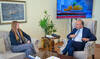
This photograph taken on October 18, 2017, shows Pakistani actress Fatiam Shah Jeelani (C) and actor Imran Ashraf filming the drama serial 'Mein Maa Nahi Banna Chahti' (I Don't Want To Become A Mother) in Karachi. (AFP)
Short Url
Updated 04 July 2020
Follow

Pakistani TV cameras slowly start rolling again with new coronavirus guidelines 

  • Pandemic has hugely disrupted the entertainment industry worldwide and many popular television shows have had to suspend production
  • Heads of major Pakistani networks say production has slowly resumed since June with strict coronavirus safeguards in place

KARACHI: Heads of major TV networks have said they have resumed, or plan to soon resume, shooting new projects after filming was largely halted in mid-March to help curb the spread of the novel coronavirus.

The pandemic has hugely disrupted the entertainment industry worldwide and many popular television shows have had to suspend production.

In Pakistan, too, production of new TV shows was halted around March, and major networks have since shown reruns of old shows or used content that had been shot before the pandemic began.

The shooting of several on-air series, like Sabaat, Meherposh, Kashf and Raaz e Ulfat, was not yet wrapped up when the pandemic hit in March. Similarly, Hum TV’s Ramazan-special series featuring Osman Khalid Butt, Mira Sethi and Youtuber Arslan Naseer did not air because the shoot was incomplete.

Since June, however, heads of major networks say production was slowly resuming with extensive coronavirus testing, daily symptom checks and other safeguards in place to allow actors and crew members to safely return to work.

Sultana Siddiqui, President of Hum TV, told Arab News that given that more people were indoors due to the coronavirus and thus had more time to watch TV, her network was planning to resume production on a smaller scale, with fewer people on set and social distancing measures in place. 

Jarjees Seja, the CEO of ARY Digital, said many of the network’s shoots had to be pushed forward because the artists had been infected with the coronavirus.

One such serial was the on-air ‘Mera Dil Mera Dushman,’ whose shooting had to be halted as the lead actor Yasir Nawaz contracted COVID-19. Shooting had resumed since mid June, Seja said, though he admitted that new safety measures would mean slower productions and less TV shows.

 “The criteria of planning, production and results would be entirely different from the previous one,” he said.

He declined to give a figure for losses faced by the drama industry or his channel but said ARY’s losses were less than the network had estimated.

Geo Entertainment Managing Director Shadab Tayyab said the network had only resumed 20-25 percent of its shoots, adding that actors were suffering the most.

“The established actors are safe for a while but the emerging actors will be in a difficult situation if they don’t get work for a longer period,” he said.

TV One’s Seema Tahir said fresh production had started at a “slow pace” but would pick up properly after August or September with strict coronavirus-related guidelines to ensure the safety of actors and crew.

She said the pandemic would require networks and production houses to undergo a “paradigm shift” in the story lines they pursued, and fewer productions would be the new reality.

“In this new setup, if we have to work with fewer locations and cast, the story lines of present day dramas would become irrelevant,” Tahir said. “If in real life, we will no longer be doing big events like wedding functions, it would be inappropriate to show them in dramas.”


Pakistan high court pauses tree-cutting in Islamabad until Feb. 2

Updated 10 sec ago
Follow

Pakistan high court pauses tree-cutting in Islamabad until Feb. 2

  • Islamabad High Court asks CDA to ‘explain and justify’ tree-cutting at next hearing
  • CDA officials say 29,000 trees were cut due to allergies, deny felling in green belts

ISLAMABAD: The Islamabad High Court has ordered an immediate halt to tree-cutting in the federal capital until Feb. 2, seeking justification from civic authorities over the legality of a large-scale felling drive that has seen thousands of trees removed in recent months.

The interim order, issued by a single-judge bench led by Justice Khadim Hussain Soomro, came during proceedings on a petition challenging the Capital Development Authority’s (CDA) tree-cutting operations in Islamabad’s Shakarparian area and H-8 sector.

At the outset of the hearing, the petitioner’s counsel argued that trees were being felled in violation of the Pakistan Environmental Protection Act 1997, the Islamabad Wildlife Ordinance 1979 and the city’s master plan.

“Respondents shall not cut trees till the next date of hearing,” Justice Soomro said in the court order released on Friday while referring to CDA officials.

“Respondents are directed to come fully prepared and to file paragraph-wise comments before the next date of hearing, along with a comprehensive report explaining the justification and legal basis for the cutting of trees,” he added.

According to the court order, the petitioner maintained that the CDA had not made any public disclosure regarding the legal basis for the operation and that the felling was causing environmental harm.

The petition sought access to the official record of tree-cutting activities and called for the penalization of CDA officials responsible for the act under relevant criminal and environmental laws.

It also urged the court to impose a moratorium on infrastructure projects in Islamabad, order large-scale replanting as compensation and constitute a judicial commission headed by a retired Supreme Court judge to probe the alleged violations.

CDA officials acknowledge around 29,000 paper mulberry trees have been cut in the capital in recent months, arguing that the species triggers seasonal allergies such as sneezing, itchy eyes and nasal congestion.

They also maintain that no trees have been removed from designated green belts and that the number of replacement trees planted exceeds those felled.

Designed in the 1960s by Greek architect Constantinos Doxiadis, Islamabad was conceived as a low-density city with green belts and protected natural zones at its core.

Critics, however, say the recent felling has extended beyond paper mulberry trees and question whether authorities are adhering to the city’s master plan and the legal protections governing forested and green areas.

The court has adjourned its hearing until Feb. 2, 2026.