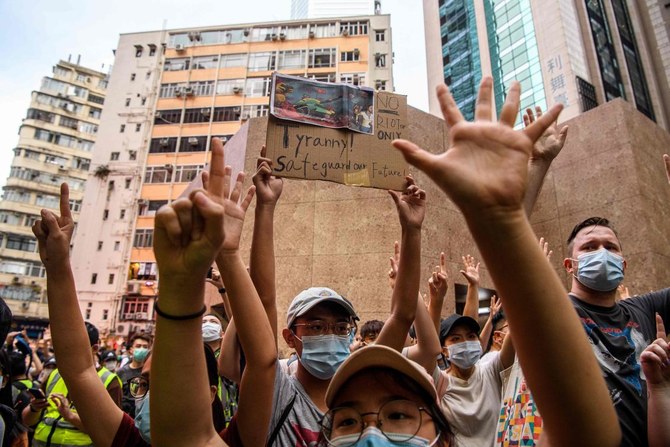
HONG KONG: Hong Kongers are finding creative ways to voice dissent after Beijing blanketed the city in a new security law and police began arresting people displaying now forbidden political slogans.
Faced with the sudden threat of prosecution for anything that might promote greater autonomy or independence for the restless city, residents are using word play and even subverting Chinese Communist Party dogma to express their frustration.
On a bridge in the busy shopping district of Causeway Bay, a key spot for pro-democracy protests over the past year, traffic thunders past newly daubed graffiti that declares: “Arise, ye who refuse to be slaves.”
The phrase is taken from the first line of China’s national anthem.
And while the graffiti could conceivably have been written by a patriotic nationalist, it is most likely a declaration of dissent.
Social media and chat forums have filled with suggestions for how to find safer ways to protest after Beijing on Tuesday imposed broad legislation banning subversion, secession, terrorism and foreign collusion.
In a semi-autonomous city used to speaking its mind, people will find ways around the law, said Chan Kin-man, a veteran democracy activist who has previously been jailed for his activism.
“In a public space, one might either not say anything or use an ‘officially-approved’ language to protect themselves,” he said. “But hidden language is something that cannot be banned by laws.”
The local government on Thursday said the popular protest slogan “Liberate Hong Kong, revolution of our times” would now be deemed illegal.
For some the phrase represents genuine aspirations to split Hong Kong from China, a red line for Beijing, but for many others it is a more general cry for democracy and an expression of rising frustration with Chinese rule.
But coded language is allowing people to keep the slogan alive.
One version “GFHG, SDGM” uses English letters from the transliterated phrase “gwong fuk heung gong, si doi gak ming.”
Another more complex example mimics the tone and rhythm of the slogan using the numbers “3219 0246” in Cantonese.
Chinese characters themselves also provide ample room for linguistic subversion.
One phrase people have started adopting online is “seize back banana,” a play on the similar characters in traditional Chinese for Hong Kong and banana.
Others have gone for English slogans that appear positive but are a clear dig at Beijing — for example the Trumpian phrase “Make Hong Kong Great.”
The very first arrest made under the new security law involved a deliberate linguistic challenge.
During protests a day after the law was enacted, police announced they had arrested a man with a flag that read “Hong Kong Independence,” posting a picture.
But eagle-eyed web sleuths zoomed in on the flag and spotted that a man had written a small “No” before his much larger phrase.
The same phrase has since gone viral online.
Multiple pro-democracy restaurants and shops across the city have taken down their “Lennon Wall” displays expressing support for the pro-democracy movement after some were warned by police that they might violate the national security law.
The walls are often made up of colorful sticky notes with protest slogans on them.
One cafe replaced its wall with blank memos.
“What is essential is invisible to the eyes,” the shop wrote on its Facebook citing popular children’s book “Le Petit Prince.”
Another symbol of defiance that has replaced some protest art across the city is blank white pages.
The gesture represents the inability to speak out and also “white terror,” a Chinese phrase used to describe political persecution.
“Suppression catalyzes people to fight back,” said Chan, who is also a sociology professor.
He likened the situation with how people in mainland China reveal dissent or anger toward the government with a wink and a nod.
“Hong Kong people will definitely respond more actively, it’s just that it might happen in a grey area.”
A slogan that went viral this week was a quote by Chinese dictator Mao Zedong.
It read: “Those who suppress the student movements will not come to a good end.”


![]()

‘Hidden language’: Hong Kongers get creative against security law
Short Url
https://arab.news/54xr2
‘Hidden language’: Hong Kongers get creative against security law
- Residents are using word play and even subverting Chinese Communist Party dogma to express their frustration
- Others have gone for English slogans that appear positive but are a clear dig at Beijing


Latest updates


© 2026 SAUDI RESEARCH & PUBLISHING COMPANY, All Rights Reserved And subject to Terms of Use Agreement.