

Pakistan says fewer people opting for coronavirus testing amid 50 percent recovery rate

A health official wearing Personal Protective Equipment (PPE) takes a swab sample from a man during door to door a screening and testing for the COVID-19 coronavirus at a restricted area sealed by the authorities in Islamabad on June 29, 2020, as virus cases continue to rise. (AFP)
Short Url
Updated 05 July 2020
Follow

Pakistan says fewer people opting for coronavirus testing amid 50 percent recovery rate

  • Officials say optimistic recovery rate may well be a temporary phase
  • Last month, government said it would increase rate of testing to 50,000 tests daily

ISLAMABAD: Pakistan’s health ministry spokesman, Sajid Shah, told Arab News on Saturday the number of people willing to get tested for COVID-19 in the country had decreased, even though the government had not reduced daily testing capacity amid optimistic rates of recovery.

After reporting its first case on February 26, Pakistan has so far officially registered nearly 213,000 infections of COVID-19 and 4,619 deaths. Of those infected, 125,000-- more than 50 percent-- have recovered.
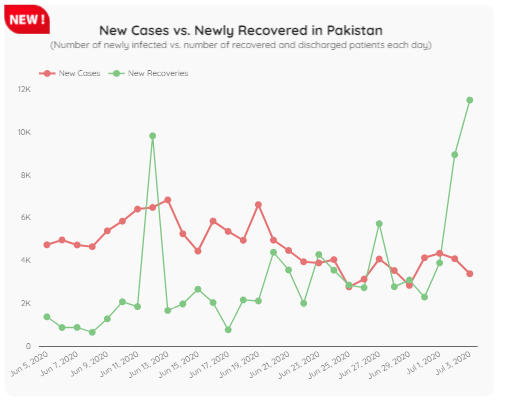
“The masses consulting the NHS (National Health Services) to treat symptoms and our doctors advising patients over the phone have helped a great deal with recoveries... but at the same time the number of people willing to test for COVID-19 has dropped,” he said, and added it was still unclear whether the country had already reached the peak of the outbreak. 

The optimistic recovery rate, he said, may well be a temporary phase. 

But statistics look encouraging as more than half of Pakistanis who contracted COVID-19 have recovered with the country’s infection curve going down.

Health officials say a number of factors contributed to the high recovery rate.

“Hospitals have ramped up their facilities and are providing better care. District administrations have helped keep people indoors,” Pakistan Institute of Medical Sciences (PIMS) executive director, Dr. Minhaj us Siraj told Arab News. He praised the government’s efforts to enforce smart lockdowns in virus hotspots, as well as people’s compliance with social distancing measures.

According to Siraj, nationwide awareness programs and recommendations of the National Command and Operation Center had also paid off with more people now conscious of the disease.

However he declined to comment on why the country’s coronavirus screening had dropped to 22,050 tests.

Last month, the government said it would increase its rate of testing to 50,000 tests a day from July. On June 19, Pakistan conducted 31,681 COVID-19 tests — the highest officially recorded.

Dr. Naeem Akhter, an infectious disease consultant and focal person for COVID-19 at PIMS, said people were “not very convinced for testing” because most knew they could recover on their own in the absence of a cure or vaccine.

“If the patients are not coming for testing, then the surveillance and record will be affected and you won’t be able to know how many people are basically affected,” she said.


Pakistan terms climate change, demographic pressures as ‘pressing existential risks’

Updated 06 December 2025
Follow

Pakistan terms climate change, demographic pressures as ‘pressing existential risks’

  • Pakistan has suffered frequent climate change-induced disasters, including floods this year that killed over 1,000
  • Pakistan finmin highlights stabilization measures at Doha Forum, discusses economic cooperation with Qatar 

ISLAMABAD: Pakistan’s Finance Minister Muhammad Aurangzeb on Saturday described climate change and demographic pressures as “pressing existential risks” facing the country, calling for urgent climate financing. 

The finance minister was speaking as a member of a high-level panel at the 23rd edition of the Doha Forum, which is being held from Dec. 6–7 in the Qatari capital. Aurangzeb was invited as a speaker on the discussion titled: ‘Global Trade Tensions: Economic Impact and Policy Responses in MENA.’

“He reaffirmed that while Pakistan remained vigilant in the face of geopolitical uncertainty, the more pressing existential risks were climate change and demographic pressures,” the Finance Division said. 

Pakistan has suffered repeated climate disasters in recent years, most notably the 2022 super-floods that submerged one-third of the country, displaced millions and caused an estimated $30 billion in losses. 

This year’s floods killed over 1,000 people and caused at least $2.9 billion in damages to agriculture and infrastructure. Scientists say Pakistan remains among the world’s most climate-vulnerable nations despite contributing less than 1 percent of global greenhouse-gas emissions.

Aurangzeb has previously said climate change and Pakistan’s fast-rising population are the only two factors that can hinder the South Asian country’s efforts to become a $3 trillion economy in the future. 

The finance minister noted that this year’s floods in Pakistan had shaved at least 0.5 percent off GDP growth, calling for urgent climate financing and investment in resilient infrastructure. 

When asked about Pakistan’s fiscal resilience and capability to absorb external shocks, Aurangzeb said Islamabad had rebuilt fiscal buffers. He pointed out that both the primary fiscal balance and current account had returned to surplus, supported significantly by strong remittance inflows of $18–20 billion annually from the Middle East and North Africa (MENA) and Gulf Cooperation Council (GCC) regions. 

Separately, Aurangzeb met his Qatari counterpart Ali Bin Ahmed Al Kuwari to discuss bilateral cooperation. 

“Both sides reaffirmed their commitment to strengthening economic ties, particularly by maximizing opportunities created through the newly concluded GCC–Pakistan Free Trade Agreement, expanding trade flows, and deepening energy cooperation, including long-term LNG collaboration,” the finance ministry said. 

The two also discussed collaboration on digital infrastructure, skills development and regulatory reform. They agreed to establish structured mechanisms to continue joint work in trade diversification, technology, climate resilience, and investment facilitation, the finance ministry said.