

22 dead as train rams bus carrying Sikh pilgrims in Pakistan

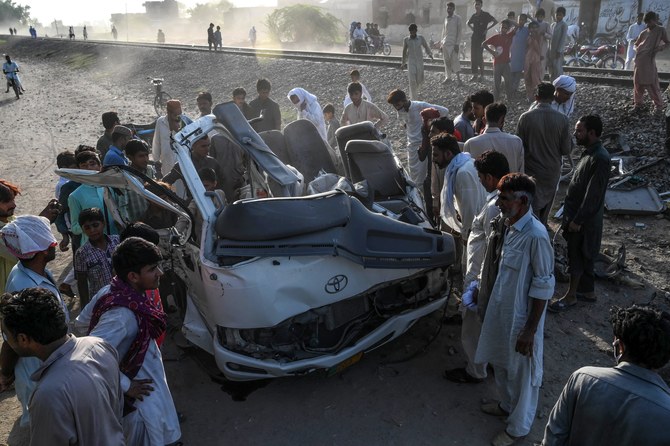
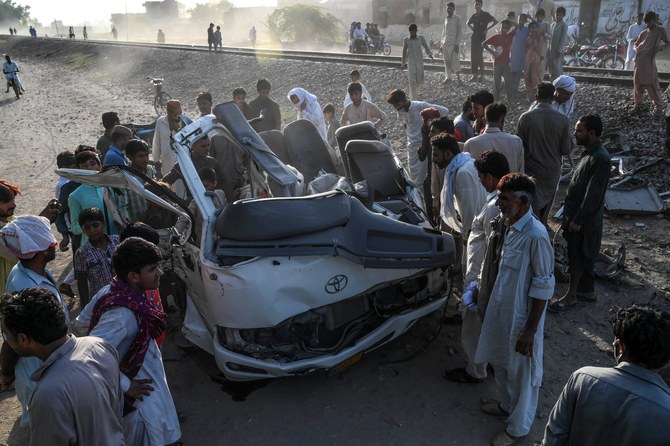
Residents gather around the wreckage of a van alongside a railway track following an accident in which a passenger train crashed into the vehicle transporting Sikh pilgrims in the Farooqabad area of Sheikhupura district in Pakistan's Punjab province on July 3, 2020. (AFP)
Short Url
Updated 03 July 2020
Follow

22 dead as train rams bus carrying Sikh pilgrims in Pakistan

  • The accident happened in the district of Sheikhupura in Punjab province
  • Accidents often happen at unmanned railway crossings in Pakistan which frequently lack barriers and sometimes signals

SHEIKHUPURA: At least 22 Sikh pilgrims — 19 from the same family — were killed on Friday when a train smashed into a van in Punjab, authorities said.

The vehicle's driver was crossing an unmanned level crossing when it was hit by an oncoming train near the small city of Farooqabad, in the district of Sheikhupura.

"The crossing was unmanned and the driver of the van took a hasty decision by driving onto the tracks," Pakistan Railways spokeswoman Quratul Ain told AFP, adding that the passengers were all Sikh pilgrims.

"Around 20 people lost their lives in (the) tragic collision. Two injured succumbed to injuries later, raising the death toll to 22", Pakistan's ministry of interior said in a statement.

Earlier a local police spokesman Wajid Abbas confirmed at least 19 dead were from the same family. In total there were 30 pilgrims in the van. No train passengers were injured.

The pilgrims from the north of the country were returning from a visit to Nankana Sahib, the birthplace of Sikhism founder Guru Nanak, near the megacity of Lahore.

Prime Minister Imran Khan tweeted that he was "deeply saddened" by the deaths.

Images broadcast on local television showed the mangled van on the train tracks.

Pakistan's minister of interior vowed to "reach to the root cause of the incident and hold the ones responsible for this accountable."

Accidents often happen at unmanned railway crossings in Pakistan which frequently lack barriers and sometimes signals.

The railway network has seen decades of decline due to corruption, mismanagement and lack of investment.

Last October at least 74 people were killed and dozens injured after cooking gas cylinders exploded on a train packed with pilgrims in Punjab province.


Pakistan engages Saudi Arabia, China in bid to ease surging Middle East tensions 

Updated 10 March 2026
Follow

Pakistan engages Saudi Arabia, China in bid to ease surging Middle East tensions 

  • Pakistan’s foreign minister stresses need for de-escalation in conversations with Chinese, Saudi counterparts
  • Tensions in the Middle East continue to remain high as conflict between US, Israel and Iran intensifies

ISLAMABAD: Pakistan’s Deputy Prime Minister Ishaq Dar spoke to the foreign ministers of Saudi Arabia and China on Tuesday, stressing the importance of diplomatic engagement to de-escalate tensions in the Middle East as the Iran war intensifies. 

Pakistan has constantly engaged regional countries in efforts to broker a ceasefire in the Middle East, after the US and Isreal launched coordinated strikes against Iran on Feb. 28. 

Iran launched fresh attacks on Gulf countries on Tuesday morning, where it has targeted US military bases in recent weeks. In addition to firing missiles and drones at Israel and American bases in the region, Iran has also been targeting energy infrastructure which, combined with its stranglehold on the Strait of Hormuz, has sent oil prices soaring worldwide. 

Dar spoke to Saudi Foreign Minister Prince Faisal bin Farhan to discuss developments in the Middle East and ongoing deliberations at the UN Security Council, Pakistan’s foreign office said in a statement. 

“DPM/FM shared Pakistan’s perspective, underscoring the importance of continued coordination and diplomatic engagement to support de-escalation and promote peace and stability across the region and beyond,” the statement said. 

Dar, who also serves as Pakistan’s foreign minister, spoke to Chinese foreign minister Wang Yi over the telephone separately. The two discussed the evolving regional situation and broader global developments.

Dar underscored the need to ease tensions in the Middle East and the wider region during the conversation, the foreign office said. 

Yi appreciated Pakistan’s constructive efforts aimed at promoting de-escalation and stability in the region, it added. 

“The two leaders stressed the importance of de-escalation and emphasized the need to pursue dialogue and diplomacy in accordance with the principles of the UN Charter,” the foreign office’s statement said. 

The conflict in the Middle East has hit Pakistan hard as well, forcing Islamabad to hike petrol and diesel prices by Rs55 per liter last Friday. 

Pakistan’s government has also announced a set of austerity measures, which include closing schools and cutting down on government expenditures, as it evaluates petrol stocks and looks for alternative supply routes.