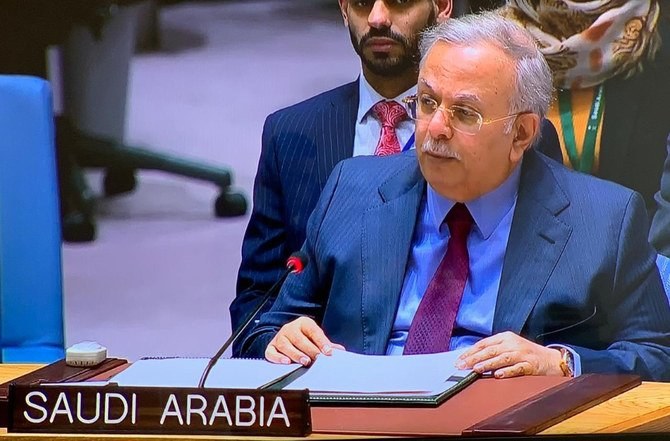

NEW YORK CITY: Saudi Arabia’s permanent representative to the UN, Abdallah Al-Mouallimi, has urged the Security Council to “very carefully” consider extending its arms embargo on Iran.
The embargo is due to expire in October, a date written into UN Security Council Resolution 2231, which endorsed and helped implement the 2015 Joint Comprehensive Plan of Action (JCPOA), also known as the Iran nuclear deal.
Extending the ban is “the right (and) cautious thing to do, and the minimum response that can be expected from the world community (to Iran’s) actions and activities,” said Al-Mouallimi.
His comments came after the Security Council was briefed on Wednesday on what he called a “welcome and long overdue” report by UN Secretary-General Antonio Guterres, which confirmed the cruise missiles used in attacks on oil facilities and an airport in Saudi Arabia last year were of “Iranian origin.” The report, published last month, marks the first time Guterres has openly acknowledged Iran’s role in the attacks.
The Saudi envoy condemned the actions of Iran and said the Kingdom has constantly brought to the attention of the Security Council “the grave violations that Iran has been committing (by supporting) the Houthi militias in Yemen in launching numerous attacks against civilian targets in the Kingdom of Saudi Arabia, contrary to the provisions of Security Council Resolutions 2231 and 2216,” which prohibit the supply of arms to the Houthis.
He added that the “Iranian pattern of behavior aims to create anarchy in the region by supporting and promoting outlaw groups, whether it is in Yemen or Lebanon or Syria or Iraq. We can only imagine how this behavior would develop ... should the ban on arms and weapons be lifted in October.”
Al-Mouallimi said the recent attacks in the Arabian Gulf show that Iran poses “an ongoing threat,” adding: “We have maintained a high degree of self-restraint in the face of all these provocations and attacks, and we will continue to do so as much as possible.”
He said that during a recent visit to Riyadh, US Special Representative for Iran Brian Hook reiterated the message of US Secretary of State Mike Pompeo, who warned that lifting the arms embargo would give Iran a license to continue its illegal actions.
Noting that an extension of the ban is in the interests of both the US and Saudi Arabia, Al-Mouallimi added: “What the US is asking us to do is make our voice heard in various circles and we’re trying to do that as much as we can.”
He acknowledged that it might be difficult to persuade Security Council permanent members Russia and China to approve an extension of the embargo, given their views on Iran and the region.
“(Russia and China) both expressed solidarity with Saudi Arabia after the attacks on its territory, so we hope we can build on that to demonstrate that the only way to (condemn those attacks) is to maintain the current arms embargo against Iran,” said Al-Mouallimi.
“We respect (Russia’s and China’s) protection of their interests in the region but we think that these interests will be better preserved and promoted by stability and peace in the region, rather than for us to continuously face this kind of threat.
“The threat that Iran poses is not only to Saudi Arabia and the region, it is a threat that can reach far and wide,” he added, referring to a warning from Pompeo that Iranian missiles would have the capability to strike targets as far away as India and Poland, along with American bases in a number of countries.
Al-Mouallimi said that Iran is exploiting the differences that have emerged between Washington and European nations, Russia and China, and capitalizing on them.
“While Iran continues to take advantage of the divisions within the international community, we are trying to promote a unified vision, and a more constructive approach,” he said.
He added that he regretted that the optimism generated by the signing of the JCPOA in 2015 turned out to be “futile,” as Iran had continued to interfere in the internal affairs of neighboring countries. US President Donald Trump withdrew the US from the nuclear deal in 2018.
“We went along with the JCPOA in the beginning (but now) the shortfalls of this agreement outweigh its benefits,” said Al-Mouallimi.
“Just yesterday, (Iranian) Foreign Minister (Javad) Zarif said clearly, ‘This is our region and we meddle with it as we please.’ No, Mr. Zarif, this is not a region that is open for you to meddle in. These are sovereign states, and you should stay out of these countries. You can meddle in the internal affairs of Iran as much as you like.”
Al-Mouallimi called for a fresh start, with the involvement of the Gulf nations “most affected by Iran’s behavior.”
Meanwhile, the trial of Saudi officials indicted in connection with the 2018 killing of journalist Jamal Khashoggi in the Kingdom’s consulate in Istanbul is due to begin in Turkey on Friday.
Asked whether Saudi Arabia would cooperate with Turkey on the trial, Al-Mouallimi said that Ankara has shunned such cooperation.
“We have asked Turkey to provide us with all the evidence, data or anything that they have that would help the process of justice in Saudi Arabia. They have failed to respond,” he said.
“During the trial that took place in Saudi Arabia, the Turkish representative was always present and witnessed the process as it went along. It is up to our Turkish friends to demonstrate their cooperation and goodwill on this issue, rather than simply use it as a political bargaining point.
“Justice is more important than to be used by any party for political games and political purposes.”
In December, a court in Saudi Arabia sentenced five people to death for Khashoggi’s murder, and three others were jailed for a total of 24 years.